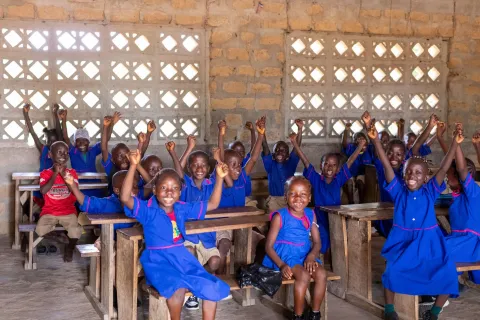
Supporting teachers to strengthen foundational learning for children in Sierra Leone
Through GPE support teachers are making lessons fun

Waterloo, Sierra Leone - When Aminata Sesay walks into a classroom, she sees more than just rows of pupils reciting numbers. She sees bright young minds full of potential, eager to make sense of the world through learning. As one of 10 Foundational Learning School Quality Assurance Officers, “FLN SQAOs,” for Western Area Rural District, Aminata has dedicated her career to helping teachers unlock that potential.
This year, she played a key role in Primary 2 Numeracy Teacher Training, a nationwide initiative supported by the Global Partnership for Education (GPE) through the Ministry of Basic and Senior Secondary Education (MBSSE), the Ministry of Technical and Higher Education (MTHE), and UNICEF. Over seven days, more than 13,600 P2 teachers and School Quality Assurance Officers across Sierra Leone participated in an intensive, hands-on programme designed to strengthen their skills in teaching numeracy at the foundational level. She conducts classroom observations and school monitoring. Based on the observations, she provides feedback on positive aspects and areas for improvement. Need more clarity on 'unlock that potential.
According to Aminata, before the training, many teachers struggled with limited instructional skills and confidence in teaching numeracy, often relying on rote methods that left pupils disengaged and struggling to grasp basic mathematical concepts. “When I visit schools now, I can see and feel the difference,” Aminata says proudly. “Teachers are more confident, more creative, and they’re teaching maths in ways that make sense to children. You can see pupils becoming more engaged and less afraid of numbers. That’s real progress.”
The training emphasized a structured, child-centered approach to teaching, with teachers learning to follow the “I Do, We Do, You Do” model, a method that guides learners step by step from demonstration to independent practice. They also explored the Concrete-Pictorial-Abstract (CPA) method, which helps children visualize mathematical concepts before solving them symbolically.
Each teacher had the opportunity to plan and deliver lessons during the training, receiving feedback from peers and facilitators. The Ministry added a day to the national teacher training this year, to ensure participants had more time to practice real classroom simulations, develop lesson plans, and enhance their understanding of monitoring, assessment, and classroom management.

For teachers like Isatu Gbessay Kanu, who has taught in a rural primary school for eight years, the training was eye-opening. “Before, I struggled to make maths fun and understandable for my pupils,” she admits. “Now, I use objects and drawings to explain numbers, and even the pupils who used to stay quiet are raising their hands to answer. I’ve learned that every child can learn maths; we just have to meet them where they are.”
Beyond improving instructional methods, the training focused on inclusion, gender equity, and formative assessment. Teachers learned how to identify learners who need extra help, support children with different learning styles, and encourage equal participation of girls and boys. They also practiced giving positive feedback and creating classroom environments where every child feels capable and valued.
“We are training teachers not only to teach but to nurture,” Aminata explains. “A child who feels encouraged is a child who will learn. We want every girl and boy to believe they can do maths — and succeed in it.” Now, when Aminata visits schools to monitor teaching practice, school conditions and teaching and learning materials, she observes whether teachers are applying what they learned in the training this summer to what they are teaching in the classroom. As Aminata and her peers conduct these observations and record their school visits, they play a critical role in understanding the quality of early learning in pre-primary and primary schools across the country.
According to Emmanuel Allie, National GPE Coordinator at the MBSSE, the initiative aligns with Sierra Leone’s broader goal to improve foundational learning outcomes for all children nationwide.
“Through the support of GPE and UNICEF, we are moving toward a future where quality teaching is the norm, not the exception,” he notes. “This training gives our teachers the tools to build a strong foundation in numeracy, which is critical for lifelong learning and national development.”

For UNICEF’s Chief of Education, Paola Ripamonti, the programme represents an important opportunity to focus on learning during the foundational years, something that shapes the trajectory of their lives.
“We are proud to see Sierra Leone investing in learning during the foundational years,” she says. “With the Ministry, we are providing a package of new teaching and learning materials; training for teachers on these materials; their provision for every child in public schools; and in-school monitoring and support provided by a new cadre of school quality assurance officers. This is a formula that we believe can shape the new generation of thinkers, problem-solvers, and leaders across the country.”


The results are already visible in classrooms. At the Wenner Kuhhnle Primary School in Waterloo, Western Area Rural, six-year-old Blessing can now count confidently and solve simple subtraction problems using her colourful workbook.
“Math is my favorite subject now,” she says with a grin. “My teacher shows us pictures, and we work in groups. I help my friends too.”
As Aminata completes her regular school observation and monitoring visit, she observes the transformation she helped nurture: teachers using their new skills, pupils actively engaging in lessons, and classrooms buzzing with energy and curiosity.
“This is what change looks like,” she reflects. “It starts with empowering teachers, but it ends with empowering children. That’s how we build a stronger Sierra Leone.”