From listening to action, Sierra Leone is building a community-led pandemic preparedness approach
By turning community concerns into action, we are strengthening trust, empowering frontline workers and building a health system better prepared for future outbreaks.

Freetown - When rumours about Mpox began circulating through communities in Sierra Leone, many people did not know what to believe.
Some feared the disease was untreatable. Others questioned whether vaccination was safe or necessary. As misinformation spread, so did uncertainty, making it harder for families to protect themselves.
For Sia Moiwa, a Community Health Worker serving the Goderich community, those conversations became part of his daily work.
“People had many questions when they first heard about Mpox. Some were afraid, while others believed information they heard from different sources. We listened to their concerns, explained what we knew about the disease, and helped them understand how they could protect themselves and their families,” says Sia
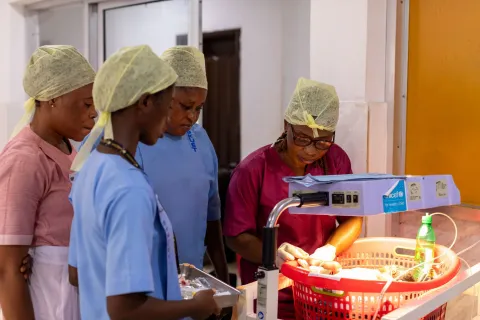
Before going into communities, Community Health Workers and health workers received coaching and orientation sessions led by the National Public Health Agency (NPHA) in partnership with the Ministry of Health and UNICEF. These sessions equipped frontline workers with the knowledge, communication skills and community engagement approaches needed to address concerns, counter misinformation and build trust during disease prevention and response activities.
Supported by the World Bank Pandemic Fund through UNICEF, the Ministry of Health and NPHA are strengthening how Sierra Leone prepares for and responds to disease outbreaks by putting communities at the centre of public health action.

The investment helped train 400 frontline workers in social and community listening and supported the training and deployment of 970 Community Health Workers using the Community-Led Action approach for Mpox prevention and control. It also supported the review and validation of Sierra Leone’s One Health Community-Led Action Manual, ensuring that community experiences informed national guidance for responding to public health threats.
“The strength of any public health response depends on whether communities trust the information they receive and whether their voices are heard. Through this support, we are strengthening the capacity of frontline workers to listen, understand community concerns and respond with information and actions that reflect people’s realities.” Monsen Owusu-Aboagye, UNICEF Sierra Leone Health Specialist.
At NPHA, the support has helped transform community engagement from a reactive activity into a more structured and data-driven approach.
“The Pandemic Fund support has helped NPHA move from reactive communication to a more structured, community-led approach. We are now better able to listen to communities, understand their concerns and use their voices to guide public health action and strengthen preparedness for future outbreaks,” says Professor Foday Sahr, Executive Director, NPHA.
Behind the work of Community Health Workers is another important transformation—one that communities may never see but benefits them every day.
With support from the Pandemic Fund, NPHA upgraded its Behavioural Intelligence s and Infodemic Management (BIIM) system, enabling public health teams to collect, analyse and visualise community feedback in real time. Instead of treating rumours and concerns as isolated reports, the system helps identify trends, detect misinformation early, and guide faster, evidence-based decisions.

As part of the ongoing national Ebola preparedness efforts, the upgraded system has enabled NPHA to consolidate community concerns, identify emerging patterns, and tailor communication and preparedness activities accordingly.
“The upgraded BIIM system has transformed the way we listen to communities and act on their concerns. We can now identify trends, analyse information in real time and respond faster with evidence-based public health actions, helping us move from isolated reports to coordinated decision-making,” Patrick Lansana, Health Promotion and Risk Communication and Community Engagement Manager, National Public Health Agency.
The investment has also demonstrated the importance of listening as much as informing. Community feedback gathered through trained frontline workers helped shape engagement strategies during the Mpox response, while complementary initiatives reached hundreds of thousands of people with prevention messages and strengthened public confidence in health interventions.

For families like Mariama Rogers, the impact is simple: having trusted health workers nearby who can provide accurate information when questions and fears arise.
“Before, we did not always know which information to believe. Now, when we have questions about diseases like Mpox, we can talk to our Community Health Worker and get the right information. This helps us feel more confident about protecting ourselves and our families,” says Mariama, a resident of Goderich Community.
As Sierra Leone continues to strengthen its preparedness for future public health emergencies, one lesson is becoming increasingly clear: resilient health systems are built not only on surveillance and technology, but also on trust.
Through the partnership between the World Bank Pandemic Fund, the Government of Sierra Leone and UNICEF, communities are no longer just recipients of health information. They are active partners in detecting risks, shaping solutions and helping to protect the health of the nation.