From a cooking pot to the mouths of infants, communities are working together to fight malnutrition
At the Goderich Community Health Centre, caregivers are gaining practical skills to nourish their children—turning knowledge into life-saving action with support from the Government of Japan, through UNICEF.

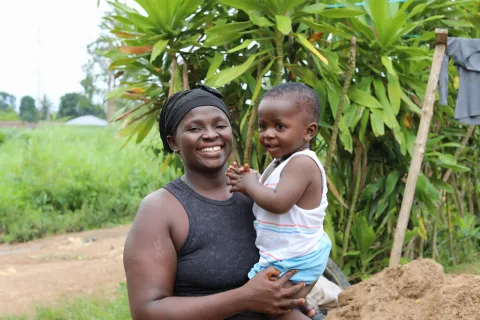
Goderich, Sierra Leone - At the Goderich Community Health Centre, the air is filled with mothers and caregivers and the aroma of freshly cooked food. Neatly arranged bowls of food are displayed, demonstrating how local ingredients can be combined into a nutritious meal. Among the mothers and caregivers is Haja Kobba, gently holding her 11-month-old son, Abdulrahman Kobba, on her lap. Abdulrahman watches curiously as his mother learns how to prepare a more nutritious meal—one that could help him grow healthily. Like many children his age, he has mostly been fed simple meals at home, often lacking the variety needed for healthy growth. “I used to give him mostly plain pap and rice,” Haja admits. “Sometimes I added a little oil or milk, but I did not know about all the different types of food here.”
Today’s cooking demonstration is changing that. Using locally available ingredients—beans, groundnuts, leafy vegetables, and small fish—health workers show mothers how to prepare balanced meals that provide essential nutrients for young children. Haja watches closely as the ingredients come together, forming a richer, more colourful meal than what she is used to preparing at home.
“I have learned that I can mix foods,” she says, smiling. “Even if I don’t have much, I can still make his food better. Now I will add beans, greens, and fish whenever I can. I want him to be strong and active.”

The Goderich Community Health Centre, which provides health services to about 23,000 children under five each year, is one of many facilities delivering these life-changing demonstrations as part of a broader nutrition programme supported by the Government of Japan, through UNICEF.
Despite an improvement from 2024, Sierra Leone continues to face a severe nutrition and food security crisis. According to the July 2025 Food Security Monitoring System report, 71 per cent of households experience food insecurity, with many families spending over 75 per cent of their income on food. For young children, this often translates into meals that fill the stomach but lack the nutrients needed for proper growth and development.
Nurse Mariama Jalloh, a nurse at the Goderich Community Health Centre, sees the impact of this every day. “Many caregivers love their children and want the best for them, but they simply don’t have the right information,” she explains, “Through these cooking demonstrations, we show them practical ways to improve their children’s diets using foods they already know and can access.”

The demonstrations are part of a comprehensive package of services that includes community health worker mentorship, nutrition screening, hygiene education, and the treatment of severe acute malnutrition. Since 2021, the programme has expanded its reach across communities, ensuring that more caregivers receive both knowledge and support.
The results are encouraging. Between March 2025 and February 2026, 4,094 children were screened and identified to have SAM for malnutrition by CHWs and referred to the treatment. The overall treatment outcomes have also been strong, with 17,356 children 6–59 months (8,817 girls and 8,539 boys) with SAM treated over the project period which is 47 per cent of the expected caseload of 36,937 children with SAM in the five project districts. Programme performance data shows recovery rates for the combined inpatient and outpatient SAM cases exceed 90 per cent, meeting the global standards. However, some inpatient facilities, especially in Bo and Pujehun, have high fatality rates which may be due to numerous factors such as late arrivals, inadequate staff at the IPFs, among other factors.

For Mariama Ellie, Nutritionist at the Ministry of Health, the success of the programme lies in combining treatment of severe malnutrition with a focus on behaviour change at the household level. “We cannot solve malnutrition by treatment alone,” she says, “We must empower caregivers with the knowledge and skills to prevent it. Cooking demonstrations like this are very powerful because they show, not just tell, what a healthy meal looks like and how to prepare it.
Beyond the health facility, the programme is supported by trained community health workers and mother support groups who reinforce these lessons at the community level. Through radio programmes and outreach activities, thousands of caregivers are being reached with life-saving nutrition information. However, challenges remain. Across the country, dietary diversity is still low, with most children not receiving the minimum acceptable diet needed for healthy development. This contributes to stunting, which affects 26.2 per cent of children under five and has long-term consequences for their growth, learning, and future opportunities.

That is why UNICEF Nutrition Specialist Brenda Kaijuka Muwaga emphasizes the importance of sustained, community-driven efforts. “Nutrition is about more than food availability—it is about knowledge, practices, and access,” she explains, “By working closely with communities, strengthening health systems and coordination with other sectors like Water and Agriculture, and supporting caregivers directly, we are helping to create lasting change that will benefit children for years to come.”
As the demonstration comes to an end, Haja carefully feeds Abdulrahman a small spoonful of the enriched meal. He responds eagerly, reaching out for more. She laughs, encouraged by his reaction and the new knowledge she carries home.
“I feel confident now,” she says “I know what to do differently. I will not feed him the same way as before.”
In that simple moment—between a mother and her child over a meal—lies the promise of a healthier future. Across communities like Goderich, these small but powerful changes are helping families take control of their children’s nutrition, one meal at a time.