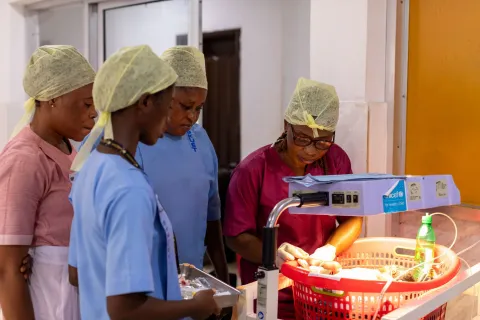
Across rivers and rough roads, the DRIVE initiative is ensuring no child is left waiting for vaccine
From the riverine communities of Bonthe to the mountainous districts of Falaba and Koinadugu, the DRIVE initiative is ensuring that distance no longer prevents children from receiving life-saving vaccines.

Mongerewa, Bonthe District – The waiting area of the Mongerewa Maternal and Child Health Post (MCHP) is filled with the gentle murmur of caregivers chatting quietly as they cradle babies wrapped in colourful cloth. Toddlers fidget on their mothers' laps while others curiously peek through the doorway, waiting patiently for their names to be called.
It is immunisation day, and families from across the community have gathered early, confident that today their children will receive the vaccines they need.
The health facility serves nearly 1,200 people across 11 villages, providing essential maternal, newborn and child health services to one of Bonthe District's hard-to-reach riverine communities.
Among those waiting is Isatu Kaikai, gently rocking her day-old daughter, Esther. Before mother and baby head home, Esther is due to receive her first vaccine—the Bacillus Calmette-Guérin (BCG) vaccine—which helps protect infants against severe forms of tuberculosis.
For Isatu, it is a reassuring start to her daughter's life. "I'm happy Esther can receive her first vaccine before we leave the health facility," she says, smiling as she looks at her newborn. "Every mother wants her baby to be protected from the beginning. Knowing the vaccine is here today makes me feel relieved," she says.

That reassurance was made possible a day earlier.
The previous afternoon, Karim Kanneh, a DRIVE rider, carefully transported a fresh batch of vaccines from the Bonthe District Vaccine Store to Mongerewa. His journey took him over rough roads before crossing the river by dugout canoe to reach the health facility, ensuring the vaccines arrived safely and remained within the required cold chain.
For Karim, each delivery carries a purpose beyond transporting supplies.
"When I deliver vaccines to a health facility, I know they will protect children," he says. "The journey can be difficult, especially during the rainy season, but when you think about the babies waiting to receive these vaccines, every kilometre is worthwhile."
Just a few years ago, the journey looked very different. Although the health facility sits at the heart of the community, it was nurses, not delivery riders, who had to make the long trip each month. They crossed the river in dugout canoes before traveling for hours along rough roads to the Bonthe District Health Management Team (DHMT) to collect vaccines. Afterward, they repeated the same journey back to Mongerewa with vaccine carriers in hand.

The trip was physically demanding and time-consuming. Because of the difficult terrain and transport expenses, vaccines were often collected only when health workers traveled to the district headquarters for monthly meetings or training sessions. As a result, vaccines were not always available when caregivers arrived for immunisation, forcing some families to return home and come back another day.
For newborns like Esther, those delays could mean missing the opportunity to receive important vaccines at the recommended time.
Today, thanks to the Direct Delivery of Routine Immunisation Vaccines for Equity (DRIVE) initiative, supported by UNICEF, that burden has shifted from health workers to trained delivery riders like Karim, allowing nurses to remain where they are needed most, with their patients.
For Sarah Barkeh, the Maternal and Child Health Aide at Mongerewa MCHP, the change has transformed the way she works. "Before DRIVE, collecting vaccines was one of the hardest parts of our job," Sarah recalls. "Every month we had to leave the health facility, cross the river by canoe and travel on rough roads to collect vaccines from the district. By the time we returned, most of the day was gone. Sometimes, because of the difficult journey and transport costs, we waited until there was a district meeting or training before collecting them. That meant some children could not receive their vaccines on time."
She gently administers Esther's BCG vaccine before continuing.

"Now Karim brings the vaccines directly to us. We stay here to care for mothers and children instead of leaving the facility. It has made our work much easier and less stressful, and mothers can be confident that vaccines will be available when they come."
The difference is visible throughout the health post. Mothers no longer ask whether vaccines have arrived before taking their seats in the waiting area. Health workers spend more time conducting antenatal clinics, supporting deliveries and immunising children instead of travelling long distances to collect supplies.
According to John Tucker, Expanded Programme on Immunization (EPI) Lead at the Bonthe District Health Management Team, the initiative has significantly strengthened immunisation services across the district.
"Many of our health facilities are located in difficult-to-reach communities separated by rivers and poor roads," he explains. "Before DRIVE, health workers spent valuable time collecting vaccines instead of providing services. Today, trained delivery riders ensure vaccines reach facilities safely and on time, reducing stockouts and helping children receive their vaccinations according to schedule."
For Monsen Owusu-Aboagye, UNICEF Immunisation Specialist, the impact extends well beyond vaccine delivery. "The DRIVE initiative is about making immunisation more equitable," he says. "When vaccines consistently reach remote health facilities, newborns like Esther can receive life-saving protection at the right time. It also allows health workers to focus on caring for families rather than overcoming logistical barriers. This is how stronger health systems deliver better outcomes for children."

Back at the Bonthe District Health Management Team, Karim has already begun preparing for his next delivery. Tomorrow, another health facility will be waiting. Another group of caregivers will gather. Another newborn will receive a healthy start to life.