With 98 per cent vaccination coverage, 3 communities lead the way in building resilience to COVID-19
An effort to increase COVID-19 vaccine coverage

Kagboray, Sierra Leone – It is a sunny and busy morning in Kagboray village, north of Sierra Leone. As children head off to school, a group of men and women are gathering under the tall and lush mango trees of the country yard in what appears to be a vivid debate. For the past months, members of the Kagboray, Kadari, and Kamagbuyeleh have made a habit of convening here to discuss what they can do to improve the health context of their communities. This morning, all discussions converge on one single question: “How do we finally get those unvaccinated in our villages to accept the COVID-19 vaccines” as David Bangura, chair of the meeting that day summarises.
Getting people vaccinated with COVID-19 vaccines had once been a challenge in Kagboray. However, if 26 percent of the Sierra Leoneans above 12 were fully vaccinated in April 2022 – 13.9 percent in Karene district where the 3 communities belong – Kagboray, Kadari, and Kamagbuyeleh showed today an impressive vaccination coverage of 98 percent. This milestone was achieved in record time, thanks to the stand taken by their community leaders and volunteers and the help of Community Led Action (CLA) mobilisers.
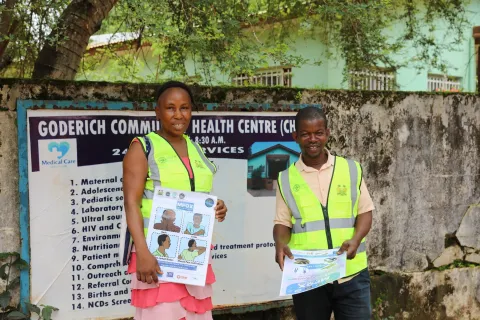
David Bangura, a supervisor of health activities in the area, was trained and deployed as a Community-Led Action (CLA) mobiliser at the end of 2021 under a UNICEF-GOAL project funded by USAID to improve the uptake of COVID-19 vaccination. In Kagboray, Kadari, and Kamagbuyeleh, he supported community leaders and members with information on vaccines and facilitated discussions on what value and benefits COVID-19 vaccination could bring to the community. “Our primary focus was to dispel rumours and myths around COVID-19 vaccines and have people understand the benefits and safety” explains David.

With the information in hand, community leaders and members went on to promote the uptake of COVID-19 vaccines, starting with publicly modelling the practice. “I took the vaccine first, followed by 20 family members, to allay the fears of my people,” Pa Sorie Kargbo, Town Chief at Kagboray proudly remembers, “and with the help of the town crier, we passed the word around and convinced everybody to get vaccinated.” David was also one to lead by example by taking the first and then the second dose of the vaccine. “For others seeing that nothing happened to me after taking the shots, helped in reducing hesitancy of the people I was talking with,” he recalls.
In Kagboray, as in Kadari, and Kamagbuyeleh, the active commitment of community leaders and members became a game changer. It created an opportunity for any community member to participate and play a role in increasing the uptake of vaccines in the community. “Those who are getting vaccinated are now helping to talk to others to get vaccinated” explains David. “When I reflect on what members of our community used to say about COVID and the vaccines, I am pleased about the changes” he concludes.
Beyond promoting the vaccine, David also made sure that community promotion efforts were not made in vain and that vaccination services were easily available by coordinating with the nearby Community Health Centre. “We went house to house together with the health workers, community leaders and volunteers to talk to people and help them understand that COVID-19 was real and that the vaccines were safe.” A mobilisation that facilitate access of people to the vaccine and also “helped make our work easier and most importantly increased vaccine uptake” according to Isata Kamara, the nurse in charge of the Kagboray Community Health Post.

Under the CLA project, more than 620 CLA mobilisers like David were deployed to support local communities to increase vaccine uptake. “Our objective with CLA was to go beyond the message of getting people vaccinated” explains Cindy Thai Thien Nghia, UNICEF Social and Behavior Change Specialist in Sierra Leone. “By providing space and resources for communities to initiate dialogue and reflection on why COVID-19 vaccination is important to them and what role they want to play, CLA mobilizers have helped empower communities to lead the change they want to see.”
While Kagboray, Kadari, and Kamagbuyeleh take pride in their achievement, they also remember the remaining challenges and have remained mobilized. “Even though we hear that the COVID situation has improved,” says Ya Alimamy Kargbo, a member of the Kagboray community, “we still observe the safety measures including hand washing with water and soap or ashes, and when we have people visiting, before hosting them, we take them to the health workers or community leaders to talk of COVID-19 vaccination. I am looking forward to the day we will have no unvaccinated person in our community.” In a short amount of time, bridging the small gap separating full coverage has become a matter of pride for members of Kagboray, Kadari, and Kamagbuyeleh communities.
Kagboray, Kadari, and Kamagbuyeleh were among the first 2,480 communities supported under a UNICEF-GOAL project funded by USAID across Koinadugu, Kambia, Karene, Falaba, and Kenema districts, and actively engaging over 299,404 community people in making their communities more resilient to COVID-19. With the support of USAID, the project is now being extended to additional communities in the five districts and to eight new districts for the deployment of 1,310 CLA mobilisers.