

Sierra Leone Launches National Life Skills Framework to Empower Adolescents for the Future
Led by MBSSE with support from UNICEF
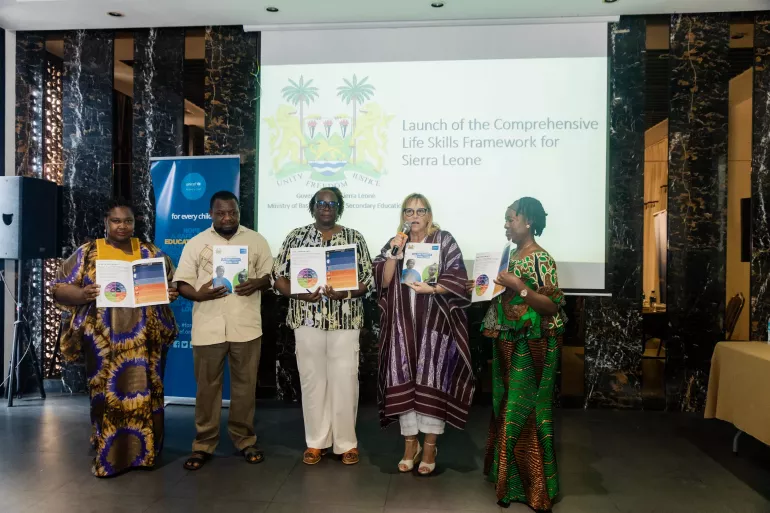
Freetown, Sierra Leone –The Ministry of Basic and Senior Secondary Education (MBSSE), with support from UNICEF and in collaboration with development partners, today launched Sierra Leone’s first-ever Comprehensive Life Skills Framework—a significant milestone in efforts to strengthen the relevance and impact of education for young people.
The new framework is a forward-looking policy tool that integrates essential life skills—such as critical thinking, emotional resilience, problem-solving, teamwork, and empathy—into the national education system. It aims to ensure that every child in Sierra Leone is equipped not only with academic knowledge, but also with the personal and social skills necessary to navigate life, work, and society in an increasingly complex world.
The framework was developed through a collaborative and consultative process involving government agencies, teachers, students, civil society organizations, and development partners. It is aligned with Sierra Leone’s national development objectives and global commitments, including Sustainable Development Goal 4 on inclusive and equitable quality education.
UNICEF Acting Representative in Sierra Leone, Liv Elin Indreiten, noted:
“This is a critical step forward. By embedding life skills in the senior secondary curriculum, Sierra Leone is investing in the full potential of adolescents and laying the foundation for a more resilient and inclusive generation. UNICEF congratulates the Ministry for its leadership and is proud to have supported this process. We call on all partners to work together to ensure its full and effective implementation,” said Liv Elin Indreiten, Acting UNICEF Representative in Sierra Leone.
Adolescents account for 23 per cent of Sierra Leone’s population, according to 2025 UN estimates. Ensuring they have access to quality life skills education is not only a matter of equity, but a strategic investment in the country's future.*
The launch comes at a critical time, as adolescents in Sierra Leone face a range of challenges including climate-related risks, gender inequality, and youth unemployment. By fostering life skills education, the framework contributes to strengthening resilience, improving learning outcomes, and promoting inclusive development.
UNICEF has provided support for the framework through technical expertise, financial contributions of over $400,000 and the facilitation of inclusive stakeholder engagement. Implementation will now move into its next phase, including teacher training, integration into curricula, and monitoring and evaluation to ensure meaningful results.
The successful implementation of the framework depends on strong national ownership and sustained investment in human capital. Ensuring access to life skills education for all learners—regardless of gender, ability, or location—requires coordinated, long-term action across sectors.
* United Nations Department of Economic and Social Affairs, Population Division. World Population Prospects 2025.
Media contacts
About UNICEF
UNICEF promotes the rights and wellbeing of every child, in everything we do. Together with our partners, we work in 190 countries and territories to translate that commitment into practical action, focusing special effort on reaching the most vulnerable and excluded children, to the benefit of all children, everywhere.
For more information about UNICEF and its work for children, visit www.unicef.org.


