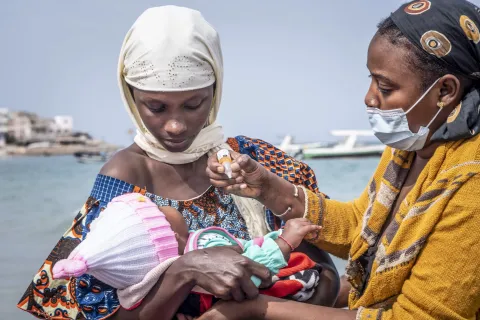
Kicking polio out of Senegal
More than 2.6 million children vaccinated in the country’s first polio vaccination drive

- Français
- English
Senegal reported 29 cases of circulating vaccine-derived poliovirus (including 17 paralytic cases) in 2021. In response, the country and its partners conducted in December a national immunization campaign that aimed to reach all children under five years. Of the 2.8 million targeted children, more than 2.6 million (around 95%) were vaccinated according to preliminary results. The second round is planned end of February.
Along with other partners of the Global Polio Eradication Initiative, UNICEF supported the communication and the management of the polio immunization campaign with the new oral vaccine (nOPV2) especially in Dakar and Diourbel, where more than 80% of the circulating vaccine-derived poliovirus cases (cVDPV2) were reported.

To increase the uptake of polio vaccine, UNICEF has promoted multisectoral interventions in support to the ministries of health, education and security, and youth organizations. Many religious leaders have been involved in promoting vaccine acceptance among polio reluctant communities. Information sessions were also organized in schools of the 14 regions of the country.
To tackle the spread of misinformation and rumours around vaccinations, UNICEF has provided support to the Ministry of Health for the implementation of a digital-based strategy. Also 50 adolescent and youth volunteers from UNICEF’s NGOs partners, DECLIC and Social Change Factory were engaged in disseminating key messages on polio, tracking down rumors on the web, and disseminating appropriate response.

About circulating vaccine-derived poliovirus
Vaccine-derived polioviruses are rare, but these viruses affect unimmunized and under-immunized populations living in areas with inadequate sanitation and low levels of polio immunization. When children are immunized with the oral polio vaccine, the attenuated vaccine virus replicates in their intestines for a short time to build up the needed immunity and is then excreted in the faeces into the environment where it can mutate. If polio immunization coverage remains low in a community and sanitation remains inadequate, the mutated viruses will be transmitted to susceptible populations, leading to emergence of vaccine-derived polioviruses.