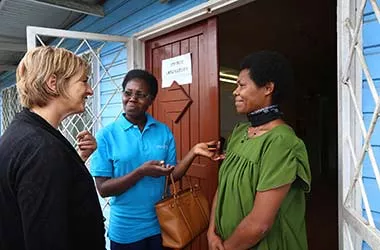
Mother mentors contribute to prevention of parent to child transmission of HIV
When Margaret Ishmael found out she was HIV positive ten years ago in 2002 at the age of 20, she was so shocked that she collapsed
When Margaret Ishmael found out she was HIV positive ten years ago in 2002 at the age of 20, she was so shocked that she collapsed, utterly devastated at what this news implied for her future.
Married for only about a year after completing grade six, this news certainly wasn't part of her plan for her future and her married life. Early on in her marriage, Margaret suspected her husband had contracted HIV when she noticed symptoms of HIV in him. After her failed attempts to convince her husband to be tested, Margaret made the agonising decision to do a blood test alone at the Rabiamul Voluntary Counselling and Testing clinic in Mt. Hagen, Western Highlands Province.
When the nurse told me my result, I just fell to the ground. I was lost. At first I refused to accept the result. Why did this happen to me. I knew my family would be very angry with me and I didn't know what to do or where to go for help
While Margaret and her husband had wanted to start a family immediately, the fear of passing the virus to their children prompted them to delay any pregnancies through the use of condoms. It wasn't until 2006 when the antiretroviral (ART) drug became available that they were able to start their family.
"I have three children now and all of them are HIV negative. When I became pregnant, I was referred to the Mingende Rural Hospital in Chimbu Province because Mingendi already had a Prevention of Parent to Child Transmission (PPTCT) of HIV programme and I received a lot of help there with counselling, family planning and I also got connected with other women who were like me," Margaret explains.
While it was challenging for Margaret to access the PPTCT programme because there was a lot of stigma and discrimination attached to people living with HIV at the time, Margaret preserved and travelled regularly to Mingendi for her antenatal visits. With limited PPTCT information and services available at the time, Margaret played it safe by bottle feeding all her babies.
Connecting with and hearing the experiences of other HIV positive women at Mingendi encouraged Margaret to live a positive lifestyle and she decided to educate other women so they would not experience the same pain.
"It was hard at first. My family told me I was crazy to talk openly about my status but I came out and started carrying out HIV prevention awareness in my community. Many people refused to talk to me at first but over time this has changed. But the stigma is still there and people think that any one I talk to has HIV. That makes my work harder because people who really need help are afraid to talk to me, Margaret stresses.
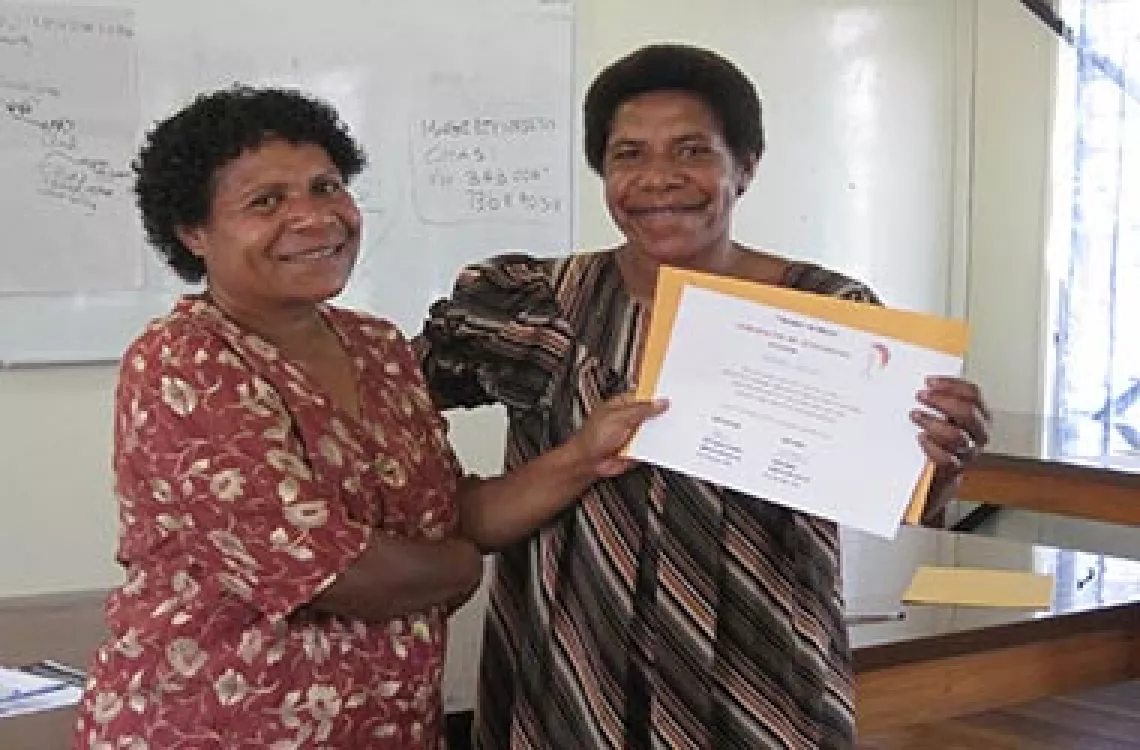
Ten years on and Margaret's active involvement in promoting HIV awareness in her council ward has been recognised. Today she is among a group of 19 women , made up of health workers and some HIV positive mothers, who have just completed a weeklong training on a Mother Mentor programme at the Mingendi Rural Hospital.
The Mother Mentor Programme (MMP) is part of the 'Haus Man- Sambai Long Ol Mama' project that UNICEF is supporting through the Catholic Bishops Conference of PNG. Aimed at reducing the number of HIV women lost to follow up in PPTCT programmes, the programme also focuses on improving male involvement in supporting the health and well being of their partners during pregnancy and breastfeeding periods.
The programme recruits and trains People Living with HIV (PLWH) who have had previous experience in PPTCT to provide peer education on HIV counselling and support new mothers and diagnosed HIV women. These peer educators, called mother mentors, provide simple information on key practices required for the health and well being of pregnant women, lactating mothers and children under five years. Mother mentors also provide emotional support and allow women to share life changing experiences in a safe environment, whole providing education to support behaviour change and adherence to treatment.
Margaret and her team of Mother Mentors have a huge task ahead of them. With HIV stigma and discrimination still an issue in most parts of the country, Margaret says their mission is challenging.
"For me, it's a huge challenge. People in my community know that I am HIV positive so when I am doing my awareness and I talk to young people of couples, people immediately think any person I talk to is HIV positive. They don't want others to know their situation because of the fear of stigma and discrimination. Tut this is my work now. I have just been trained as a Mother Mentor and I will go back and do my job," a determined Margaret states.