Nourishing futures
How health workers combine care and education to beat malnutrition

As Lai Usman’s children play in the backyard, a pile of firewood sits in the corner, untouched. This is the family’s only source of income.

“Binebenta namin sa ₱35 (US$ 0.60) ang isang sako nitong panggatong na kahoy. May kapansanan ang asawa ko, pero tumutulong pa rin siya sa pagputol at paghanda ng kahoy para maibenta,” [“We sell firewood at ₱35 (US$ 0.60) per sack. My husband is disabled, but he still helps cut and prepare the wood for selling,”] says Lai.

A few moments later, there is a loud cry from the children. It’s Abdullah, two years old and Lai’s youngest child. Only a year ago, he was suffering from severe acute malnutrition.
Muhammad Datumaas, a barangay health worker in Barangay Aposong, Piagapo, Lanao del Sur, has been monitoring Abdullah since October 2023. At that time, he was alarmed by the short length and lack of response of the baby who, by then, should have started crawling and mimicking sounds1.
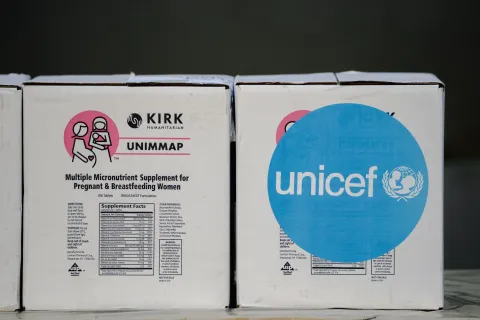
Along with vitamins and nutrient-rich meals, Abdullah was given two packets of Ready-to-Use Therapeutic Food a day. Each packet provides him with at least 500 calories and vital micronutrients. In cases like Abdullah’s, energy-packed food items are a crucial lifeline.
Encouraging Lai to prepare nutritious foods was a different challenge. With her small income, she struggles to buy the protein sources that would support her child’s nutrition and growth.
“Hindi ko na maalala kung kailan pa kami nag-ulam ng manok, isda o baka,” [“I can’t remember the last time we ate chicken, fish or beef,”] Lai says. “Kapag hindi sinuwerte sa tanim naming kamote at kamatis, kumakain kami ng dahon ng kape.” [“If our harvest of kamote (sweet potato) and kamatis (tomato) fails, we eat coffee leaves.”]

This is where Muhammad’s role became even more vital. Growing up in the same community, he understands the struggles and knows local, culturally appropriate solutions.
Muhammad combines this knowledge and his learnings from training sessions facilitated by the local government and UNICEF, with funding from the European Union, to turn every home visit into a chance to share practical tips on health and nutrition.
“Maraming masustansiyang pagkain ang tumutubo dito, pero hindi sila karaniwang kasali sa kinasanayang pagkain dito,” [“Many nutritious foods grow locally, but they’re not always included in everyday meals,”] Muhammad says. “Tinuruan ko silang kumain ng iba’t ibang pagkain na makikita dito, gaya ng kanin at iba pang klase ng butil, butong gulay, prutas at gulay, para mapatibay ang kanilang nutrisyon. Pinakita ko rin sa kanila ang paraan paano ihanda ang mga pagkain na ito para maipakain sa bata.” [“I encouraged them to use a variety of local foods, such as grains, legumes, fruits and vegetables, to improve nutrition. I also showed them how to prepare these foods safely for young children to eat.”]
Muhammad also taught Lai about proper hygiene and its importance to children’s health.
“Mula noong tinuruan kami ni Muhammad na importante ang maligo at magpalit ng damit araw-araw, hindi na masyadong nagkakasakit ang mga anak ko, lalo na si Abdullah,” [“Since Muhammad taught us about the importance of bathing and changing our clothes every day, my children, especially Abdullah, don’t get sick as often anymore,”] Lai says.

After just three months of treatment, Abdullah’s health has improved significantly.
As for Lai, she is hopeful for her children’s future.
“Kakatapos lang ng panganay kong anak ng Grade 6. Kahit na hindi ko mapabaunan ng pera ang mga anak ko sa tuwing pumapasok sila, binibigay ko pa rin sa abot ng aking makakaya ang meron akong kakayahang ibigay– ang mabigyan sila ng tamang nutrisyon,” [“My eldest daughter just finished sixth grade. Even though I can’t give my children money for school, I do the best with what I have—to offer the nutrition that they deserve,”] she says.
Muhammad, overcome with emotions, reflects: “I can’t explain the joy of helping save Abdullah’s life. I look forward to the day he goes to school and sees this as just a distant memory.”
1 UNICEF, “Your Baby’s Developmental Milestones at 6 Months,” n.d., https://www.unicef.org/parenting/child-development/your-babys-developmental-milestones-6-months.
ABOUT THE EUROPEAN UNION-UNICEF PROJECT
With funding from the European Union, UNICEF is working with key agencies and ministries in the BARMM to strengthen community resilience, increase coverage of essential services, and promote child-friendly family and community behaviours in the provinces of Lanao del Sur, Lanao del Norte and Bukidnon. The project supports maternal, neonatal, child and adolescent health, nutrition, water, and sanitation services; early childhood education and basic education services; child protection/social welfare systems; and child-friendly provincial and municipal planning and investment for children’s rights and reduced disaster risks.
UNICEF helps deliver integrated immunisation and nutrition services to children under five while building youth-friendly health services and promoting healthy behaviours to support improved health outcomes. This project is part of the European Union’s long-term support to building lasting peace and promoting inclusive development in the Bangsamoro Autonomous Region in Muslim Mindanao (BARMM).