Hope for Sama-Bajaus with Birth Registration Woes
UNICEF helps community members become advocates for the own right to a legal identity

When they had their first child in 2020 and their second child in 2021, they promptly had the births registered in the local civil registry office.
But when their third child, Aleeyah, was born in 2023, additional requirements discouraged them from getting her a birth certificate.
“We were asked to submit a marriage certificate, which we don’t have. We had a traditional wedding in 2015, but we didn’t have it registered.”
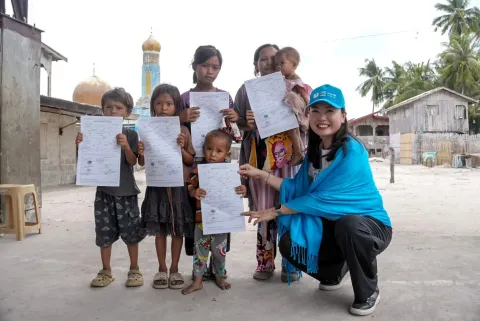
Gardo and his family belong to a Sama-Bajau community in Maluso town, Basilan province, about 1,400 kilometers south of the national capital, Manila. Known for their nomadic way of life, Sama-Bajaus live in stilt houses along the coast.
“The parents’ marriage certificate has long been a requirement in acquiring a birth certificate,” said Kathlyn Catan-Quinto, the local civil registrar of Maluso.
Catan-Quinto added that erroneous entries take time to correct and can cause problems for the owner of the birth certificate.
“Sometimes government offices give considerations, but we also want to make sure that the entries in a birth certificate are accurate and coincide with the other legal documents of the family,” she explained.

Ghafryan Cawanan, a community organizer of Maluso-based Claret Samal Foundation, Inc. (CSFI) said Instead of a marriage certificate, parents may submit an affidavit from the imam who solemnized the marriage.
“But the additional steps and expenses often discourage parents from completing the birth registration process,” he said.
Cawanan noted that many community members have limited income and often prioritize buying food over spending on legal documents.
In the case of the Pintasan family, Gardo works as a laborer and fisher, and Alfaisa is the primary caretaker of their children.
Japan-funded initiative
The Pintasan family's experience is common among Sama-Bajau communities, and shows the importance of a comprehensive approach to helping them get birth certificates.
Understanding of the local culture is as crucial as providing families with financial and other support.
Funded by the Government of Japan, the Initiative for Promoting Digital Birth Registration empowers indigenous communities to advocate for policy change, for their own and their children’s right to a legal identity.
With a budget of ¥858 million (approximately US$5.5 million) and started in 2024, this 30-month initiative aims to provide birth certificates to 30,000 individuals in the province of Sulu and the Bangsamoro Autonomous Region in Muslim Mindanao (BARMM), which includes the province of Basilan.
UNHCR, in partnership with UNICEF, government agencies, local authorities, and civil society groups, is implementing the Birth Registration Advocacy for Vulnerable Populations to End Childhood Statelessness (BRAVE) project.
The Japan-funded birth registration initiative covers 50 selected municipalities in Sulu and BARMM.
For many, this will be their first time to benefit from birth registration, including Sama-Bajaus, unregistered children displaced by conflict, and former combatants now transitioning to civilian life under BARMM’s peace and reintegration efforts.

Through BRAVE, families like Gardo’s are learning more about the value of birth registration. After attending an advocacy session at the CSFI Yellow School of Hope, just a short walk from his home, he became more determined to secure a birth certificate for his daughter, Aleeyah.
Seed grants and training are also being provided to local youth networks in other municipalities.
The session, led by teacher and BRAVE advocate Belbita Bahali, used a flip chart in Sinama, the community’s mother tongue, to explain its importance.
“In the future, they will need it in getting a job and in getting a passport so that they can travel to other countries or stay there without fear of being arrested or driven away,” Gardo says.
The Sama-Bajaus, to which Gardo’s family belongs, traditionally live in boats and moor along coastlines spanning the Philippines, Malaysia, Brunei, and Indonesia.
Working beyond raising awareness
Sitti Vilma Quin, UNICEF’s child protection officer said the lack of awareness on the benefits of having a birth certificate is the common reason for the low registration rate in the community.
“Other reasons are fear of consequences associated with registering a birth in certain States; cultural practices, such as delayed naming or frequent name changes during childhood; and complicated or discriminatory registration procedures, especially against single mothers, ethnic minorities, or forcibly displaced children,” Quin explained.
Under the BRAVE Project, CSFI collects data on birth registration in Sama-Bajau communities in Maluso and provides support to local advocates.
Bahali, the teacher, works alongside four Sama-Bajau college students who volunteered as advocates after receiving training from UNHCR, UNICEF, and CFSI. Together, they compiled a list of unregistered individuals, including two-year-old Aleeyah.
“We will help these individuals acquire a birth certificate. As advocates, our role goes beyond raising awareness. We work with families, community leaders, and the local civil registry office until the process is completed and an authenticated copy of the birth certificate is issued,” Bahali said.

She added that for the birth registration initiative to be truly sustainable, there is ongoing advocacy for the passage of a civil registration and vital statistics law, both at the national level and in the BARMM parliament, supported by local ordinances.
The goal, she noted, is to integrate birth registration with other essential programs on health, nutrition, WASH, and education.
With the success of this Japan-funded initiative, more Sama-Bajau children can now claim their rights to a name, a legal identity, and access to government services that will help them survive and thrive.
“I’m thankful that a lot of people are helping us,” Gardo says.