Children need support as families recover from Typhoon Odette
Needs of affected children and families are still huge more than a month after the typhoon.

It’s been more than a month since Typhoon Odette (Typhoon Rai) swept through 11 of the Philippines’ 17 regions and left thousands of families without shelter, food, safe water, and livelihoods. Recent UN assessments show that the scale of devastation was greater than initial estimates, with 2.4 million people, including 912,000 children in need of assistance.
The UNICEF team headed by Representative Ms. Oyunsaikhan Dendevnorov visited Surigao City, Siargao, and the Province of Dinagat Islands to see the progress of UNICEF’s response and listen to affected children and families as communities recover and start rebuilding their lives.

Contaminated water supply and destroyed health facilities
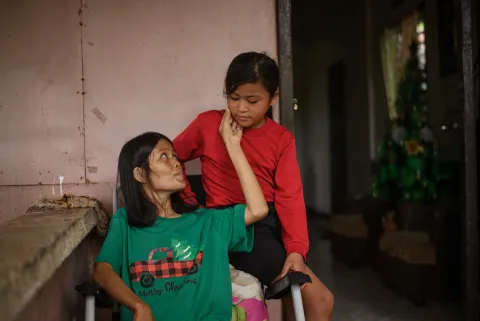
Coastal communities are still displaced after floods and storm surges destroyed their homes. “For two weeks, my family sought shelter and slept in a waiting shed. It was while we were staying there when my husband and one of my children suddenly contracted diarrhea,” said Azelyn, a mother from Barangay Laguna, Cagdianao in Dinagat Islands.

Since December 2021, UNICEF has been sending supplies to help children and families. “Days after the typhoon hit, we began sending water kits and family hygiene & dignity kits to the most affected provinces to prevent the spread of water-borne diseases and other common illnesses”, said Rasul Abdullah, UNICEF Philippines Water, Sanitation and Hygiene Officer.

UNICEF continues to work closely with local governments to reach more vulnerable communities. “I felt relieved as a mother when we were given these water treatment solutions and jerry cans. Now, I make sure that my family is drinking clean water every time”, Azelyn added.

Typhoon Odette also damaged public health facilities and supplies, leaving healthcare workers unable to provide vital healthcare services to children, pregnant women and newborns. UNICEF sent tents which medical assistance teams are now using as temporary health clinics.

Severely damaged schools
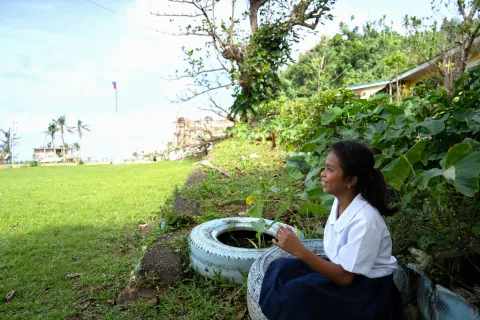
The Department of Education (DepEd) estimates that 14.8 million learners from affected areas are impacted. Upon visiting damaged schools, the team saw destroyed classrooms, books and modules. “We think this will further delay the resumption of the pilot face-to-face learning”, said Kamille Ruiz, UNICEF Philippines Disaster Risk Reduction Programme Officer and Emergency Focal Point.

“Almost everyone’s priorities right now are to restore their homes and secure enough food for the day. But teachers are also concerned for students and their fellow teachers who have lost their tools for learning,” said Lope Papeleras, Chief Education Supervisor, DepEd Division Office in Dinagat Islands.

UNICEF continues to coordinate with DepEd to provide the most-affected schools, students and teachers with new learning and teaching supplies so that distance learning can continue.

Children’s mental health at risk
As schools remain closed and as families build back their lives, children’s mental health needs to be attended to and prioritized. “Because it’s still rainy season here, some of us still feel terrified whenever we hear strong winds or roofs banging. There are also kids who do not want to go outside or play outside”, said France Donoso, a youth volunteer from Del Carmen, Siargao.

To help children recover from what they’ve experienced and help bring back a sense of normalcy in their lives, UNICEF is collaborating with partners and youth volunteers from affected areas in running child-friendly spaces where children can safely play, meet new friends, and participate in activities.

“We are also providing psychological first aid and other psychosocial support services to children and families in distress. Together with our government partners and local actors, we continuously monitor and report possible cases of child rights violation and ensure appropriate case management interventions” said Rohannie Baraguir, UNICEF Child Protection Specialist.

Crisis within a crisis
Children who have been suffering from the effects of the COVID-19 pandemic now have to deal with the effects of the typhoon. They lost their homes, their schools, and their belongings. UNICEF and partners remain committed to help ensure children are healthy, protected, and that their learning can continue as their families recover.

“One month on, and needs are still huge. A lot more work has to be done in the coming months to protect the rights of children whose lives have been disrupted by this devastation,” said Oyun Dendevnorov, UNICEF representative to the Philippines. “In my visit, I can really see that people are so resilient. We really hope that things will get better. I call on everyone who can help children in this difficult situation, to please help in any way that you can” she added.
You can help us reach more children and families affected by Typhoon Odette. Donate at bit.ly/UNICEFEmergencies