Mental Health and Psychosocial Support Services Help Adolescents Overcome Depression in Pakistan
Thanks to UK funding, a UNICEF-suported project helps vulnerable women and children receive mental health support in Pakistan’s Balochistan province

QUETTA, Balochistan – 8 June 2021: Like the rest of the world, Pakistan was hit hard by the outbreak of COVID-19 pandemic in the early months of 2020.
As part of the national response to reduce the spread of the deadly coronavirus, federal and provincial authorities imposed lockdowns in many parts of the country. This led to the closure of public offices, schools, commercial centres, and restriction on social gatherings.
As the number of COVID cases surged and the death toll started to rise, the pandemic also took a toll on people's mental health, particularly women and children.
With the sudden closure of schools, eleven-year-old Kulsoom* suddenly found herself spending most of her time at home.
Born in an impoverished family in Quetta, the provincial capital of the south-western province of Balochistan, Kulsoom had already had her share of challenges before the pandemic started. It only grew worse as she found herself at home, stuck with a stepmother she had come to resent.
Kulsoom lost her mother at the tender age of eight. Being an only child, she had to shoulder household responsibilities while continuing her studies. The circumstances made her an introvert. She would get irritated by small things happening around her.
A few years later, Kulsoom’s father Iftikhar remarried, thinking that his daughter needs a mother to take care of her. This relieved Kulsoom from some of her tasks. At first, she was happy to have Shagufta join the family.
“I was very happy when Shagufta, my new mother, started living with us,” Kulsoom recalls. “I no longer had to do all the household chores by myself. I had more time to focus on my studies.”

One year later, Shagufta gave birth to a baby girl. As her focus shifted to her own child, her relations with Kulsoom started to deteriorate.
“Her attitude started to change and it became worse over time,” Kulsoom tells in a painful voice. “She shifted all the household work back to me and started using abusive language. At times she would hit me with a stick or a shoe. When I complained to my father, he ignored it as if I was lying. I felt lonely, helpless and depressed, which affected my performance at school.”
As the relationship between Kulsoom and her step mother worsened, her father Iftikhar became worried and sought help. One of his friends told him about a UNICEF-supported project which provides specialized psycho-social support services to women and children in Balochistan.
As soon as the first wave of COVID-19 started to subside, UNICEF supported the provincial Government and its partners to restore essential public services for women and children.
“At times my stepmother would hit me with a stick or a shoe. When I complained to my father, he ignored it as if I was lying. I felt lonely, helpless and depressed, which affected my performance at school.”
One of this was a project aiming to provide vulnerable families and communities affected by the pandemic with community-based first aid services and psychosocial support.
Funded by the United Kingdom’s Foreign, Commonwealth & Development Office (FCDO), the Mental Health and Psychosocial Support (MHPSS) project is being implemented by UNICEF together with partner Drugs and Narcotics Educational Services for Humanity (DANESH), a civil society organization.
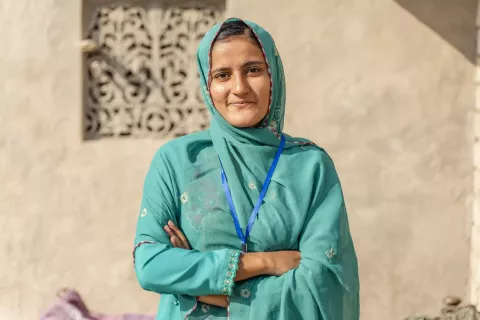
After Iftikhar approached DANESH about his daughter, the case was referred to Sadia Ishfaq, an experienced psychologist.
“My first meeting with Kulsoom was not very productive,” Sadia recalls. “She constantly cried, avoided eye contact and did not talk to me at all. It was only after couple of sessions, and after convincing her that I was her friend, that she opened up and started talking about her problems with her stepmother.”
Having listened to Kulsoom’s perspective, Sadia visited her house and held a family session together with her father Iftikhar, her stepmother Shagufta and her young stepsister. She also talked to Shagufta alone to understand her side of the story.

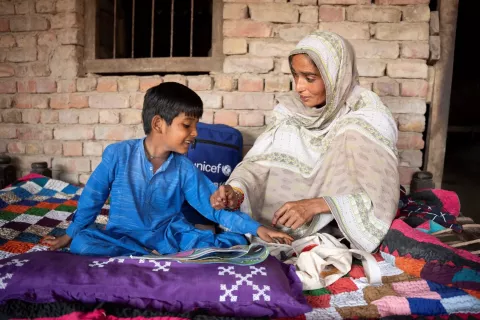
In total, Sadia conducted eight sessions with Kulsoom, some of which Shagufta attended. Sadia used different therapies for each member of the family, based on their age and personality.
“Kulsoom loves art and can express her feelings through drawings. This is why I used drawing therapy with her,” Sadia explains.
Sadia told Shagufta that if she wanted Kulsoom to help her with household work, they should do it together. She told her to treat Kulsoom as a partner and always be kind. Gradually, their relation started to improve. Kulsoom’s father Iftikhar says that his wife and daughter are now getting along just fine.
Following this successful intervention, Iftikhar referred a new case to DANESH. He had heard about a young girl who was suffering from domestic abuse at the hands of her relatives, and asked Sadia to intervene.
Nearly 22,000 people have directly benefited from the MHPSS project so far (more than 6,000 women, 5,000 girls and 4,000 boys, and nearly 6,000 men). Moreover, about 9 million people have benefited indirectly from the project through awareness-raising work on stigma prevention, community-based MHPSS services and the dissemination of messages to prevent violence against children.
One of the secrets to its success is that it builds on a cross-sectoral, multi-stakeholder collaboration between Balochistan’s Provincial Disaster Management Authority, Health department, Social Welfare department, Human Rights and Special Education department, Institute of Psychiatry & Behavioural Sciences, DANESH and UNICEF. The project helps provide vulnerable children, adolescents and women with psychosocial support, and identify cases of child abuse of exploitation, which can be referred to relevant child protection authorities in the province.
*Some names have been changed in the story to protect people’s identities