Hope After Harm: How Child Protection Services Rebuild Lives
Sweden and UNICEF strengthen Child Protection Systems in Pakistan

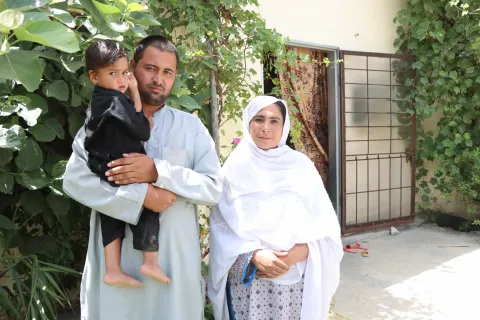
28 February 2024 – Rajanpur, Punjab: *Athena, her two siblings, and their parents live in a rural neighbourhood on the outskirts of Rajanpur, a city in southern Punjab, Pakistan - often affected by natural disasters, especially floods. Athena’s father, Ahmed, has accompanied them today to the UNICEF-supported District Child Protection Unit (DCPU) in Rajanpur. He was once a motorbike taxi driver but now works as a wage labourer at a flour mill.
UNICEF established the unit in 2024 with funding from the Swedish International Development Cooperation Agency (SIDA). Since its launch, the DCPU has managed over 135 cases of children in critical need of protection services.
A year ago, when Ahmed was out working and the children were home with their mother Sabrina, Athena went missing. When she did not return for over three hours, Sabrina alerted Ahmed. They mobilised the community and involved the authorities. Then only four years old, Athena was last seen helping a visiting sanitary worker in their street. She brought him food and water and helped him collect alms from neighbours.
By dusk, they found her in the ruins of an abandoned mud house a mile so away. The sanitary worker had abducted and assaulted her. “I couldn’t stop crying,” Ahmed says, his hands trembling. It took two days before the family could take Athena to a doctor.
Athena survived. Medical and legal proceedings began. Ahmed took it upon himself to seek justice. Meanwhile, Sabrina went numb as women from the community reminded them of the tragedy daily. Athena lost her ability to speak. At times, she collapsed without warning. “The only time we heard our child was when she screamed in pain or from nightmares,” Ahmed and Sabrina share.
“The only time we heard our child was when she screamed in pain or from nightmares,” Ahmed and Sabrina, Athena's parents, share.
Medical care kept Athena alive, but she was drowning in silence. Her parents, struggling with legal battles beyond their means, were unaware of her mental and physical health needs beyond emergency care.
A few weeks later, UNICEF-supported caseworkers stepped in. The DCPU had been expanding social mobilisation efforts to raise awareness about its protection services, ensuring families like Athena’s knew where to turn when they needed help. Many of the cases at the DCPU are of abuse, neglect, and violence. Despite being newly established, the DCPU has already become a lifeline for vulnerable children.
“The biggest problem is that communities don’t understand children’s needs or the protection systems they require,” says Syed Muzammil Karim, one of the two DCPU caseworkers supporting Athena’s family. “We may not be able to prevent every crime, but we can help families heal—if they reach us in time.”
Once the family reached the DCPU, a support system was activated. A dedicated psychologist at the DCPU led Athena and her family’s emotional and mental healing and recovery.
“Sexual abuse cases in this district are sadly common,” Awais Nasir, the psychologist, shares. Originally from Lahore, he previously worked in public emergency services before shifting to psychology. “Therapy sessions with the family, community, and institutions like Athena’s school are just as important as her individual therapy. We use art and play therapy, breathing exercises, and other techniques to help children like Athena deal with trauma.”
Regular sessions also involve close peers and teachers, ensuring a supportive school environment for affected children. Keeping all sensitivities in mind, children are taught behaviours to avoid. For example, during Athena’s early days of recovery, her siblings and young relatives would jokingly scare her about the ‘bad uncle’ who took her. After sessions with the DCPU psychologist, they learned that this was inappropriate and triggering.

Beyond individual rehabilitation, the DCPU actively works with communities to educate children and parents about abuse prevention.
“Explaining good touch, bad touch becomes different in Rajanpur,” explains Awais Nasir, the psychologist. “For instance, we teach children to not allow anyone to touch them at all unless their parents are present and it is for a purpose such as a medical checkup or assistance.”
“Today, Athena is laughing again. She is playing again. She is alive again,” shares Ahmed. Athena’s recovery is far from complete, but her progress is heartening.
""With Sweden's humanitarian support, UNICEF established two DCPUs in areas impacted by the 2022 floods that are regularly emergency-prone. This approach allows strengthening services, sustainability and resilience in and beyond emergencies," says Zahida Manzoor, Child Protection Officer, UNICEF Lahore Field Office. "These units improve how child protection cases are handled and make it easier to connect children with the right services,” explains Zahida. She shares that to expand this safety net, three additional DCPUs are set to become operational by April 2025, ensuring more vulnerable children receive essential protection and support.
When Ahmed is asked if there is anything UNICEF and our partners can do to improve the work of the DCPU, he responds:
“It is already great work that the centre is doing for the community,” he replies, expressing gratitude for the support his family has received. “But if I could ask for one more thing, it would be a lawyer on staff. The legal system is slow, and child protection cases often do not get the attention they deserve.” With public prosecutors already burdened with large caseloads, child protection issues struggle to be prioritised.
“The process of support only has a beginning, but never an end,” Muzammil, the caseworker, adds.
*The names Athena, Sabrina, and Ahmed have been changed to protect the family’s privacy, while all other names remain unchanged.