Creating sustainable primary healthcare solutions for mothers and children
The Republic of Korea supports UNICEF in Pakistan to pilot a new approach to increase vaccination rates and strengthening access to health services

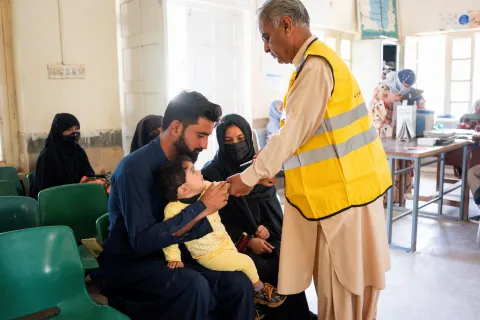
PESHAWAR / CHARSADDA, Khyber-Pakhtunkhwa, Pakistan: Eighteen-month-old Rohal clings silently to his mother, Tanzeela Bano, as they wait at the triage desk in the Musa Zai Basic Health Unit (BHU), around 15 kilometres from Peshawar. Rohal, who has yet to receive his second dose of the Measles and Rubella (MR) vaccine, is unwell today, showing signs and symptoms of high-grade fever and weakness. His vaccination is now postponed until he recovers. A few months earlier, Rohal might have missed this critical vaccine entirely. However, thanks to the updated records at the BHU and the diligent efforts of Lady Health Workers (LHWs) conducting door-to-door visits and holding mother and child healthcare sessions, Rohal’s vaccination status is closely monitored. Even if he cannot make it to the centre, healthcare workers will reach him – a critical responsibility to provide a safety net for children like Rohal.
Importantly, Rohal has received a thorough check-up at the entrance of the health unit. He is checked for nutrition-related complications, any missed vaccinations, symptoms that may require urgent care, and other health problems.

“We make parents and caregivers who bring their children to the health unit more informed,” says Nabeela Farooq, a young Lady Health Visitor (LHV) who manages the triage desk at the health unit. “This also helps with patient data, and we manage the workload of our health staff more efficiently,” she adds.
The next child she examines before referral to the relevant section of the BHU is Mustafa, who turns two in one month. Four weeks prior to this visit, he was screened at the triage desk for malnutrition using a colour-coded tape for mid-upper arm circumference (MUAC). His last MUAC measurement was less than 11.7 centimetres, indicating borderline moderate acute malnutrition. He was given Ready-to-Use Therapeutic Food (RUTF) sachets, food supplements meant to improve infants’ nutritional status. Unfortunately, inadequate hygiene and safe drinking water has worsened his condition, reducing his MUAC to 9.1 centimetres, pushing him into the severe acute malnutrition (SAM) category – a dangerous level that can cause irreversible stunting. He has been referred for specialised care at a public hospital in the city.
This triage desk, piloted by UNICEF through Pakistan’s Federal Ministry of National Health Services Regulation and Coordination (MNHSR&C) and the Khyber Pakhtunkhwa Department of Health, was made possible with generous funding from the Republic of Korea. Since its launch in March 2024, the desk has screened over 1,700 children, identifying hundreds with health-related complications, ensuring they receive the necessary care at the health unit or nearby public hospitals. Within the first hour of the day of visiting, two babies have received their timely vaccines thanks to the service desk. A QR code on the immunisation card – an approach being tested here – makes it easy to know the vaccination status of the child.

Pakistan’s overburdened health system struggles to provide quality healthcare services due to several reasons. Dr. Muhammad Akram Shah, Medical Superintendent at Moulvi Ameer Shah Hospital, notes that cross-infection and gastrointestinal health issues are rampant in most public health facilities because of inadequate hygiene and clean drinking water. In response, UNICEF and the relevant health departments, with support from the Republic of Korea, has installed water treatment plants and renovated toilets at Moulvi Ameer Shah Hospital and the Charsadda District Headquarter Hospital. Staff at these facilities received training on improved hygiene practices and one year’s worth of hygiene supplies, including soap, liquid handwash, cleaning equipment and sanitisers.
“This initiative has helped decrease cross-infection at the hospital and encouraged more caregivers to use the healthcare facilities,” says Dr. Shah.

Another key component of the initiative was the provision of incinerators for medical waste management, a significant problem for public health institutions in the country. Moulvi Ameer Shah Hospital is now the first public health facility in Peshawar to acquire an incinerator, thanks to the generous grant from the Republic of Korea. The incinerator, installed by UNICEF, can manage waste from nearby public and private health facilities as well. Earlier, all medical waste was treated as regular waste, leaving everyone in the proximity at heightened risk of diseases. “We have seen direct and indirect benefits to the community from this initiative,” Dr. Shah concludes, adding, “Mothers and children now receive healthcare as well as a clean environment along with clean drinking water.” Complementing this heavy machinery, UNICEF has installed a 50-kilowatt hybrid solar energy system, aligning with its shift towards clean and reliable energy.

Expertise, experience, and enterprise – all three need to come together to create health solutions for underserved communities like Rohal’s. The Triage Desk at the Musa Zai BHU and the upgrading of facilities in public hospitals in Peshawar is one part of a comprehensive initiative that extends beyond health facilities, providing critical support and care to mothers and children in need.
The critical work continues when mothers and children return to their homes after receiving healthcare at the facilities. Lady Health Workers (LHWs), community-based primary healthcare providers, become the bridge between institutional healthcare and women and children. Since the 1990s, this all-female workforce has saved countless lives in the country and continues its mission with fervour. Understanding the strength of their network, UNICEF equipped LHWs with improved training materials in this project. These are books designed with pictorial art to help the LHWs spread awareness on mother and child healthcare.

“The pictures make it easier for the women in community sessions to understand what we are explaining,” says Sohaila Khan, an LHW who runs a home-based child dispensary in Peshawar’s Faqirabad Union Council. “We were sceptical at first, but it has been an eye-opener how such a small improvement can help make our difficult jobs easier,” she adds.
She regularly holds sessions with mothers and pregnant women in her neighbourhood, teaching them how to care for newborns and infants, and how to ensure their own well-being.
“From hospitals to homes, we understand that knowledge is as important as services and infrastructure,” says Kamran Qureshi, Immunisation Officer, UNICEF Peshawar. “Toilets are helpful only if those using the facilities maintain appropriate hygiene. Machines like incinerators are useful only if we train staff on hospital waste management,” he adds. Of course, knowledge combined with services makes it possible for our efforts to reach the most vulnerable mothers and children.