Fast Facts: Over One in Four Children in Fiji Face Multidimensional Poverty

SUVA FIJI, 24 November 2025 – A new report released today by the Ministry of Women, Children and Social Protection, in partnership with UNICEF, reveals a concerning reality: 28.2 per cent of children in Fiji are living in multidimensional poverty.
This goes far beyond a lack of income. For a child, poverty means missing out on the essentials needed to survive and thrive such as nutritious food, safe housing, clean water, education, and good healthcare. When children are deprived of these basic rights, they experience what is known as multidimensional poverty - a condition that reflects multiple, overlapping hardships.
Drawing on data from the 2021 Multiple Indicator Cluster Survey, which covered nearly 8,000 children nationwide, the report, Multidimensional Child Poverty in Fiji, is the first of its kind for the country.
“The true measure of our nation’s progress is in how our children grow up - healthy, safe, educated, and able to pursue their dreams,” said Minister for Women, Children and Social Protection, Hon. Sashi Kiran. “Poverty is not just about how much a family earns; a child’s reality is shaped by many more dimensions.”
Key facts from the report:
- The youngest children are most at risk: 63.2 per cent of children aged 0–23 months and 42.4 per cent of those aged 24–59 months are deprived of three or more essential needs. These are such as good nutrition, safe and adequate housing, as well as safe and clean water.
- Rural children are disproportionately affected, with 34.7 per cent experiencing multidimensional poverty compared to 23.2 per cent in urban areas.
- The central division reports the highest rate of child deprivation (34.4 per cent), while the western division is lowest (21.7 per cent).
- Nutrition is the most critical gap: 56.1 per cent of infants are not exclusively breastfed, and 58.1 per cent of young children do not meet international standards on the quantity and variety of meals.
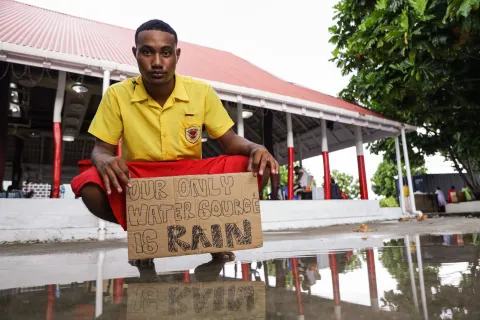
- Nearly half of all children are deprived of housing and water, with 57.9 per cent lacking adequate housing and up to 49.8 per cent facing water deprivation.
“When a child is unable to access nutritious food, clean water, or a safe place to sleep, their future is stolen before it even begins,” said UNICEF Pacific’s Deputy Representative, Ms. Roshni Basu. “Together with the Government of Fiji and our partners, UNICEF is committed to urgently act on these findings as the cost of waiting is measured in lost childhoods, and every day without action is a day too many.”
The report recommends raising awareness and education on nutrition, health, and hygiene, especially among families who are most at risk. Support should be prioritized for children living in rural areas, the central division, and in households with low education levels or many children. The report also calls for implementation of activities to improve housing and water access for all children, while highlighting the need for different sectors to work together to address the many challenges children face. Finally, it also calls for further research into the health and nutrition of children aged 5 to 17 years, to ensure no child is left behind.
# # #
Media contacts
About UNICEF
UNICEF promotes the rights and wellbeing of every child, in everything we do. Together with our partners, we work in 190 countries and territories to translate that commitment into practical action, focusing special effort on reaching the most vulnerable and excluded children, to the benefit of all children, everywhere.
For more information about UNICEF and its work for children, visit https://www.unicef.org/pacificislands/