COVID-19: IFRC, UNICEF and WHO issue guidance to protect children and support safe school operations
Guidance includes practical actions and checklists for administrators, teachers, parents and children
Download the joint guidance on protecting children and schools from COVID-19: https://uni.cf/33hxaSd
SUVA, 11 March 2020 – The International Federation of the Red Cross and Red Crescent Societies (IFRC), UNICEF and the World Health Organization (WHO) today issued new guidance to help protect children and schools from transmission of the COVID-19 virus. The guidance provides critical considerations and practical checklists to keep schools safe. It also advises national and local authorities on how to adapt and implement emergency plans for educational facilities.
In the event of school closures, the guidance includes recommendations to mitigate against the possible negative impacts on children’s learning and wellbeing. This means having solid plans in place to ensure the continuity of learning, including remote learning options such as online education strategies and radio broadcasts of academic content, and access to essential services for all children. These plans should also include necessary steps for the eventual safe reopening of schools.
Where schools remain open, and to make sure that children and their families remain protected and informed, the guidance calls for:
- Providing children with information about how to protect themselves;
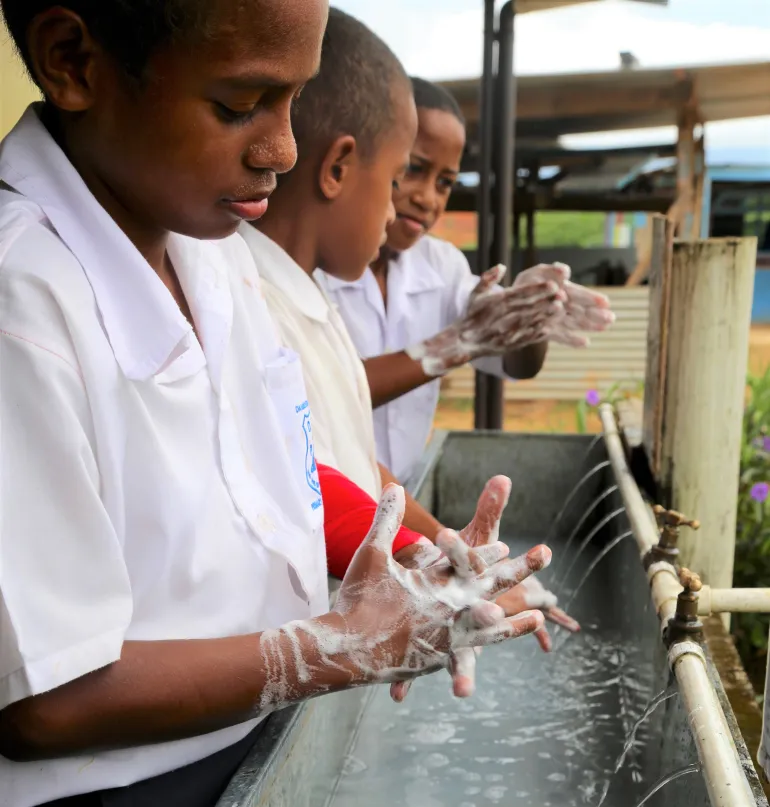
- Promoting best handwashing and hygiene practices and providing hygiene supplies;
- Cleaning and disinfecting school buildings, especially water and sanitation facilities; and
- Increasing airflow and ventilation.
The guidance, while specific to countries that have already confirmed the transmission of COVID-19, is still relevant in all other contexts. Education can encourage students to become advocates for disease prevention and control at home, in school, and in their community by talking to others about how to prevent the spread of viruses. Maintaining safe school operations or reopening schools after a closure, requires many considerations, but if done well, can promote public health.
For example, safe school guidelines implemented in Guinea, Liberia and Sierra Leone during the outbreak of Ebola virus disease from 2014 to 2016 helped prevent school-based transmissions of the virus.
UNICEF is urging schools – whether open or helping students through remote learning – to provide students with holistic support. Schools should provide children with vital information on handwashing and other measures to protect themselves and their families; facilitate mental health support; and help to prevent stigma and discrimination by encouraging students to be kind to each other and avoid stereotypes when talking about the virus.
The new guidance also offers helpful tips and checklists for parents and caregivers, as well as children and students themselves. These actions include:
- Monitoring children’s health and keeping them home from school if they are ill;
- Encouraging children to ask questions and express their concerns; and
- Coughing or sneezing into a tissue or your elbow and avoid touching your face, eyes, mouth and nose.
###
Note to editors
To support Pacific COVID-19 preparedness and response efforts, a Joint Incident Management Team (IMT) was quickly established in January 2020 and has been fully operational since then. Coordinated by WHO, this Joint IMT based in the WHO office in Suva, Fiji, currently includes the Australian Department of Foreign Affairs and Trade (DFAT), New Zealand Ministry of Foreign Affairs and Trade (MFAT), the Pacific Community (SPC), the United Nations Children’s Fund (UNICEF), the United Nations Office for the Coordination of Humanitarian Affairs (UNOCHA), and the World Food Programme (WFP). Through the IMT, close coordination with Ministries of Health across the Pacific is ongoing, as well as with key partners, including the International Federation of Red Cross and Red Crescent Societies (IFRC), International Organization for Migration (IOM), Pacific Island Health Officers’ Association (PIHOA), the Pacific Island Forum Secretariat, and the United States Centers for Disease Control and Prevention (CDC).
About UNICEF Pacific’s response:
UNICEF Pacific is supporting governments across the Pacific region to prepare for COVID-19. UNICEF and WHO have supported procurement of medical, laboratory and other supplies, including 128,700 surgical masks to be distributed to countries based on population size, 5000 ‘N95’ masks for health workers, 300 no-touch thermometers, 5000 respirators, chlorine granules, 110 body bags, 2100 specimen collection swabs, 2200 biohazard bags, and 1380 infectious sample transport boxes. UNICEF is also working with IOM and the Pohnpei Public Utilities to build 100 handwashing stations in schools and other public facilities as part of a hygiene promotion campaign.
Together with WHO, UNICEF is providing support to preparedness materials for governments to use at airport arrivals, in schools and communities. Risk communication specialists are based in Solomon Islands, Vanuatu, Kiribati, the Federated States of Micronesia/Republic of Marshall Islands and Fiji to support on preparedness measures. UNICEF is also addressing misinformation and sharing information via a social media campaign.
About IFRC
IFRC is the world’s largest humanitarian network, comprising 192 National Red Cross and Red Crescent Societies working to save lives and promote dignity around the world.
www.ifrc.org - Facebook - Twitter - YouTube
About WHO
For updates on COVID-19 and public health advice to protect yourself from coronavirus, follow WHO on Twitter, Facebook, Instagram, LinkedIn, TikTok, Pinterest, Snapchat, YouTube
For further information, please contact:
Cate Heinrich, UNICEF Pacific, +679 922 5606, [email protected]
Christopher Tidey, UNICEF New York, +1 917 340 3017, [email protected]
Media contacts
About UNICEF
UNICEF promotes the rights and wellbeing of every child, in everything we do. Together with our partners, we work in 190 countries and territories to translate that commitment into practical action, focusing special effort on reaching the most vulnerable and excluded children, to the benefit of all children, everywhere.
For more information about UNICEF and its work for children, visit https://www.unicef.org/pacificislands/