The Chants of Learning, The Echoes of a Second Chance
Out-of-school children in Adamawa find a second chance to learn through a GPE-funded education initiative

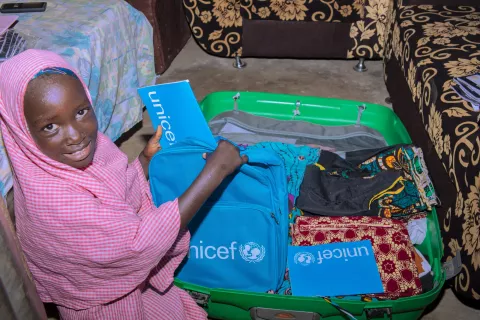
The chants rise from a small learning center in Gombi, Adamawa State, vibrant, rhythmic, and full of life. Children’s voices echo down the streets, brimming with hope and confidence. Among them sits 13-year-old Halima Ibrahim, her eyes fixed on her teacher, her voice blending into the joyful chorus.
Just a few years ago, Halima’s world was very different. She grew up in Damboa, Borno State, but when conflict reached her community, her family fled, leaving behind their home, friends, and Halima’s school. “When we came to Gombi, the only place we went was the farm,” she recalls softly. “My education stopped.”
Every morning, she would watch other children walking to school. “I felt pain in my heart when I saw people taking their children to school. I wanted that to be me,” she says.
Halima’s story mirrors that of thousands of children across Adamawa. Many are out of school because of poverty, insecurity, or social barriers, their dreams interrupted, and their confidence shaken. “When children miss school for long, it’s hard to start again,” explains one of the teachers at her Accelerated Basic Education Programme (ABEP) center. “They lose faith in themselves. But with the right support, they can recover and learn again.”
That support came through the ABEP, a joint initiative of the Adamawa State Government, Global Partnership for Education (GPE), and UNICEF. The programme offers a fast-track pathway for older children who never attended school or dropped out. By condensing the primary curriculum, it helps learners quickly gain essential literacy, numeracy, and life skills.

“When the center started, we were learning under a tree,” Halima says, smiling at the memory. “The sun was hot, sometimes the rain would fall, but we didn’t stop. We were happy because we were finally learning again.”
Later, with help from the state government, GPE, and UNICEF, new sheds were built in more than 120 ABEP centers across Adamawa. “When the sheds came, it was a big relief,” Halima says. “We didn’t have to stop classes because of rain or sun anymore.”
But for Halima, the real gift was not the shelter, it was hope. “I can read in Hausa now. I know some English. I can do small Mathematics,” she says proudly.
Across Adamawa, 123 community-based learning centers have been established, each designed to reach out-of-school children where they are. Beyond lessons, the centers restore dignity and inclusion. Adolescent girls receive menstrual hygiene kits so they can attend school confidently. Teachers and parents are trained in play-based methods that make learning fun and welcoming for every child.


The ABEP is also supported by the Teaching at the Right Level (TaRL) approach, which helps children catch up in basic reading and math. Instead of grouping by age, teachers assess each child’s learning level and tailor lessons to their needs, making every session interactive and relevant.
Each day, as Halima chants with her classmates, her voice carries more than words, it carries a future reclaimed. With the support of the state government, children who complete ABEP are enrolled in formal schools, continuing their journey toward a better life.
“I am happy now,” Halima says with a shy but confident smile. “I can learn again.”
Through ABEP, Halima has found not just education, but a second chance, a chance every child deserves.