Bearing the brunt of war
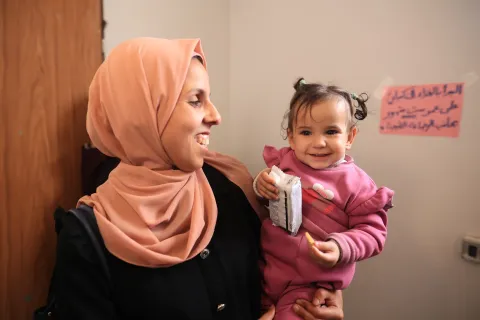
Narjis copes with life after injury

2 July 2018 – Lattakia, Syria. Almost three years ago, Marwa and her five children left Damascus to visit relatives in the town of Foah in Idleb. Her husband stayed behind not knowing that it would be years before he would see his family again.
Shortly after they arrived, the security situation started deteriorating, fighting escalated and the village fell under siege.
“We had no choice but to wait and hope that the siege would be lifted and that we’d be able to flee,” recalls Marwa. “Unfortunately, the situation only got more dangerous,” she adds.
One day, as the family was having breakfast, a shell hit their building and they found themselves under rubble.
“When the neighbours ran to rescue us, we were frozen in shock,” she continues.
As they hastily fled into the basement, Marwa did not notice any visible injuries on her children. Later, Marwa observed that her four-year-old daughter, Narjis, could not get up or walk, something she had been doing easily since she was two.
“I assumed it was the shock, but I had no idea the extent of it,” says Marwa.
As she fed her, she also noticed that Narjis was not able to look at her food or her mother. One of the few doctors in the besieged town confirmed that shrapnel has damaged Narjis’ eyesight and that she needed multiple surgeries and a medical attention that was not available under siege.
I assumed it was the shock, but I had no idea the extent of it

Due to the severe stress and trauma, Narjis also developed Vitiligo - a loss of skin pigment that causes white spots or patches to appear on the skin. Studies have shown that stressful life events can act as triggers for Vitiligo.
With lack of medical and psychological care under siege, Narjis spent her time lying in bed. She could not go to school or play with her siblings. The family’s plight got worse as food became scarce. “I counted the days until we could leave and seek proper medical care for her,” adds Marwa.
It was two full years before the family was evacuated from Foah, to reunite with Wisam, the father, in northern rural Lattakia where they now live.
“On the day they arrived, we took Narjis from one doctor to another to find a cure for her suffering,” recalls Wisam.
Since then, Narjis has undergone multiple eye surgeries and has partially regained her eyesight. She also started walking again but her the challenges she faces are far from over.
“The years she spent in bed took a toll on her because they were in an important developmental period,” says Marwa about Narjis who has developed speech and language problems.
“Before the attack, she used to love to dress up and play outside but now she’s being bullied by other children for her skin pigmentation and glass eye so she remains indoors and does not interact with her peers or go to school,” she adds.
But Narjis’ only dream is to be able to go to school one day like her siblings.
Before the attack, she used to love to dress up and play outside but now she’s being bullied by other children for her skin pigmentation and glass eye so she remains indoors and does not interact with her peers or go to school
“The school bus comes every morning to pick up my younger sister, but it leaves me behind,” says Narjis, who is now eagerly learning the alphabet with help from her parents at home.
Narjis and her family receive monthly cash assistance from UNICEF, meant to help families ease the financial burden associated with caring for a child with disability. In 2017 alone, the programme helped over 5,800 children and their families in Aleppo and Lattakia, funded by over 20 national committees for UNICEF worldwide.