Number of ‘zero-dose’ children increased by more than one third last year in the Middle East and North Africa
Conflicts and humanitarian crises continue to hinder immunization recovery efforts after COVID-19 in the region
- English
- العربية
Amman, 15 July 2024 - Millions of children in the Middle East and North Africa (MENA) remain unprotected against preventable diseases due to a steady decline in vaccination coverage, according to the latest WHO and UNICEF estimates of national immunization coverage (WUENIC) published today.
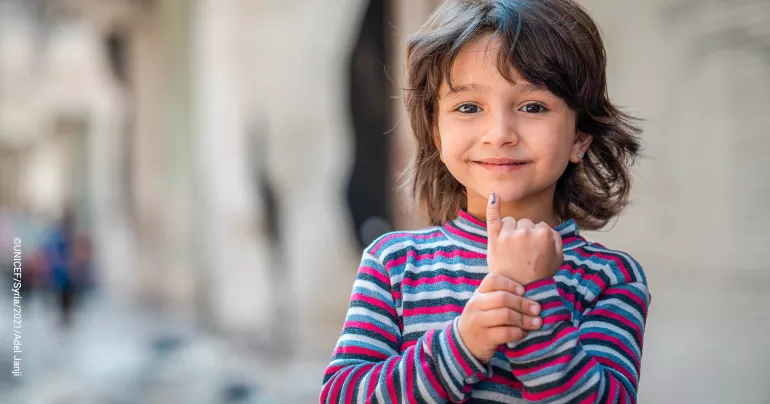
In 2023, the number of 'zero-dose' children in the MENA region – those who did not receive even the first dose of the diphtheria, tetanus, and pertussis vaccine (DTP1) – was 1.64 million, up from 1.2 million in 2022, representing the highest ever reported number. This new figure is even more staggering when compared to 2019, when we had 872,000 zero-dose children.
"The increase in the number of zero-dose and under-vaccinated children is alarming. The drop in immunization rates poses a real threat to children from vaccine-preventable diseases," said Adele Khodr, UNICEF Regional Director for the Middle East and North Africa Region.
The latest data ranks MENA sixth out of seven UNICEF regions, with DTP1 coverage at 85 per cent in 2023—a drop of seven percentage points since 2019.
"While the underlying causes are varied, conflicts and humanitarian crises are among the main drivers of this decline. Conflict-affected countries are home to the majority of zero-dose children, making humanitarian access and response in such contexts an even higher priority," added Khodr.
As conflicts continue to impact children around the region, Sudan, Yemen, and Syria are home to nearly 87 per cent of the total zero-dose children in the region, with Sudan alone contributing 42 per cent of these zero-dose children. In the State of Palestine, traditionally a high-coverage country, the impact of the conflict has already started to show while the ongoing violence in the Gaza Strip is expected to further deteriorate immunization coverage in 2024 unless urgent lifesaving services are re-established and the violence ends.
The situation is similar for the Measles vaccine. A drop of 4 percentage points has been observed in 2023 compared to 2019, with a total of almost 2 million children in MENA missed their first dose.
Vaccine coverage varies between countries and within countries for different vaccines. While the backslide in vaccine coverage draws a grim picture, there is still good news. Some countries in the MENA region have maintained their progress, while others have advanced. Thirteen out of 20 countries in the region had coverage of at least 90 per cent, and recovery from the COVID-19 pandemic has been evident in at least five middle-income countries, putting them on the right trajectory to achieve the targets of the Immunization Agenda 2030.
“To achieve progress and protect children and communities from preventable diseases, we call on governments to continue investing in health systems, sparing no effort to reach every child with all necessary vaccines. Critical and lifesaving services provided by front-line workers, particularly in conflict and crises-affected contexts, should be supported and protected, and safe humanitarian access guaranteed and facilitated,” said Khodr.
__________________________
Links:
Access the WHO dataset: Global dashboard country profiles, and additional resources
Access the UNICEF dataset: Overview page, Full datasets, Data visualisation, Regional data visualisation, Country profiles
Download content:
WHO photo gallery and social media content, UNICEF multimedia and immunization page
Notes to editors:
About the data
Based on country-reported data, the WHO and UNICEF estimates of national immunization coverage (WUENIC) provide the world’s largest and most comprehensive dataset on immunization trends for vaccinations against 14 diseases given through regular health systems - normally at clinics, community centres, outreach services, or health worker visits. For 2023, data were provided from 185 countries.
About the Immunization Agenda 2030 (IA2030)
The IA2030 is a global strategy endorsed by the World Health Assembly aiming to ensure everyone, everywhere, at every age benefits from vaccines for improved health and well-being by 2030. It focuses on increasing vaccine coverage, equity, sustainability and pandemic preparedness while promoting life-course immunization and integrating immunization with other health services.
Media contacts
About UNICEF
UNICEF promotes the rights and wellbeing of every child, in everything we do. Together with our partners, we work in 190 countries and territories to translate that commitment into practical action, focusing special effort on reaching the most vulnerable and excluded children, to the benefit of all children, everywhere.
For more information about UNICEF and its work for children, visit www.unicef.org/mena
Follow UNICEF on Twitter Facebook Instagram LinkedIn Youtube
Join our UNICEF MENA WhatsApp group to get the latest news. Send us a text message at the following number and we'll add you to our list: 00962790082531