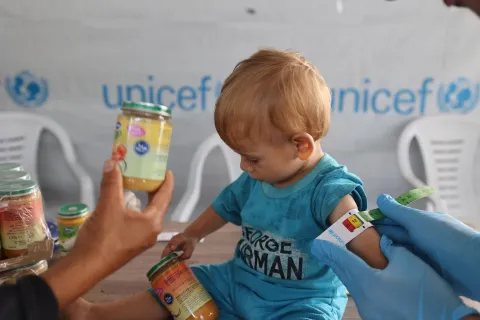
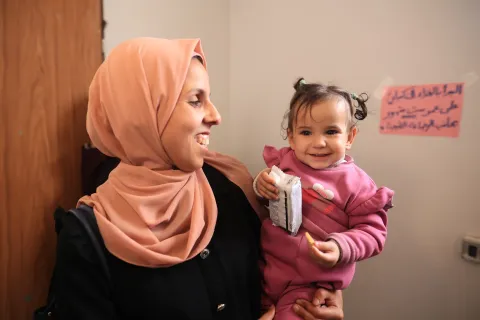
Fifty-two million children and adolescents live with overweight and obesity in the Middle East and North Africa
UNICEF warns that millions of children across the region are eating unhealthy diets while others are pushed to famine.

- English
- العربية
AMMAN, 10 September 2025 – Obesity among school-aged children and adolescents across the Middle East and North Africa (MENA) has doubled since 2000, and is surpassing underweight rates, UNICEF said today, warning of a double burden of malnutrition in a region where millions of children face both unhealthy diets and life-threatening hunger.
According to UNICEF’s new report “Feeding Profit: How Food Environments are Failing Children,” 52 million children under 19 in MENA are living with overweight or obesity, including 22 million with obesity. Between 2000 and 2022, obesity prevalence among 5–19-year-olds in the region rose sharply from 7.5 per cent to 16 per cent – one of the steepest increases worldwide.
The report comes at a time that severe food crises in parts of the region are leaving children living hungry and severely undernourished. In Sudan, over two years of brutal conflict have devastated food systems, displacing millions and the risk of mass child mortality is growing rapidly in areas already near famine thresholds while famine is already occurring in several areas. Meanwhile in the Gaza Strip, nearly two years of relentless war and severe restrictions on aid allowed into the Gaza strip in the past months have left families unable to access sufficient nutritious food, with famine already confirmed in Gaza Governorate, projected to spread to other areas in the coming weeks.
“The contrast could not be more stark,” said Edouard Beigbeder, UNICEF Regional Director for the Middle East and North Africa. “While millions of children in the region are eating ultra-processed foods that harm their long-term healthy growth and development, others are going to bed hungry, wasting away in war zones. This is the true face of malnutrition in MENA today.”
The report warns that diets high in unhealthy, ultra-processed foods, are driving high overweight and obesity in children and adolescents in MENA. Nearly half of surveyed adolescents aged 15-19 years (47 per cent) drank a soft drink on the previous day, and 73 per cent consumed more than one sugary food or beverage, while 37 per cent consumed more than one salty processed food.
More than 30 per cent of surveyed children aged 6-23 months ate no fruit or vegetables the previous day, while 40 per cent consumed no eggs or flesh foods – essential sources of protein and micronutrients.
These patterns are driven by aggressive marketing of ultra-processed foods. Even in crisis-affected settings, adolescents report high exposure to food advertising, with rates reaching 82 per cent in Iraq and 81 per cent in Lebanon.
In crises, children’s diets deteriorate even further. Refugee and displaced families usually struggle to access affordable, nutritious food, with shops, food stalls and even fast-food restaurants, introducing an abundance of ultra-processed foods and beverages to the local food environment. On the other hand, many rely on aid that often prioritizes calories over quality with limited access to fresh foods, clean water, and essential services – compounding risks of wasting, stunting, and long-term developmental harm.
Meanwhile, the ultra-processed food industry exploits these very crises, using donations of unhealthy products to promote their brands and normalize poor diets among vulnerable communities.
Some countries are making notable advances to improve children’s food environment. Lebanon, for example, has banned the promotion of commercial complementary foods for children under three years of age, restricted cross-promotion with breastmilk substitutes, and mandated breastfeeding-supportive labelling – measures that improve food environments for young children.
To prevent further deterioration of children’s nutrition across the region, action is needed, including to secure humanitarian access for children in conflict zones, while ensuring every child has access to safe, nutritious, and affordable food through stronger protections against harmful food marketing, healthier school environments, clearer front-of-pack labelling, and expanded social protection so families can afford better diets.
“Every child in MENA has the right to grow up healthy – not undernourished, not obese, not deprived of the foods that nourish body and mind,” said Beigbeder. “We need urgent action with our partners and governments to turn the tide and build healthier food environments and stronger futures for all children.”
- ENDs –
Notes for editors:
The Child Nutrition Report 2025 draws on data from over 190 countries and includes household surveys, modelled estimates, projections, and polls.
Data on overweight, stunting and wasting among children under the age of 5 from 2000-2024 are based on UNICEF/WHO/World Bank Joint Child Malnutrition estimates.
For children and adolescents aged 5-19 years, data on overweight, obesity and underweight is modelled using population-based surveys, administrative data or studies that measured height and weight in representative samples. Country level data is available from 2000-2022 and coordinated by the Non-Communicable Disease Risk Factor Collaboration (NCD-RisC).
Categories of overweight, obesity and underweight (thinness) are defined based on body mass index (BMI). For school-aged children and adolescents aged 5-19 years:
- Overweight is defined as a BMI greater than 1 standard deviation above the median, according to the WHO references for school-age children and adolescents.
- Obesity is defined as a BMI greater than 2 standard deviations above the median, according to the WHO references for school-age children and adolescents.
- Underweight, also known as thinness, is defined as a BMI less than 2 standard deviations below the median, according to the WHO references for school-age children and adolescents.
Child malnutrition has three dimensions: undernutrition (stunting and wasting), overweight/obesity and hidden hunger or micronutrient deficiencies.
Ultra-processed foods are industrially formulated foods and beverages made primarily from refined ingredients and additives, with little or no whole foods. They often contain high levels of added sugars, refined starches, salt, and unhealthy fats, and are designed to be convenient, highly palatable, and appealing through marketing, packaging, and branding.
Media contacts
Additional resources

About UNICEF
UNICEF promotes the rights and wellbeing of every child, in everything we do. Together with our partners, we work in 190 countries and territories to translate that commitment into practical action, focusing special effort on reaching the most vulnerable and excluded children, to the benefit of all children, everywhere.
For more information about UNICEF and its work for children, visit www.unicef.org/mena
Follow UNICEF on Twitter Facebook Instagram LinkedIn Youtube
Join our UNICEF MENA WhatsApp group to get the latest news. Send us a text message at the following number and we'll add you to our list: 00962790082531