Cultural activities with a psychosocial focus for the well-being of young people in Taoudénni
Cultural activities with a psychosocial focus for the well-being of children and young people in Taoudénni

- Français
- English
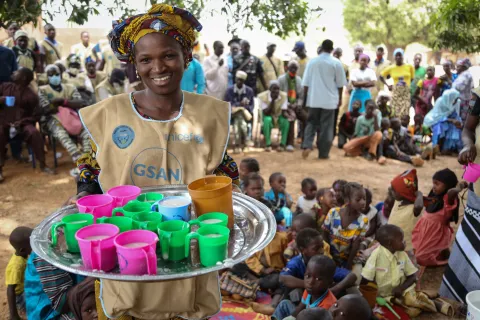
On the white dunes of Touwal in the Taoudénni region, a festive atmosphere fills the air this August. This community mobilization has been made possible through the efforts of the NGO Action Recherches pour le Développement des Initiatives Locales (ARDIL). Men, women, and children have answered the call of ARDIL, which operates in the Taoudénni region as part of the Project to Promote Access to Finance, Entrepreneurship, and Employment in Mali (PAFEEM).
Aïchatou Mint Oumar, a psychosocial assistant with ARDIL, is one of the key organizers of the group cultural activities with a psychosocial focus carried out under the PAFEEM project in Touwal, Taoudénni region.
“These cultural activities help mobilize the community especially PAFEEM participants for awareness sessions on social behavior change and psychological resilience building,” explains Aïchatou.

From income-generating activities (IGAs) and labor-intensive public works (TP-HIMO) to psychosocial support sessions, PAFEEM targets the most vulnerable groups, particularly adolescents and young people. The activity organized by ARDIL’s team offers a true mosaic of experiences: cultural performances, games, and peer discussions allow everyone to participate meaningfully.

“We don’t just play games,” says Aïchatou. “We also give participants the chance to ask questions and get answers to their concerns. Teenagers share their worries so they can find solutions together.”

Malika, an 11-year-old girl from Touwal in the Taoudénni region, is one of the many children who took part in the various games. “We love having time to play and do what we enjoy.”
Like Malika, other young girls gathered to celebrate their culture and discuss the impact of conflict on the mental health of children and adolescents.
“Games bring us together as young people.” We learn and have fun,” says.Today I learned the importance of dialogue through question-and-answer games.”


Psychosocial sessions featuring cultural activities and peer exchanges offer valuable spaces for learning, cohesion, and integration. “These activities allow our community to come together, play, and enjoy themselves despite the difficult situation caused by the security crisis,” says Aïchatou, adding that these gatherings have a positive impact on participants. “They help them release daily stress and live more fulfilling lives.”

To the beat of the Toubal (drum), young girls and boys enjoy their favorite board games.
“There’s a game here designed especially for girls.” It allows them to relax, forget their stress, and have fun,” explains Aïchatou.

As part of the PAFEEM project, the Taoudénni region counts 838 participants in the Income-Generating Activities (IGA) component and 835 participants in the Labor-Intensive Public Works (TP-HIMO) component. These activities have enabled hundreds of participants to develop their own businesses while helping improve their living environment through sanitation and cleaning initiatives.
The project also integrates essential psychosocial support to help beneficiaries rebuild self-confidence, manage stress, and strengthen their social skills. This support promotes both economic and emotional stability, thereby enhancing individual well-being and fostering social cohesion within local communities.
Since 2012, Mali has faced an ongoing political and security crisis that continues to affect the country’s economy and could undermine the long -term results of public policies. In response, the government launched several initiatives, including the Project to Promote Access to Finance, Entrepreneurship, and Employment in Mali (PAFEEM), which supports national efforts to improve financial inclusion, access to funding for micro, small, and medium enterprises (MSMEs), and job creation. This objective aligns fully with the National Strategy for Emergence and Sustainable Development (SNEDD 2024–2033), which implements the vision “Mali Kura ɲɛtaasira ka bɛn san 2063 ma” in accordance with its third pillar: “Structural transformation of the economy and growth.” PAFEEM's activities are organized around five components, including Component 3, “Support for Income-Generating Activities (IGAs) and Job Creation,” implemented with the operational support of the United Nations Children's Fund (UNICEF).