

Inclusive learning for more children to empower the next generation
More children in crisis-affected regions will access inclusive and protective learning environments thanks to the second phase of the successful multi-year resilience programme, funded by Education Cannot Wait (ECW) and launched today.
- Français
- English
BAMAKO, 15 May 2025 – The Ministry of Education, in collaboration with UNICEF Mali, officially launched today the second phase of the Multi-Year Resilience Programme (MYRP II). The Programme aims to provide equitable access to quality education for 204,496 children aged 3 to 18 in some of Mali’s most crisis-affected regions, including Gao, Kidal, Ménaka, Mopti, Taoudénit, and Timbuktu.
This initiative is made possible thanks to a generous contribution of $22 million from Education Cannot Wait (ECW), the global fund for education in emergencies and protracted crises.
“The MYRP2 represents a true hope for our children, especially the most vulnerable,” said Amadou Sy Savané, Minister of Education.
Around one third of school-aged children – more than two million – are out of school, particularly in areas affected by insecurity (Analysis of the situation of children in Mali, 2024). Over half of households (56 per cent) report that education services do not meet their needs, including access to inclusive, quality learning, according to the Multi-Sector Needs Analysis (MSNA) conducted as part of the 2025 planning process. These challenges are largely linked to the surrounding security situation.
Ongoing crises have severely disrupted education across Mali, leading to the closure of 2,006 schools, according to the Mali education cluster report from March 2025. This has impacted 601,800 children and 12,036 teachers. Out-of-school children are especially vulnerable to increased risks such as child labour, early marriage, recruitment by armed groups, and long-term psychosocial distress.
The Education Sector Strategic Plan 2022–2026 identifies marginalized groups – including children with disabilities, refugees, and internally displaced persons (IDPs) – as being disproportionately affected by environmental disasters and climate-related conflicts.
Building on lessons learned from Phase I, MYRP II will implement interventions across three key outcomes:
- Access to Education: Girls and boys aged 3 to 18 will have access to formal and non-formal education in inclusive, protective learning environments.
- Quality Education: Children will benefit from continuous, inclusive, and quality education tailored to their needs.
- Crisis Response Capacity: The education system will be equipped to provide rapid, coordinated, and inclusive responses in times of crisis.
The first phase of MYRP, supported by $16.1 million in funding, expanded access to learning spaces and ensured continuity of education for 191,616 children – 50 per cent of them girls. It also covered school fees for vulnerable families, particularly for girls, and engaged communities in strengthening learning opportunities in crisis-affected areas. The programme focused on supporting girls and children with disabilities through a holistic approach that addressed their physical, mental, and psychosocial needs.
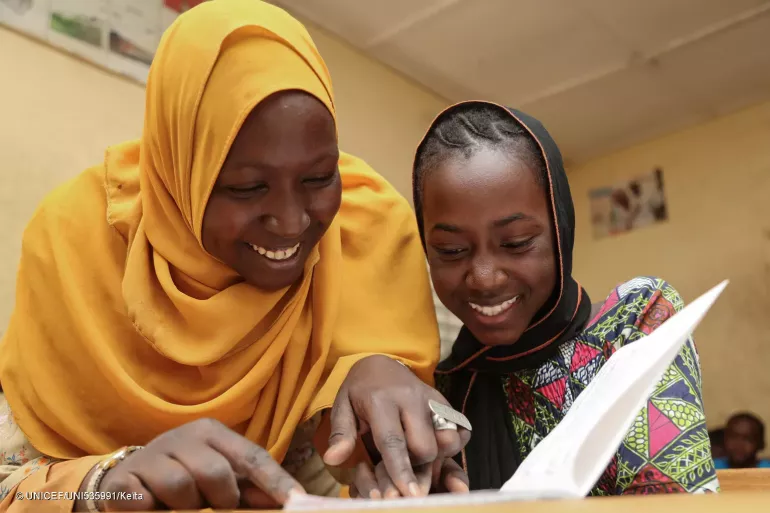
"Inclusion is when every child, no matter their differences, has the chance to learn and play with their peers. Imagine a classroom where everyone feels welcome," said Mama, 16, a child parliamentarian and young advocate for children's rights. "I believe that if we all work together, we can build schools where kindness and respect prevail. Every child deserves to feel loved and respected, and inclusion at school is an important step towards that."
“This new ECW grant represents a lifeline for some of the most vulnerable girls and boys in Mali enduring the devastating impacts of conflict, climate change, and forced displacement,” said Yasmine Sherif, Executive Director of Education Cannot Wait, the global fund for education in emergencies and protracted crises hosted by the United Nations. “These children, their teachers, and our partners on the ground are in dire need of sustained funding to help rebuild their lives through an inclusive and continued quality education.”
“The testimony of 15-year-old Arya still resonates: despite difficult conditions and starting school late, she regained hope thanks to the construction of new classrooms in her school. This transformation is a concrete example of what we can achieve through determined, collective action,” said Pierre Ngom, UNICEF Representative in Mali.
UNICEF Mali has been designated as the primary grantee responsible for the programme’s technical implementation and financial oversight. The initiative will be delivered in partnership with seven local and international non-governmental organizations.
Sustainability and localization are central to MYRP II. By co-developing implementation strategies with local actors, including women-led organizations, the programme aims to build community capacities and ensure long-term educational resilience.
UNICEF remains committed to aligning its efforts with the objectives of PRODEC2 (Second Generation of the Ten-Year Programme for the Development of Education and Vocational Training), and to working closely with key education sector actors to strengthen the national education system, particularly its resilience and its ability to respond to emerging shocks and the prolonged effects of multidimensional crises.
Media contacts
Additional resources
About UNICEF
UNICEF promotes the rights and wellbeing of every child, in everything we do. Together with our partners, we work in 190 countries and territories to translate that commitment into practical action, focusing special effort on reaching the most vulnerable and excluded children, to the benefit of all children, everywhere.
For more information about UNICEF and its work for children, visit www.unicef.org.


