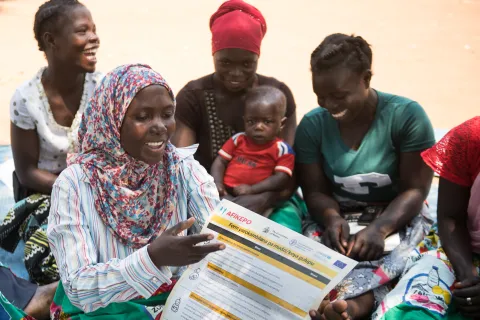
Ending child marriage from community up: Local leaders take lead in Malawi
Communities driving action to end child marriage

In a meeting room in Lilongwe this week, 20 representatives of community-based organisations (CBOs) from Malawi’s Northern, Central and Southern regions have come together around one shared goal: strengthening community-led action to end child marriage.
The orientation, organised by Firelight Foundation - as part of the joint UNICEF – Children's Investment Fund Foundation (CIFF) project ‘Protecting Girls, Transforming Futures’ - is training CBO leaders to work with traditional leaders, faith leaders, parents and other community influencers to challenge social norms and practices that drive child marriage.
This meeting focuses on shifting more leadership to the communities themselves.
For the participating CBOs, this approach recognises that ending child marriage requires more than national policies, campaigns and messages. Sustainable change must also happen in villages, families, places of worship and other spaces where decisions affecting children are made.
Bringing experience from the communities
The organisations participating in the orientation are not new to the challenges facing children and families.
The Executive Director of the Centre for Youth Development and Social Empowerment in Lilongwe Nancy Kunambale, Executive Director of Kamwanga CBO in Mzimba, Blessings Mbulo, and Programme Officer at Matwanga CBO in Machinga, Julius Bamusi, describe organisations already deeply involved in addressing challenges affecting women and children.
Their work includes promoting human rights, preventing gender-based violence, providing care and support to survivors, identifying vulnerable children and supporting girls rescued from child marriage to return to school.
Some CBOs also work with parents on economic empowerment, recognising the close relationship between household poverty and children's vulnerability.

“Sometimes poverty puts families in a situation where marrying off a girl may be seen as a solution to economic hardship,” explained Mbulo.
In Mzimba, for example, economic migration can place additional pressure on families. Some men travel to South Africa in search of employment and may establish new relationships there, leaving wives and children behind with limited financial support. In communities where lobola, bride price is practised, economic hardship can increase the temptation for families to view a daughter's marriage as a source of financial relief.
It is these complex realities that the CBOs say make locally led interventions essential.
Why communities need to lead
Despite years of work to address child marriage in Malawi, participating CBOs believe significant gaps remain because interventions have not always been designed close enough to the communities where harmful practices occur.
Community-based organisations argue that programmes designed primarily at higher levels may struggle to respond to the specific social norms, economic realities and power structures influencing decisions within individual communities.
CBOs can help bridge that gap.
“We already know the traditional leaders. We know the faith leaders. We know the families and, importantly, we understand the local context in which decisions about girls' lives are being made,” said Bamusi.
The scale of the information gap can be significant. Nancy Kunambale working in the rural area of Lilongwe – Chimutu -, pointed to a population of more than 118,000 people spread across numerous villages and traditional leadership structures. Reaching these leaders with knowledge and practical skills to prevent child marriage is therefore critical.
According to the Program Officer for Firelight Foundation, Zainab Chisenga, "Firelight's Community Driven Systems Change approach empowers CBOs to lead community transformation because it believes change happens when communities collectively lead. This is why they selected CBOs that are well established in their communities.
“We also looked at their ability to build strong networks and work with traditional leaders, religious leaders and other community influencers so that their impact can extend beyond their immediate communities,” she added.
After the orientation, participants are expected to return to their districts and strengthen the capacity of community leaders to facilitate conversations on child marriage, challenge harmful social practices and engage influential community members in identifying appropriate local solutions.
Men becoming part of the solution
One striking feature of the orientation is the strong presence of men among the CBO representatives.
While gender balance remains important, their participation also presents an opportunity.
As fathers, husbands, traditional leaders, faith leaders and decision-makers in many communities where child marriage persists, men have a crucial role to play. They can question the norms that enable men to marry girls and - in influencing their peers - can aim to reject the practice.
Learning from each other
The Lilongwe orientation is also creating space for CBOs from across Malawi to learn from one another.
Each organisation arrives with its own experience, approaches that have worked, challenges encountered and lessons learned from working directly with communities.