From Copenhagen to Lilongwe and beyond
Delivering COVID-19 vaccines to the last mile

As the world fights a pandemic that has claimed about 4.4 million lives worldwide with over 200 million confirmed cases (WHO, 26 August), UNICEF is at the centre of the response. UNICEF is leading the procurement and delivery of COVID-19 vaccines through the COVAX facility in the largest, most complex ground operation in the history of immunization.

Around 2 pm on a Saturday afternoon, a plane carrying COVID-19 vaccine doses lands at Kamuzu International Airport in Lilongwe. Malawi’s Minister of Health and other senior government officials, Acting British High Commissioner Fiona Ritchie and UNICEF Malawi’s Chief of Health are on the tarmac to receive this latest consignment delivered from the UK Government via the COVAX facility.
By the time this new consignment of vaccines arrived on 14 August, only about 261,000 people had been fully vaccinated. The need is apparent.
“We are excited to receive yet another consignment of COVID 19 vaccines. This is timely,” said the Health Minister, Honourable Khumbize Kandodo Chiponda.

The devil is in the details
About 30 kilometres away from the airport, at the country’s national vaccine store, Mphatso Mtenje’s day is about to get busy. Mphatso is the Cold Chain Manager. He makes sure all vaccines are stored and delivered safely to their destinations once they arrive in Malawi. As the vaccines are being transported to the vaccine store for onward distribution, Mphatso and his team are ready with distribution instructions. Their goal is to dispatch the vaccines to public hospitals and health centres that Saturday night so that early Monday morning, eligible Malawians can get their jab.
“When the vaccines arrived, I checked the documents to confirm that what we have received is indeed the consignment we were expecting. After that, I verified that the vaccines arrived safely, at optimum temperature,” explains Mphatso.
There is a lot happening in the vaccine store. Mphatso and his team are in the cold room unpacking, sorting, counting, confirming vaccines for Malawi’s 28 districts and repacking them safely in the cold boxes which have been conditioned in advance.
“We use the cold boxes to transport small shipments at the right temperature, in this case between the range of two and eight degrees Celsius. The temperature must be just right to safeguard the potency of the vaccines. UNICEF helps us to achieve this by procuring and installing cold rooms at the national vaccine store and refrigerators for the districts, including solar-powered refrigerators in remote health facilities that are not connected to the power grid,” says Mphatso.
The cold rooms and refrigerators were procured with funding from GAVI, the Vaccine Alliance. As more vaccines arrive from the US, UK and French Governments via COVAX- Mphatso’s routine is the same. He and his team ensure the doses allocated to each district are transported safely and quickly across Malawi.

Through the COVAX facility, UNICEF is working with manufacturers and partners on the procurement of COVID-19 vaccine doses, as well as managing freight, logistics and storage. Every week thousands of COVID-19 doses are being transported from manufactures and from UNICEF’s warehouse in Copenhagen- the largest humanitarian warehouse – to countries in need.
UNICEF Malawi Chief of Health Tedla Damte says this work is important for children. “COVID-19 has disrupted essential services, including children’s education. It is important to work together to end the pandemic and give children the education, healthcare and protection they need consistently.”

To the last mile
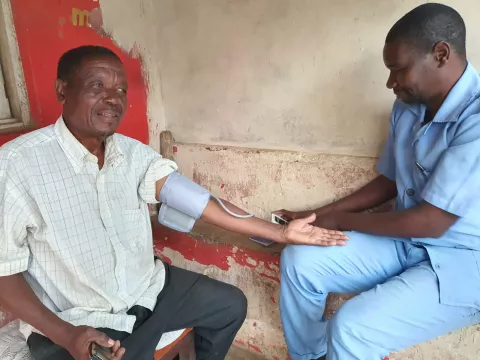
At Nathenje Health Centre, Golden Chizungu, a Health Surveillance Assistant is pleased with the number of people showing up to get the vaccine. He says things were slow in the beginning because there was a lot of misinformation around COVID-19 and COVID-19 vaccines.
“We engaged the communities about the pandemic, and the efficacy of the vaccine and more people started coming. After we ran out of vaccines in June, many people were worried about when they would get the next dose. Now that we have received another consignment, the turn-up is much better than before with some returning for their second dose and others getting the first dose,” explains Golden.

Maggie Nyamulani used to work for a family of five in Lilongwe. She cooked, cleaned and managed other chores commuting from her home 3 kilometres away. When COVID-19 hit, she was laid off as her daily commute put her and her employer at risk of COVID-19. This job was Maggie’s only source of income, so life has been tough.
“I just got the vaccine, and I encourage others to get it. As more people get the vaccine, our lives can return to normal so that I can get back to work and take care of my children,” says Maggie.