
How a birth certificate opened the door to support for Marethabile Ramolamu’s family
Across Lesotho, birth registration remains an important first step in ensuring that children are recognized and connected to essential services

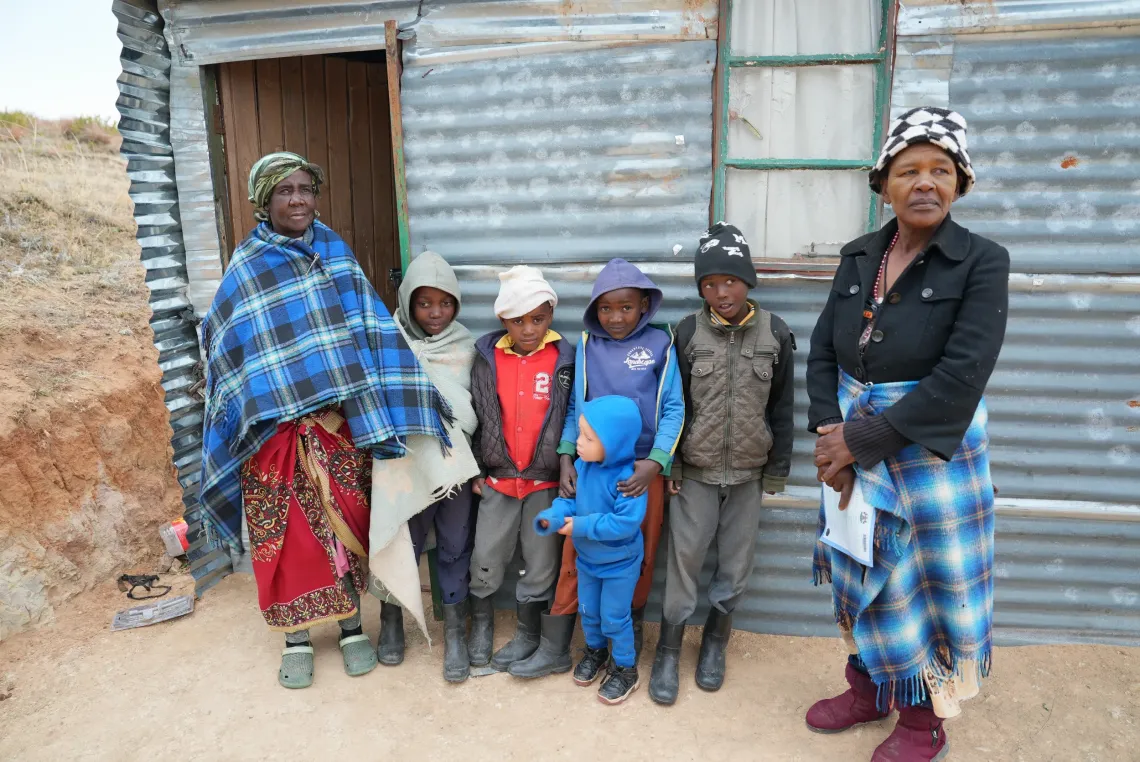
For Marethabile Ramolamu, a birth certificate is more than a piece of paper. It is what helped open the door to support, protection and opportunity for the children under her care.
Ramolamu is a grandmother of nine children, who depend on her for their daily care and wellbeing. Eight of the children currently receive child grant support, while one no longer qualifies because of age. In a household with many needs and limited resources, support has become an important lifeline, helping ensure that the children are fed, clothed and able to attend school.
“The social assistance is very helpful because I can buy them food, clothing and get anything they require from school,” she explains.
But before the children could access child grant support, they first needed legal identity documents. Without birth certificates, registering them for social assistance would have been difficult, delaying access to support intended to protect vulnerable children.
“These birth certificates have helped me a lot because it would not have been easy to register the children for social assistance,” says Ramolamu.
Across Lesotho, birth registration remains an important first step in ensuring that children are recognized and connected to essential services. A birth certificate gives children legal identity and helps enable access to education, health care and social protection programmes that support their survival, development and wellbeing.
In the past, obtaining birth certificates could be a lengthy and frustrating process, particularly for families living in remote rural communities. Registration systems relied heavily on physical paperwork that could easily be delayed, damaged or lost before reaching district offices for processing. Families often travelled long distances and waited extended periods before certificates could finally be issued.
Today, digital systems introduced through Ntlafatsa Bana are helping transform birth registration services and bringing legal identity closer to children and families.
At the National Civil Registry office in Quthing, Tholang Moloi says the shift from paper-based registration to digital data capturing has significantly improved efficiency and reduced delays in processing children’s information.
“At first, we used physical forms to capture details on newborns and children for birth registration, but we have now moved to digital data capturing,” says Moloi. “We now use tablets to capture data.”
The digital system allows information to be transmitted instantly for processing, reducing the risk of lost records and improving confidentiality.
“The digital way of doing things is faster,” Moloi explains. “We are no longer experiencing data that is lost. Other times, forms would get destroyed by rain. This way also ensures that data is kept private and confidential.”
For Ramolamu, the benefits of improved systems extend beyond birth registration alone. Digital mobile payments introduced through Ntlafatsa Bana are also helping vulnerable caregivers access child grant support more safely, efficiently and conveniently.
Before mobile payments were introduced, collecting grants often required travelling long distances to payment points, spending money on transport and waiting for hours in queues. The process placed additional financial pressure on already vulnerable households.
“There is a huge difference because before we had to incur transport costs,” Ramolamu recalls. “Sometimes I even had to borrow money, which I then had to repay from the children’s grant money.”
The journeys were not only costly, but also physically exhausting and sometimes unsafe for caregivers returning home with cash.
“We were incurring a lot of expenses at the time when we used to go physically to collect the grants, and even on returning, it was never safe,” she says.
Today, instead of preparing for long journeys to collect payments, Ramolamu waits for a notification on her phone confirming that the child grant money has arrived. The change has helped her save both time and money, while allowing her to focus more directly on the needs of the children.
“Things are now easy because the money comes through the mobile payment, and I can already start doing the necessary,” she explains.
Ntlafatsa Bana is a collaborative initiative of the Government of Lesotho the European Union and UNICEF. The programme aims to improve the wellbeing of children and families through integrated services including birth registration, nutrition, water, renewable energy and social protection.
Through the programme, 1,953 children have obtained birth certificates, while 25,575 households now receive child grant payments through digital cash transfers.
For caregivers like Marethabile Ramolamu, these integrated systems are helping ensure that vulnerable children are not left behind. From birth registration to child grant support, the programme is helping children gain recognition, protection and access to the services they need to grow, learn and thrive.

