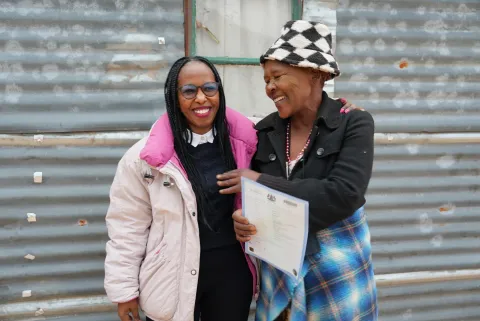
High-level delegation to visit Qhoasing Community Council to witness the impact of the Equitable Lesotho – Ntlafatsa Bana Project
Qhoasing, Mohale’s Hoek, 2 April 2025 – A high-profile delegation visited the Qhoasing Community Council today to witness the transformative impact of the Equitable Lesotho - Ntlafatsa Bana Project on the lives of children. The visit also marked the official launch of the digitization of birth registration services, a critical milestone in advancing child rights and social protection in Lesotho.
The delegation included the Hon. Pitso Lesaoana, Minister of Gender, Youth and Social Development; Hon. Lebona Lephema, Minister of Local Government, Chieftainship, Home Affairs, and Police; H.E. Paola Amadei, Ambassador of the European Union to Lesotho; and Mr. Deepak Bhaskaran, UNICEF Representative to Lesotho. Their visit underscored the strong partnership between the Government of Lesotho, the European Union, and UNICEF in promoting equitable access to essential services for children and families.
Since 2007, the Government of Lesotho, the European Union, and UNICEF have collaborated to strengthen Lesotho’s social protection system. This 20-year partnership has led to significant milestones, including the establishment of the Child Grants Programme (CGP), the development of the National Information System for Social Assistance (NISSA), and the institutional strengthening of the Ministry of Gender, Youth, and Social Development (MoGYSD). The CGP plays a crucial role in addressing child deprivation by ensuring access to essential services such as nutrition, water, child protection, and cash transfers for vulnerable households. Through these sustained efforts, the Ntlafatsa Bana Project continues to build on these foundations, expanding access to vital services and reinforcing social assistance programs across the country.
Hon. Pitso Lesaoana, Minister of Gender, Youth and Social Development, pledged to support and improve the implementation of the Ntlafatsa Bana programme, noting that the Project will conclude in 2026:
“Ntlafatsa Bana has come at the right time in the implementation of the National Social Protection Strategy whereby child poverty is one area that has to be tackled to improve child nutrition and access to services. It is a flagship project that integrates services for children to improve child wellbeing.”
During the visit, the delegation will engage with communities and observe key project interventions, including water rehabilitation efforts in Ha Tankele village, where community-led maintenance plans are ensuring sustainable access to clean water. The rehabilitation works include source protection, replacement of distribution pipes, and installation of standpipes to enhance water access. Additionally, the delegation will witness the impact of nutrition clubs, which support home gardens and nutrition education to improve food security for children and families.
A central highlight of the visit will be the transition from manual to digital birth registration, a key innovation under Ntlafatsa Bana. Qhoasing is among nine Community Councils benefiting from this initiative, which includes community outreach, training of Village Health Workers and Civil Registration officers, and the deployment of a newly developed digital birth registration application installed on tablets procured through project funding. The digitization of birth registration is a transformative step in ensuring that every child in Lesotho has a legal identity, granting them access to essential services such as healthcare, education, and social protection.
Hon. Lebona Lephema, Minister of Local Government, Chieftainship, Home Affairs, and Police, expressed his support for the digital birth registration system and the government's commitment to reaching marginalized communities:
“We are honored to officially roll out the use of digital birth registration system today, with a genuine commitment to extending support to the underprivileged and marginalized segments of our society. Concurrently, we recognize and embrace the strides in technology that have led to increased efficiency in the registration process using digital platforms. The significance of this milestone goes beyond mere recognition. Moreover, its impact is poised to ensure registration of more women and children, thereby empowering and protecting their rights and contributing to a more inclusive and empowered society.”
He also thanked the European Union and UNICEF Lesotho for their partnership in strengthening Civil Registration and Vital Statistics (CRVS) systems in Lesotho:
“We pay gratitude to the European Union and UN Development Partner, UNICEF Lesotho, for their support in strengthening CRVS systems in Lesotho and ensuring the achievement of the UN Legal Identity Agenda.”
In some communities in Lesotho, 2 out of 5 children do not have birth certificates, leaving them at risk of exclusion from fundamental rights and essential services. The absence of a birth certificate can limit access to healthcare, education, and social protection. The Digital Birth Registration system addresses this challenge by making the registration process faster, more efficient, and accessible—particularly in remote areas like Qhoasing. Furthermore, the integration of birth registration data with the National Information System for Social Assistance (NISSA) will strengthen service delivery for vulnerable children and families, reinforcing Lesotho’s social protection framework.
The European Union in Lesotho Ambassador Paola Amadei highlighted the role of technology in improving service access
“Technology allows the Government of Lesotho to improve access to services for their citizens and in particular for the most vulnerable among them. Not only does technology improve the process of birth registration, but also Ntlafatsa Bana allows a more efficient delivery of payments to vulnerable families—already households receive their children’s grants directly, avoiding the long journey to payment points and the efforts and risks involved.”
Speaking at the launch event, UNICEF Representative in Lesotho, Mr. Deepak Bhaskaran, emphasized the importance of the initiative:
“By enhancing access to essential services such as nutrition, clean water, energy, and birth registration, the Ntlafatsa Bana Project is ensuring that every child has the foundation to thrive. These investments not only safeguard their health and well-being but also empower them to reach their full potential, fostering a brighter future for Lesotho.”
Through these integrated interventions, the Equitable Lesotho - Ntlafatsa Bana Project is driving meaningful change, ensuring that children across Lesotho have the opportunities they deserve to thrive and reach their full potential.
Media contacts
About UNICEF
UNICEF promotes the rights and wellbeing of every child, in everything we do. Together with our partners, we work in 190 countries and territories to translate that commitment into practical action, focusing special effort on reaching the most vulnerable and excluded children, to the benefit of all children, everywhere.
For more information about UNICEF and its work for children, visit www.unicef.org.