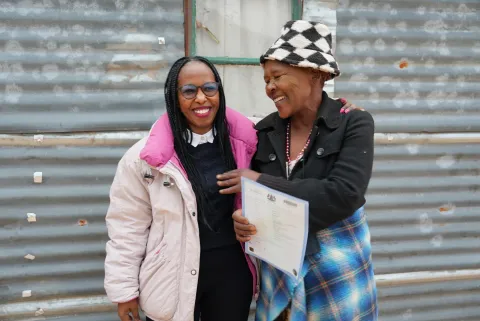
Energy for equity: Renewable solutions reach child grants programme families
Maseru, Lesotho — The Government of the Kingdom of Lesotho, with support from the European Union and UNICEF, has officially launched the Renewable Energy Component of the Ntlafatsa Bana programme, further strengthening social protection systems and improving the wellbeing of children under five.
Initial demonstrations conducted in Leribe and Thaba-Tseka engaged 161 households across 100 villages and four community councils. Families participated in hands-on demonstrations of three renewable energy options, including fixed solar home systems, clean energy cookstoves, and ultraclean biomass cookstoves. Following the demonstrations, households selected their preferred solutions based on their needs. Early results show that 59 percent selected fixed solar home systems, 29 percent chose clean energy cookstoves, and 11 percent opted for ultraclean biomass cookstoves. This demand-driven approach ensures that the intervention responds directly to household priorities while promoting sustainable and affordable energy access.
The energy component forms part of the broader Ntlafatsa Bana Cash Plus approach, which combines cash transfers with complementary services to address multiple deprivations affecting ultra-poor households. In addition to renewable energy, the programme improves access to safe water, nutrition services, birth registration, and strengthened social assistance systems. Other components of the programme are already underway across targeted districts, and the launch of the renewable energy component deepens the integrated support provided to vulnerable families.
The initiative builds on years of collaboration between the Government of Lesotho, the European Union, and UNICEF to strengthen national social protection systems. Since 2007, this partnership has supported the establishment and expansion of the Child Grants Programme and the development of the National Information System for Social Assistance and the Management Information System for Social Assistance. These systems improve targeting, reduce duplication, enhance transparency, and ensure more efficient and inclusive delivery of social assistance services. By embedding renewable energy within the Cash Plus framework, the Ntlafatsa Bana programme not only addresses immediate household needs but also reinforces long-term institutional capacity.
In the coming weeks, renewable energy demonstrations will expand to Quthing, Qacha’s Nek, and Mohale’s Hoek, alongside ongoing implementation in Leribe and Thaba-Tseka. The initiative will ultimately reach 1,000 Child Grants Programme households with children under five across nine community councils. This phased rollout reflects a coordinated national effort to ensure equitable access to clean, sustainable, and affordable energy solutions for vulnerable households.
Media contacts
About UNICEF
UNICEF promotes the rights and wellbeing of every child, in everything we do. Together with our partners, we work in 190 countries and territories to translate that commitment into practical action, focusing special effort on reaching the most vulnerable and excluded children, to the benefit of all children, everywhere.
For more information about UNICEF and its work for children, visit www.unicef.org.
Follow UNICEF on X, Facebook, Instagram and YouTube.
About MoGYSD
The Ministry of Gender, Youth, and Social Development, in collaboration with World Vision Lesotho and UNICEF Lesotho, is committed to the empowerment and protection of children’s rights, ensuring their voices are heard and their needs are met.
About EU
The European Union is an economic and political union of 27 European countries. It is founded on the values of respect for human dignity, freedom, democracy, equality, the rule of law and respect for human rights, including the rights of persons belonging to minorities. It acts globally to promote sustainable development of societies, environment, and economies, so that everyone can benefit. It has been a partner of Lesotho since 1976.
For more information about EU Delegation visit http://eeas.europa.eu/delegations/lesotho.
Follow the EU Delegation on Facebook and X.