

Sanaicar and the lost girls and boys in the Darien
Sanaicar is one of the 100 children unaccompanied that UNICEF received in La Casita, a project in partnership with Aldeas SOS to support and protect babies, children and adolescents who arrive in Panama
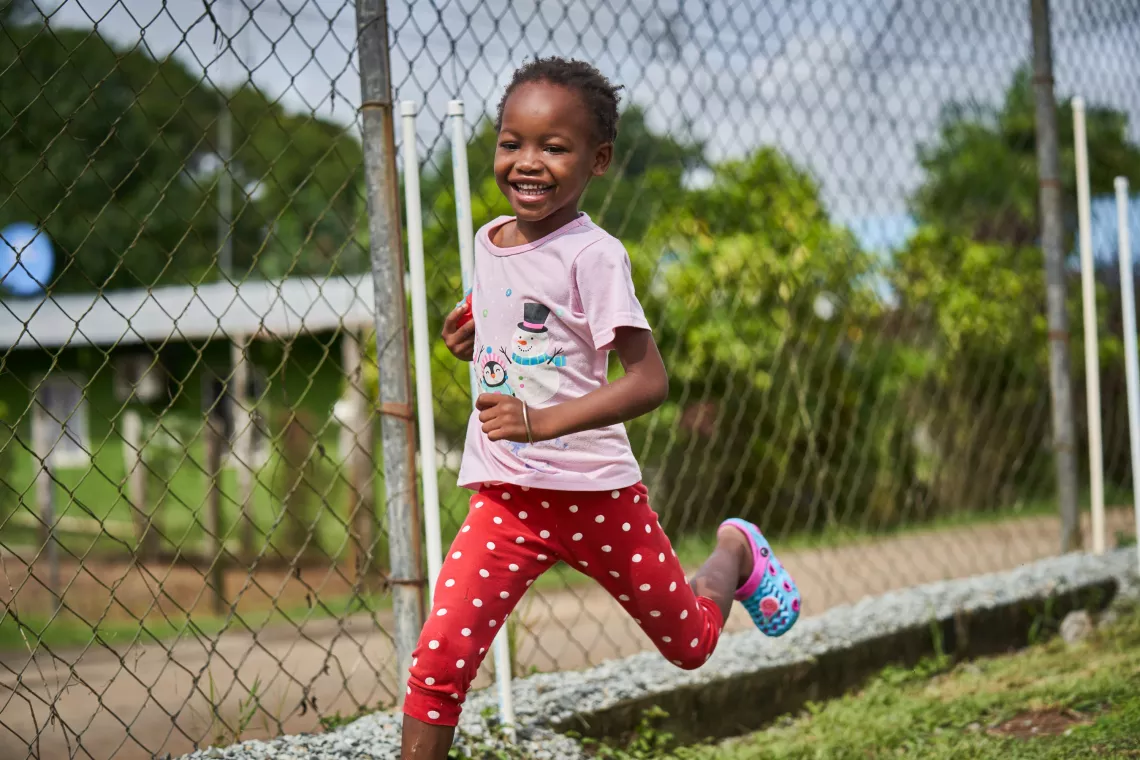
Kneeling on the floor of the doorway of a typical Panamanian countryside house - gabled roof, a yard, brightly colored walls - in the center of a border town, a five-year-old girl named Sanaicar tries to comfort a three-year-old, Franky, who cries with the strength of a jaguar.
- Don't cry - Sanaicar tells Franky, - Your mommy is coming to get you.
The place is nicknamed 'La Casita' and is located in Metetí, the town of reference in Darien, where two of the three Migrant Reception Stations (ERM) are also located, equipped to receive thousands of migrants who arrive in Panama after crossing one of the most dangerous migratory routes in the world: the Darién Gap, a dense jungle full of wild animals, criminal groups and stormy rivers that connect Colombia and Panama.
It is a Wednesday morning in October and, in addition to Sanaicar and Franky, in La Casita there are three more girls and a boy, an adolescent, a baby and three caregivers who feed, bathe and accompany them until their fathers or mothers, who have not yet left the jungle, arrive.
Like them, hundreds of thousands of children and adolescents travel on foot along a route where there are no roads and no laws. Despite the risks, in the last four years the number of migrants has multiplied by 15. In 2021, the flow reached an all-time high: UNICEF warned in October that nearly 19,000 children arrived in Panama through the jungle this year. That is about three times more than the number recorded during the previous five years combined.
There are those who don't make it because they died along the way. Those who do make it are survivors who carry with them a fragile state of health, a physical state of staggering vulnerability, and trauma from what they have seen and experienced. More than 150 children arrived without their parents during 2021, like Sanaicar, Franky and the others waiting at La Casita. Most of them, also like them, are children of Haitians whose parents became ill or suffered some injury or disability that prevented them from continuing to carry the children. So, they continue the journey in the care of someone else.
The first stop out of the jungle is one of the three ERMs where local authorities receive unaccompanied children, who are alone and painfully helpless. They used to wait for the older ones at the National Border Service (Senafront) barracks, along with minors in conflict with the law. Since July 2021, they have been coming to La Casita: a place that is a temporary home for girls like Sanaicar and boys like Franky.

"La Casita is a protective space where children can be temporarily placed and where they receive food, healthcare, and the care of a mothering caregiver, so they can wait for their parents to exit the jungle," says Diana Romero, UNICEF's Emergency Specialist in Panama. Romero explains that UNICEF has been advocating for two years for Darien to have child care protection measures, especially for migrant children: to have a place to put them, so they can be received in case they are separated from their parents in the jungle. Last year they made an alliance with Aldeas SOS and with governmental institutions in Panama to have La Casita, which opened in July 2021.
"We give them all the care and protection we can so that they are in a safe, quiet space that has everything they need," says Sheyla Reyes, the project coordinator. What they are looking for, in short, is: to provide protection, friendly, familiar treatment and care, so that they can be children after the frightening experience of crossing the jungle.
That is what Sanaicar is doing on this October morning, the girl of only five years of age but with the spirit of an adult, experienced in comforting sad children who miss their mothers: she plays, although far from the toy animals that frighten her like the actual ones she encountered in the jungle. Sanaicar's family has experience in leaving things behind: her mother left the devastated country of Haiti six years ago to look for a future in Chile, where Sanaicar was born. The future she was looking for never came, so she left the south heading north with her five and two-year old daughters.
But Sanaicar arrived alone on this side of Darien and came to La Casita, where she now says:
-I like to play soccer.
The air is mild, summer air, and in La Casita it feels like a weekend with friends. "Sanaicar is a born leader," says Arisela Gondola, the psychologist who treats the children who come to La Casita. It's not usual, adds Arisela: "In general, physically and emotionally, they come out of the jungle in very bad shape. They see dead people on the way, they are separated from their parents and they always have itchy skin, fungus on their feet, some lacerations, colds with horrible coughs and stomach problems. Here they recover while they wait.
Sanaicar no longer has any visible marks. She plays with two more children who speak the same language because they are the children of Haitian parents although they were born in Brazil: Franky and Nelsaisha, a shy four-year-old girl. In a few hours, the three will be reunited with their families, but they do not know it now, and Sanaicar runs as if there were no tomorrow behind a ball that she reaches with the ease of a professional player and only abandons it to say, with the certainty that only hope can give:
-My best friend is my sister, who is now with my mom a bit far away but she arrives today.

A few hours after this moment, Sanaicar finally met up with her mother Sabina, as did Franky and Nelsaisha, in a profoundly moving scene.
At noon, the mothers and fathers arrived desperately at the ERM asking for their children. The UNICEF field coordinator in Darien asked for their names and, after locating them, told them to stay calm, that their children were well cared for at La Casita and that they would be brought to them shortly. After two o'clock in the afternoon on that Wednesday in October, after days apart, it happened: Sanaicar, Franky and Nelsaisha ran to embrace their mothers and families in a corner of the ERM in San Vicente, Darien.

Nelsaisha's face lit up. She ran, hugged her mom and began to talk non-stop, abandoning the shyness she had maintained until minutes before.
"I was so worried about her.... I didn't know if she was okay, nothing," said Nelda, the 27-year-old mom, excited and happy after the reunion.
Nelda and her husband are Haitians who migrated to Brazil and then made their way to Mexico in search of "tranquility and stability". Exhausted and limping, with her feet swollen from bites, she recounted the atrocious experience of crossing the Darien Gap: "I have seen many people die while crossing the river, I was carried by the current and hit by a stone, I could no longer walk well," she said. Before arriving in Colombia, it was the police in Bolivia and Peru who forced them to hand over money. In the jungle, thieves stole their money and food.
Therefore, she said, "I ask people not to come, it is very difficult, very difficult. Horrible.

Next to her, Franky was jumping and smiling with his family, also Haitians who migrated first to Brazil and then to the United States. After the earthquake in Haiti in 2010, many like them left for Brazil and Chile. But the economic effects of the quarantines in those countries made them resume their journey across the continent.
"I always had the idea of leaving Chile," said Sabina, Sanaicar's 32-year-old mother. A cousin in Haiti explained to me that if I took the road I would have better opportunities, so I decided to walk with my cousin."
In Chile, Sabina was unable to make ends meet or find steady work. She also had no help to take care of her two daughters, after their father abandoned them. So she decided to leave. On September 13, she embarked on a dangerous journey of more than 7,560 kilometers to the United States, with the hope of finding a job and that her daughters could go to school. She arrived in Colombia almost a month later, on October 7, and after more than ten days of walking, she crossed the Panamanian border....
"Chile is not bad, it just wasn't enough to support and care for the girls," Sabina said. The road was more difficult than she imagined: "I had to carry the two-year-old baby to cross a river and I could not carry Sanaicar too, so I waited and when I saw a couple without children, I asked them for help with her. The man said yes, he crossed her but I was going slower and we lost track of each other."
After a few days apart, they finally found each other. Sanaicar waited for her mother and her sister, who is also her best friend, in the loving company of caregivers and other children at La Casita. Before boarding a bus to continue her migrant journey, she looked at Franky, who was no longer crying, and said:
- See? Your mom was going to come!
UNICEF has been providing services in the Darien to ensure access to safe drinking water, hygiene and sanitation, training and delivery of menstrual hygiene kits, maternal and child health, protection against all forms of violence and psychosocial support, with recreational activities and child development in Child Friendly Spaces for the last 3 years thanks to funds from the United States Government. The European Union has recently joined this effort.