The Invisible Toll: New Study Calls for Timely, Predictable Funding to Protect Kenya’s Children
The Government of Kenya launches The Invisible Toll: Rising Debt, Shrinking Aid and Kenya’s Children, alongside the Annual Public Debt Management Report 2025/26
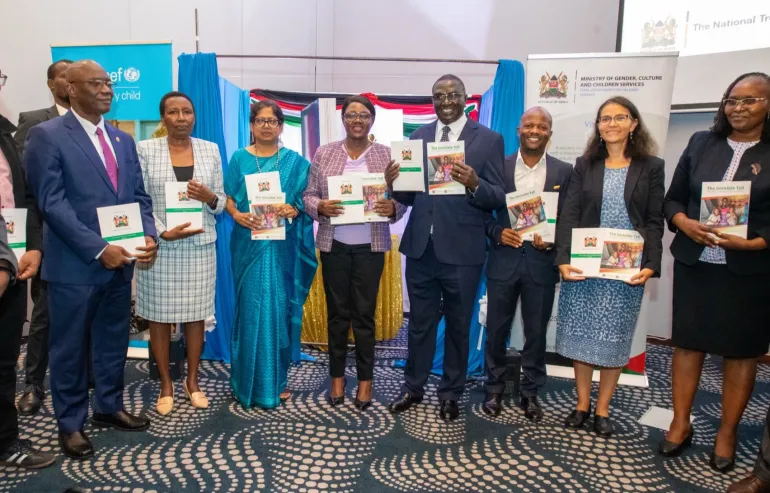
Nairobi, 25 November 2026 – Today, the National Treasury and the State Department for Children Services, in partnership with UNICEF, launched The Invisible Toll: Rising Debt, Shrinking Aid and Kenya’s Children, that shows how rising debt, shrinking aid and economic pressures can delay or disrupt crucial services for children. The study recommends timely release of funds, a guaranteed minimum level of spending on children and stronger oversight to keep those services on track. The report was launched alongside the Annual Public Debt Management Report 2025/26.
The study examines health and social protection, tracing public money from borrowing and revenue decisions, through cash releases and budget execution, to health facilities and households. It finds that budgets protect children when funds are released on time and spent as planned. According to the report, debt service absorbed more than half of ordinary revenue in the 2024/25 Financial Year. Net official development assistance fell from nearly USD 4.0 billion in 2020 to about USD 2.6 billion in 2023, while tax revenue stood at around 14–15 per cent of Gross Domestic Product. Despite these constraints, the Government now finances about 90 per cent of the health budget from domestic resources and has sustained cash transfers to vulnerable households through the Inua Jamii National Safety Net Programme.
“The study and its launch carry forward a message delivered by H.E. President William Samoei Ruto on 22 September 2026 at the UNICEF High-Level Dialogue on Debt, Development and the Next Generation in New York: that debt is not only an economic issue, but also a development, equity and children’s issue. Kenya will honour its obligations, and we will protect our children. These are not competing commitments; they are two sides of responsible fiscal management. A budget’s value lies in what reaches the frontline, on time. The National Treasury will strengthen cash management, budget execution and the quality of borrowing, and we will draw on these findings in the 2027 Budget Policy Statement, so that every shilling delivers for Kenya’s children today and for the generations who will inherit our decisions,” said Hon John Mbadi Ng’ongo, Cabinet Secretary, The National Treasury and Economic Planning.
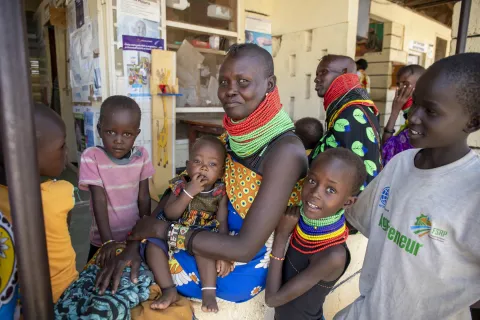
The report finds that the impact on children stems less from budget cuts than from the timing of fund releases. In the 2024/25 Financial Year, releases to counties were uneven, with delays, often exceeding six months, reported by more than 70 per cent of sampled health facilities, 68 per cent of pre-primary units and about half of sampled nutrition units. Children make up more than two in five Kenyans, about 22 million, and more than half experienced multidimensional poverty in 2022. Recent gains, including a rise in facility births from 61 to 88 per cent and a fall in stunting from 26 to 18 per cent between 2014 and 2022, face risks: infant immunization coverage declined from 82.7 to 73.3 per cent between 2021 and 2025, only about one in ten children receives a child cash benefit, and the KES 2,000 Inua Jamii transfer has not kept pace with the cost of living. Children in poorer households, arid and semi-arid counties, informal settlements and refugee-hosting areas are most affected by delays.
“Children do not sit at the table where fiscal decisions are made, yet they live longest with the consequences. This study brings their interests into those decisions. With predictable releases, reliable social assistance and protected funding for child-critical services, today’s fiscal choices can widen children’s futures rather than narrow them. Together with the National Treasury, county governments and partners, we will take forward child budget tagging and turn this evidence into results for every child, starting with those furthest behind,” said CPA Carren Achieng Ageng’o, Principal Secretary, State Department for Children Services.
The study sets out options for the 2027 Budget Policy Statement and the 2027/28 Financial Year budget. It proposes quarterly minimum cash releases for child-critical services at national and county levels, and a costed spending floor for immunization, nutrition, pre-primary and primary education, water and sanitation, child protection and social assistance. It also recommends child budget tagging in the Integrated Financial Management Information System (IFMIS), an annual child budget statement, and timely Cash Transfer for Orphans and Vulnerable Children payments that keep their real value. To support the transition from aid, it calls for costed domestic financing plans and timely clearance of service-related arrears, alongside child-sensitive debt decisions, including stronger project readiness and transparent debt-for-development mechanisms such as debt swaps.
“Children experience fiscal policy not as a budget line, but as a vaccine given on time, a meal served, a safe classroom and a cash transfer that arrives when it is needed most. By launching this study alongside its debt report, Kenya is showing real leadership in looking at public debt through the eyes of its children. As part of the UN family, UNICEF is proud to support this nationally owned agenda. Together, let us make the 2027/28 Financial Year budget, one that can be followed, shilling by shilling, all the way to the child. Every child counted. Every shilling tracked. Every service delivered,” said Dr. Shaheen Nilofer, UNICEF Representative to Kenya.
Read the full study to learn more: https://www.unicef.org/kenya/reports/invisible-toll
Media contacts
About the National Treasury
The National Treasury and Economic Planning is the Government of Kenya ministry that formulates financial and economic policies and oversees the effective coordination of Government financial operations. Its mandate, derived primarily from the Public Finance Management Act, 2012, covers economic policy management, formulation of the national budget, resource mobilization, public debt management through the Public Debt Management Office, and oversight of national and county government financial management systems.
For more information about the National Treasury and its work, visit: www.treasury.go.ke.
Follow: X (KeTreasury) and Facebook (The National Treasury and Economic Planning)
About UNICEF
UNICEF works in some of the world’s toughest places to reach the world’s most disadvantaged children. Across more than 190 countries and territories, we work for every child, everywhere, to build a better world for everyone.
For more information about UNICEF and its work for children, visit www.unicef.org.