From Chalkboards to Dashboards
Building a Brighter Future for Every Child

Imagine a school where teachers spend less time on administrative tasks and more time doing what they do best, which is to teach and inspire their students. A school where parents are better able to support their children's learning, where principals make decisions using real-time information, and where every child has access to the tools and opportunities needed to succeed in a rapidly changing digital world.
This vision is not far-fetched as it lies at the very heart of Jamaica's digital transformation journey.
Over the past several years, the Government of Jamaica, working with the United Nations, European Union and other development partners, has been investing in a new model for education through the United Nations Sustainable Development Goals (SDG) Joint Programme on Digital Transformation for Education. With the Programme now entering its final year, a key question that comes into sharper focus is what tangible changes will define its success for its intended beneficiaries?
The answer begins with children.
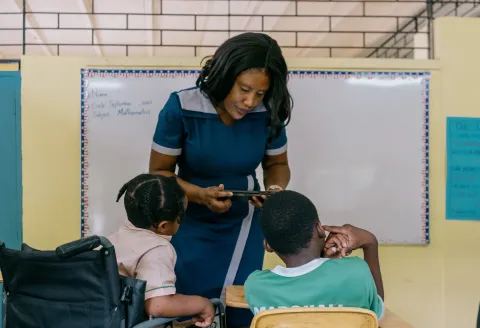
For students, a digitally transformed school is not simply a classroom equipped with computers. It is an environment that makes learning more engaging, accessible and responsive to individual needs. Digital platforms help identify learning gaps early and connect students to additional support before they fall behind.
For a child in rural Jamaica, digital tools can expand access to the same quality resources that are available in urban areas. For a child struggling with a specific subject, digital platforms provide additional resources to practice and learn at their own pace. For all students, digital literacy therefore becomes an accessible and essential skill that prepares them for a rapidly changing world.
The benefits extend equally to teachers.
Across the world, educators are being asked to do more with limited time and resources. A digitally transformed school can help reduce administrative burdens, equip teachers with relevant skills and give them better tools to support students. Access to digital content, training opportunities in the use of ICT and AI tools and modern learning platforms allow teachers to enhance lesson delivery and adapt instruction to individual learning needs.
Technological innovation should be used ethically and viewed as a tool that supports and strengthens teachers’ work, rather than as a substitute for their expertise, judgment, and human connection. This is evidently so in the most successful education systems globally.
Parents also stand to benefit significantly from this transformation.
Digital systems can strengthen communication between schools and families, enabling parents to play a more active role in their children's education. When schools and families are connected, students benefit through improved academic performance, attendance and well-being.
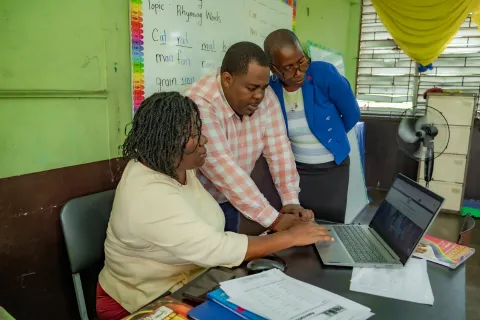
For principals and school administrators, digital transformation can unlock an entirely new level of efficiency and effectiveness.
Through the programme, school leaders will have access to reliable real-time information on attendance, teacher management and deployment, performance, resource needs and operational challenges at their fingertips. This will enable them to respond quickly to emerging issues and make informed decisions based on evidence.
This is where the concept of "dashboards" becomes particularly significant.
A dashboard is a tool that helps leaders understand what is happening across the school, identify challenges early and direct resources where they will have the greatest impact. Better information leads to better decisions. Better decisions lead to better outcomes for children.
This transformation reflects the integrated approach at the heart of the SDG Joint Programme. Working alongside the Ministry of Education, Skills, Youth and Information, UNICEF, UNESCO, the World Food Programme (WFP) and the Food and Agriculture Organization (FAO), with oversight from the UN Resident Coordinator's Office, are supporting the strengthening of the education management information system (EMIS) and the development of a connected digital education ecosystem. Spanning digital learning, digital schools, effective teacher management and deployment, school feeding and nutrition, food systems and data standards and governance, the Programme is bringing together the systems that shape teaching and children's learning and well-being, enabling more informed decision-making and more responsive services that help improve outcomes for every child.
Digitally transformed schools can support more efficient school feeding programmes, strengthen accountability and improve coordination between schools, ministries and communities. Integrated systems can help ensure that resources reach students and teachers more effectively while providing policymakers with the information needed to plan.
Importantly, these improvements are not intended to benefit only a handful of schools. The fifty-four selected schools supported through the Joint Programme are designed to pilot and demonstrate what is possible when innovative solutions are implemented together in a real-world setting. Their experiences will help identify effective approaches for expansion across the education system.
Jamaica's future prosperity will increasingly depend on a generation equipped with the skills, knowledge and confidence to thrive in a digital economy. The education system has a critical role to play in preparing young people for opportunities that may not even exist today.
Digital transformation has become a national development imperative with education serving as one of its most important foundations. Success will ultimately be measured by the impact on children’s learning, wellbeing and future opportunities rather than by technologies deployed.
The future we are working toward is one in which technology serves people, where innovation advances inclusion and where every child, regardless of background or geography, has the opportunity to learn, grow and achieve their full potential.
The journey from chalkboards to dashboards is about building schools that are ready for the future and creating opportunities that will benefit Jamaica's children for generations to come.