

2022 UNICEF Iraq’s Humanitarian Appeals
Funding to support displaced, returnee and refugee population in Iraq

Donate to UNICEF this Ramadan and help us reach the most vulnerable children
Overview
In 2022, UNICEF is requesting US$52.2 million to meet the critical and acute humanitarian needs of vulnerable Iraqi children and families affected by a combination of humanitarian situations, including protracted crisis due to conflict, political instability and the COVID-19 pandemic. As protection is central to UNICEF’s humanitarian action, the child protection response is the largest component of the country’s appeal at 41 per cent, followed by education and WASH.
Additionally, UNICEF Iraq needs US$ 11.7 million to address critical needs of Syrian refugee children and their families in Iraq residing in camps and host communities by provision of critical, health and nutrition, WASH, child protection and education services.
In 2022, there is a significant funding gap of nearly 70 per cent to support UNICEF’s humanitarian response, which will have a huge impact on programme delivery, unless new funds are received. Given the criticality of the situation, continuing this support is crucial to ensure the well-being of the IDP and returnee communities and refugees.

CHILD PROTECTION
Over 650,000 children are in need of child protection and gender-based violence support due to displacement. Stress, fear and anxiety, along with child labour and violence, abuse or neglect within the household are major child protection concerns.
UNICEF aims to continue to work with Government and NGO partners to deliver both group and individualized age-appropriate and structured mental health and psychosocial support (MHPSS) services to enhance children and adolescents’ resilience and capacity to address stressors related to violence, displacement, loss and family separation. The overall 2022 target for children and caregivers accessing MHPSS is 59,540, while the target for gender-based violence prevention, risk mitigation and response services is 81,344 (in addition to 10,000 and 3,500 Syrian refugee children respectively).
Specialized child protection and case management services as well as civil birth registration and civil documentation, are dependent on adequate support from funding partners. Without support from donors, UNICEF cannot continue to provide these important services to vulnerable children and women, nor can it continue to strengthen the skills and knowledge of parents and caregivers on the prevention of violence against children through parenting education programmes, awareness-raising campaigns, and safe channels to report sexual exploitation and abuse.

EDUCATION
UNICEF has envisioned an education emergency response that provides access to formal or non-formal education - including early learning; individual learning materials to children; skills development programmes for children/adolescents – and ensures that schools are implementing safe school protocols (infection prevention and control). UNICEF also works to enhance both access and quality of education through training of teachers, School Management Committee members and Parent-Teacher Association members in host community, IDP and refugee schools.
In 2021, access to formal and non-formal education was ensured for 60 per cent of the planned target. UNICEF and partners have been enabling IDP and refugee students to access improved classrooms and WASH facilities through light rehabilitation works and installation of prefabricated classrooms, including refugees, IDPs and host community students. The continued implementation of these activities in other at-risk areas is threatened by the funding gaps. Classroom furniture – including desks, whiteboards and educational supplies –cannot be distributed to schools without adequate support. For 2022, UNICEF plans to enable 447,786 children to access formal or non-formal education, in addition to 39,000 Syrian refugee children.
HEALTH & NUTRITION
Iraq’s health sector has suffered enormously from decades of conflict, low public sector financing, old and inadequate infrastructure, fragmented service delivery and weak governance, all resulting in low trust of public health services. COVID-19 has exacerbated these issues.
HEALTH
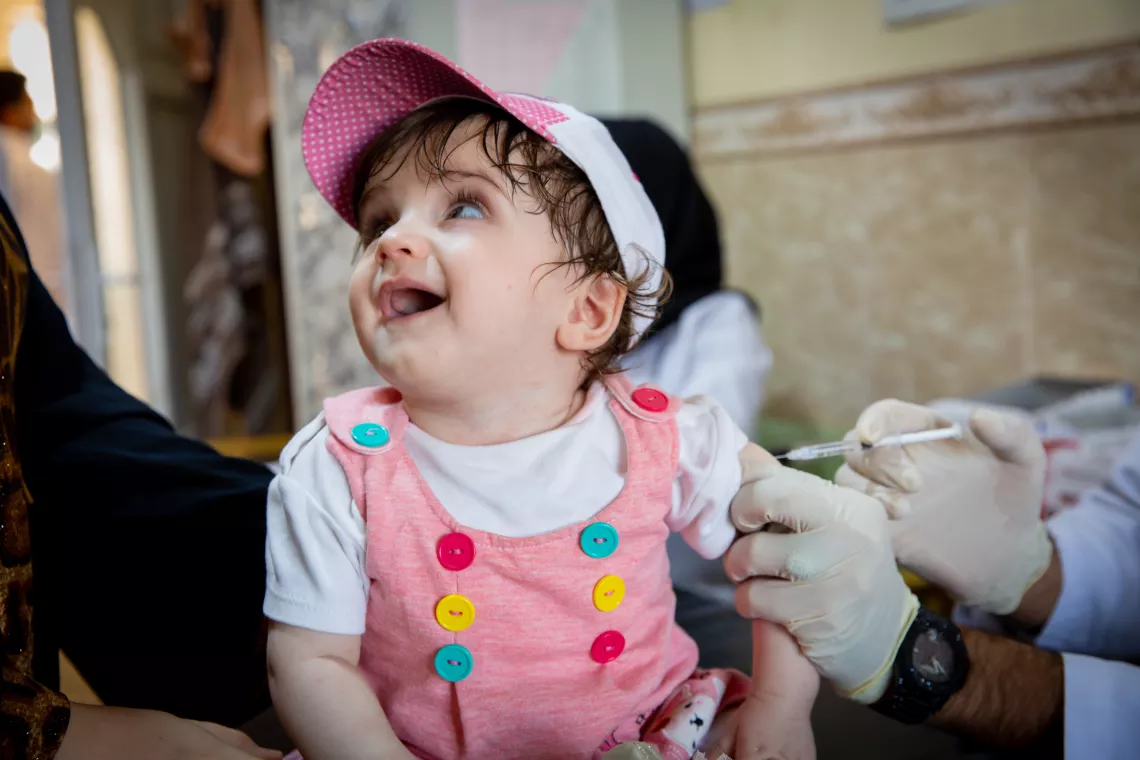
UNICEF supports the implementation of a “continuity of care” plan for immunization, nutrition and maternal and newborn health within the context of COVID-19. Without the support from our donors, UNICEF cannot continue to provide children and women with proper child health, ante-natal and post-natal services and counselling in UNICEF-supported facilities.
To reduce morbidity and mortality amongst vulnerable children, UNICEF provides immunization services and vitamin A supplementation. In 2022, UNICEF plans to reach 332,100 children, in addition to 33,669 Syrian refugee children, with vaccination against polio and other routine immunization activities (Bacille Calmette–Guérin (BCG), measles or measles, mumps, and rubella (MMR). In 2021, 86 per cent of the planned target was reached; funding support is needed if UNICEF is to fulfil its commitments towards the IDP and refugee population.
Within the framework of the COVID-19 pandemic response, UNICEF has remained the main partner on procurement and distribution of personal protective equipment (PPE) and on orientation of health personnel on its use. UNICEF is also the global partner for procurement of vaccines through the COVAX Facility, including AstraZeneca vaccine distributed in humanitarian programme locations in Iraq. UNICEF also works with local authorities to train health personnel on the handling and administration of this new vaccine, on risk communication and community engagement related to COVID-19 and the vaccines and provides equipment for vaccine storage and logistics to ensure vaccine safety. Thousands of healthcare workers are to be reached in 2022 with training in infection prevention and control, pending financial support.
NUTRITION
To reduce cases of severe and moderate acute malnutrition amongst vulnerable children and support their mothers in IDP camps, UNICEF provides home-based visiting of new-born babies and their mothers; breastfeeding and counselling of mothers on appropriate infant and young child feeding (IYCF) and growth monitoring of children aged below five years. In 2022, UNICEF plans to reach 369,000 primary caregivers in and outside the camps with IYCF counselling, in addition to 5,642 Syrian refugees. In 2021, due to funding constraints UNICEF only reached 17.5 per cent of the planned target. IYCF counselling is under threat if adequate funding is not received.

WASH
In 2021, the Government of Iraq continued to close IDP camps and large informal displacement sites. Based on the 2021 Multi-Cluster Needs Assessment (MCNA), around 182,000 individuals remain displaced in camps in the Kurdistan Region, while around 450,000 are displaced in out-of-camp settings. Deteriorating infrastructure and insufficient investment in improvements in many camps, overburdened services in out-of-camp locations, and damaged infrastructure and slow reconstruction in return areas have resulted in reduced access to services as well as lower quality services.
To reduce exposure to waterborne disease, UNICEF has been working to provide access to safe drinking water in camps across the country. Without funding support, access to safe drinking water cannot continue to be provided, which is normally guaranteed by UNICEF through emergency water trucking services, operation and maintenance of water systems, and provision of water purification materials along with Water Quality Monitoring (WQM). Due to funding gaps, in 2021, only 55 per cent of the planned target was reached. In 2022, UNICEF plans to provide 449,300 individuals (in addition to 75,523 Syrian refugees) with access to safe, drinking water, pending financial support.
UNICEF has also been providing IDPs and refugees with access to safe sanitation through operation and maintenance of the existing sanitation systems, latrines, desludging as well as through solid waste management. In 2021, only 50 per cent of the target population was reached, due to shortage of funding. In 2022, UNICEF plans to reach 206,000 individuals (in addition to 49,064 Syrian refugees) with appropriately designed and managed latrines. The continuation of these activities severely depends on the receipt of funds.
Within the context of the UNICEF COVID-19 response, UNICEF also engages with refugees, IDPs and returnees through hygiene promotion interventions and awareness raising activities on COVID-19 Infection Prevention and Control and personal hygiene, including Menstrual Hygiene Management (MHM). At the beginning of 2022, funding is urgently required if UNICEF is to fulfil its WASH commitments to refugees and IDPs.