Tinkering with Tech: Equipping children with AI literacy
Giving students, especially girls, and teachers the tools to explore AI and technology, identifying real problems and testing probable solutions.

Ask a child what artificial intelligence (AI) can do, and they may picture a chatbot on a screen. Ask them to build something instead, a device that helps a plant survive harsh conditions, an alarm that warns a community when heavy rains threaten to flood their school, and AI stops being something they only use. It becomes something they made, tested, got wrong, and made better. That shift, from user to builder, is what AI literacy means for a child.
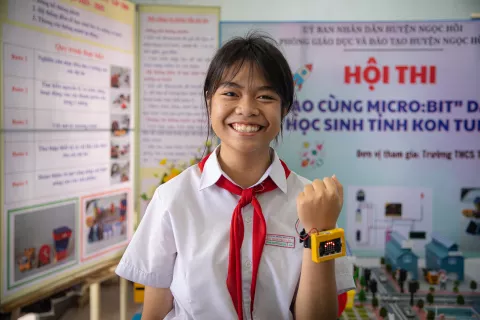
Tinkering with Tech and AI is a hands-on initiative that gives students, especially girls, and teachers the tools to explore AI and technology, identifying real problems and testing probable solutions.
Enabling this creativity, is a simple device like micro:bit, that children can programme to respond to movement, light, temperature, touch or sound. As Tinkering with Tech expands beyond its founding cohort, the model adapts to context. In Uzbekistan, students are building with Raspberry Pi, while in Ukraine, where remote learning is often the reality, the approach may use no device at all.
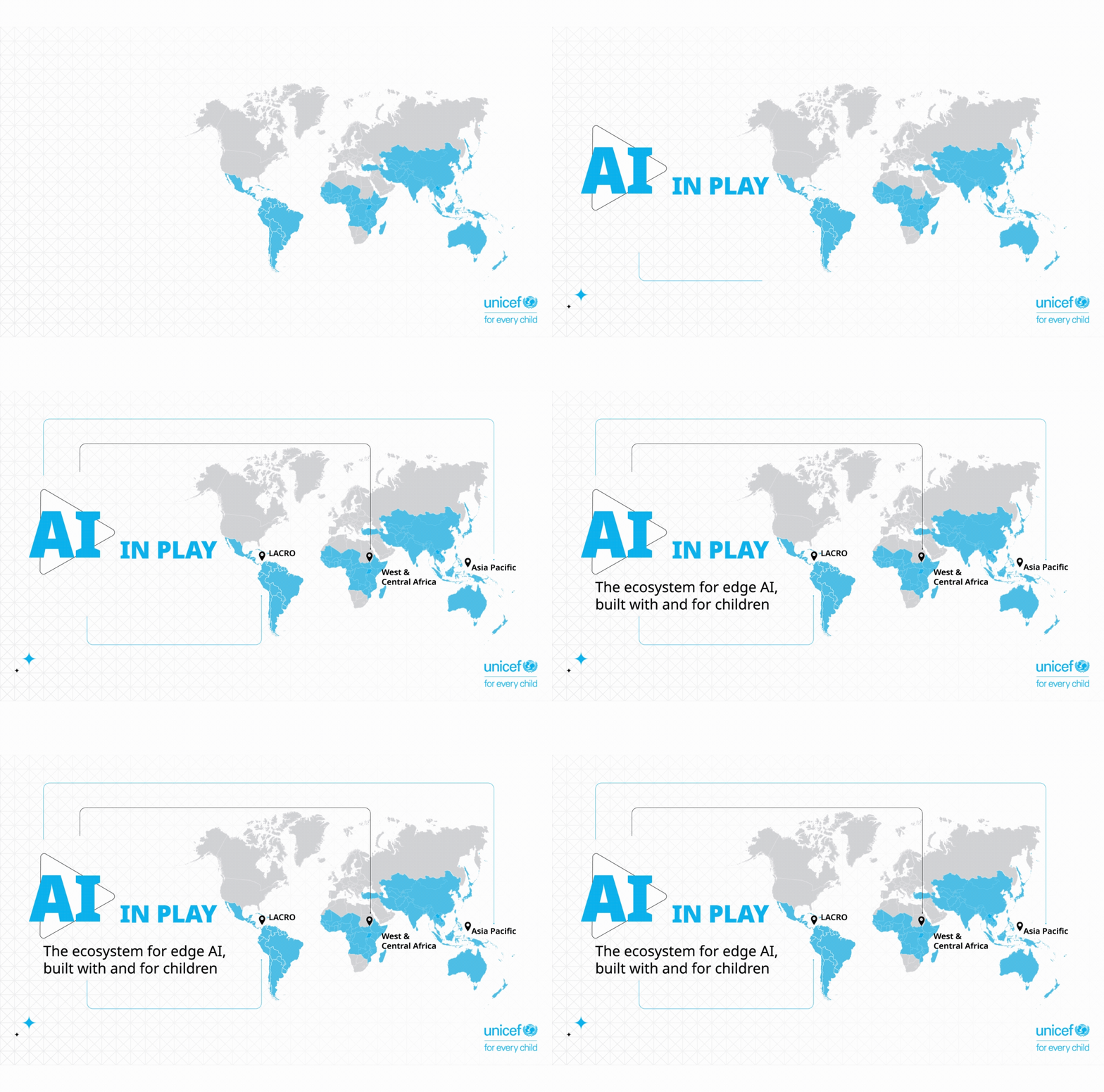
Tinkering with Tech is one of the working models within AI in Play, UNICEF's ecosystem for responsible AI, co-founded with Arm. Where the ecosystem's solutions do run on hardware, they're built on edge AI: technology that runs directly on a device rather than depending on a constant, fast internet connection, so it can reach classrooms and communities the cloud doesn't. Every solution, device-based or not, is safe by design and equitable by default.
The results speak for themselves. Across the first cohort of countries; Honduras, the Maldives, Montenegro and Viet Nam, students are gaining the future-proof skills to thrive as technology evolves: sharper problem-solving and creativity, alongside newfound confidence and a genuine enjoyment of learning through play. Teachers, too, are discovering new ways of working alongside their students.
In Montenegro, about 16 percent of 9–10-year-olds are coding, creating and problem-solving with micro: bits in just one academic year, turning AI literacy into a hands-on, everyday skill.
Tinkering with Tech is delivered by UNICEF with the Micro: bit Educational Foundation and the Raspberry Pi Foundation, backed by Arm and the Ministry for Foreign Affairs of Finland. It is expanding beyond its founding cohort into Lao PDR, Ukraine and Uzbekistan, proof that every child, wherever they live, can develop digital and AI literacy in a way that is safe, responsible and genuinely their own.