Investing in Building a Transdisciplinary Future
How possibility-led collaborations are discovering new and emerging approaches to innovating for children.

This thought piece is authored by Tanya Accone, Senior Advisor on Innovation, UNICEF and Professor Janice Limson, Director, Biotechnology Innovation Centre, Rhodes University.
When we reflect on the world’s most pressing challenges, one thing becomes clear: they cannot be solved in isolation. Issues like climate change, inequities in education and health, and the need for sustainable development require solutions that transcend traditional boundaries. To meet these demands, we need approaches that unite diverse perspectives and expertise.
Bridging Gaps
Transdisciplinarity brings together a broad spectrum of knowledge, breaking down silos between disciplines and fostering collaboration across sectors. For us, this means creating solutions that integrate insights from the natural sciences, humanities, policymakers, and even youth and community leaders. It’s not just about combining knowledge—it’s about working together to address challenges in meaningful, practical ways.
We’ve witnessed how transdisciplinary collaboration can drive transformative change. UNICEF’s Innovation Nodes exemplify this approach by creating spaces where diverse expertise and methodologies converge to co-create scalable solutions. Through these Nodes, we’re shaping a future where innovation is no longer limited by disciplinary boundaries.
The Butterfly Effect in Action
It started with a simple idea: bring research out of the lab and into communities where it can make a real difference. In 2023, at SXSW Sydney, UNICEF partnered with the Rhodes University Biotechnology Innovation Centre (RUBIC) to champion this vision. Public support secured us a spot at the event, but that was just the beginning.
We connected with people eager to act, not just listen. These conversations led to collaborations with academics from the University of Technology Sydney’s TD School, soon joined by the University of Pretoria. With resources aligned and a shared purpose, we convened at Rhodes University in Makhanda, South Africa, for a multi-day workshop. What began as a series of discussions quickly grew into actionable plans, including student exchanges, new educational modules, and strategies for using transdisciplinary methods to address real-world challenges.
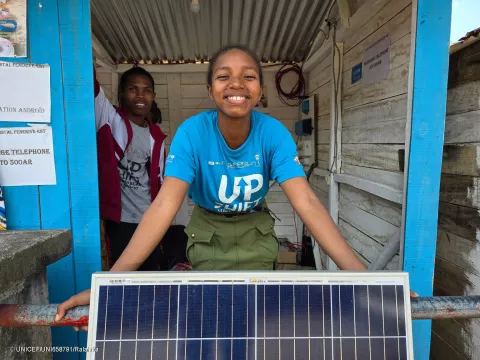
One critical issue tackled by an Innovation Node is energy availability. With 745 million people worldwide lacking basic access to electricity, the collaboration focused on renewable energy technologies. Insights from this work informed decisions by multiple UN entities to adopt thin-film solar solutions, enabling field operations in extreme environments across several countries.
These moments embody the essence of Innovation Nodes. They don’t just encourage collaboration; they ignite fresh thinking and build bridges across sectors to drive lasting social impact.

Measuring the Immeasurable
The impact of Innovation Nodes isn’t always immediately quantifiable. While tangible outcomes—like a 16 per cent improvement in cost efficiency over the past three years—offer one measure of success, the true value lies in ripple effects: sparking new collaborations, influencing better policies, and shifting mindsets.
To capture these outcomes, we’ve developed a model that goes beyond traditional metrics, emphasizing both direct results and second-order effects. These include inspiring innovative approaches, amplifying community voices in research, and embedding youth engagement into science-policy dialogues.
Beyond Numbers: The Node Effect
What would we lose without the Innovation Nodes? This is a question we often ask. Without these transdisciplinary spaces, we might not have achieved the insight products, youth engagement platforms, or collaborative initiatives now making an impact globally.
Through the Nodes, UNICEF has strengthened its presence in global science, technology, and innovation (STI) discussions. These collaborations have informed key global dialogues, such as the UN Pact for the Future, the Science, Technology and Innovation Forum, and Science20 (S20), which bridges conversations between scientists and policymakers in G20 countries. The Nodes have also showcased best practices through the UN Innovation Toolkit and high-profile events like SXSW and the LinkedIn Talent Connect Summit.
Transdisciplinarity: A Challenging but Transformative Path
The challenges we face today are too complex for any single discipline to solve. By blending insights from science, humanities, policymaking, and community voices, we create holistic solutions that reflect diverse perspectives. This approach values contributions from those often excluded from traditional research—such as youth, women, and local leaders.
Transdisciplinary work isn’t without its challenges. It requires patience, trust, and a commitment to breaking down silos. But it’s also where true breakthroughs happen. For example, RUBIC earned community trust in a water-scarce region by involving local voices in shaping water quality monitoring. Citizens influenced everything from testing schedules to facility design, creating a model of science shaped by the people it serves

What We’ve Learned
Since 2022, we’ve established 11 Innovation Nodes across seven focus areas, co-producing reports, briefs, and case studies—with more to come.
Through this journey, we’ve learned several invaluable lessons:
- We can contribute to global agendas. Innovation Nodes turn high-level commitments, like the UN Pact for the Future and Open Science, into tangible outcomes by creating pathways for action.
- We can optimize for value creation. The Nodes expand impact by exploring less traditional channels, such as research-based innovation and new research and development pathways.
- We must embrace the unknown. Transdisciplinary work is inherently experimental, often leading to discoveries that transform how we address global challenges for every child.
Today’s interconnected challenges demand urgent, collaborative action. The Innovation Nodes show what’s possible when diverse ideas intersect, and partnerships thrive across disciplines.
As we look ahead, we remain optimistic. Every conversation—whether at SXSW, in a community workshop, or on a global stage—is an opportunity to break down boundaries and spark transformative ideas. Together, we can continue unlocking innovations to tackle our most pressing challenges.
The future is transdisciplinary, and we’re excited to continue this journey with those who share our vision for a sustainable, equitable world.