A growing movement of game changers
Young people around the world are creating video games, and in the process, building skills, confidence, and ambition

Have you ever experienced the excitement of video gaming? A world to explore, a challenge to solve, a feeling of joy and possibility. For millions of young people, it is not just entertainment, it’s a learning experience.
Across hundreds of classrooms around the world, the UNICEF Game Changers Coalition (GCC) equips young people with Science, Technology, Engineering, Arts, and Mathematics (STEAM) and digital skills through video game development to be architects of a safe, secure and equitable digital future.
“I didn’t imagine entering the world of technology,” says Florismar da Silva Bezerra, 19, from Brazil. “The UNICEF Game Jam opened my mind. I saw that this is really what I want for myself.” In just 48 hours of collaborative game-making, Flor discovered the confidence to see herself as a future computer scientist and someone who could inspire other girls to follow. “I realised I am capable. I can do it,” she says.
20,000 video games and counting
At the heart of the UNICEF Game Changers Coalition is a simple yet radical idea: young people, including girls, should be able to shape the technologies that shape their lives.
In 2025 alone, young creators developed more than 20,000 original video games through the GCC curriculum. Each one is more than a technical exercise. Together, they form a portrait of a generation - exploring climate action, social justice, identity and community, and the realities of growing up in the 21st century through interactive storytelling.


A model moving into public systems
What began as a pilot in 2023 has evolved into a model designed for scale.
Since its inception, GCC has reached over 642,000 young people, 52 per cent of which were girls, as well as parents and teachers across eight countries: Armenia, Brazil, Cambodia, India, Kazakhstan, Malaysia, Morocco and South Africa. Nearly three-quarters of that growth happened in 2025 alone, marking a sharp acceleration and signalling a transition from early testing to system-level adoption.
The shift is increasingly visible as the model is embedded into public systems, with a new generation of girls gaining equal access to advanced digital skills alongside their male peers.
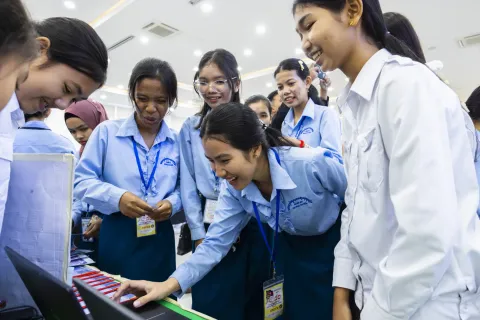
In Brazil, the GCC curriculum is now integrated into public-school Art and Digital Media courses across the state of São Paulo, reaching all third-year high school students. In Morocco, GCC content is planned to be integrated into a national youth training platform with over half a million registered users. In Cambodia, video game development is now part of the national teacher training platform, with expansion across dozens of schools and growing nationwide reach.
“We used to think that rural kids couldn't do [STEAM]. But we can do it. This means that education has no limits; it doesn't matter if it's a child in a rural area, a child in the city, or a child in a developed country,” says Im Kem Hong, a former student at Sok Ann Sam Rong High School in Takeo Province in Cambodia who returned almost two decades later as an Information Technology teacher.

A Coalition of youth champions
Game Changers Coalition builds on UNICEF’s Skills4Girls Global Initiative, which has reached over 17.4 million girls in 24 countries since 2020. As the world rapidly shifts into the digital sphere, GCC brings a unique innovative learning approach to equip girls and young people with the skills they need to thrive in the 21st century.
This is possible with support from Coalition partners. The Global Video Game Coalition (GVGC), Bitget and the Micron Foundation share an ambition to turn play into opportunity for girls and young people.
“The video game industry has an important role to play in shaping an inclusive and diverse digital future,” said Tatjana Sachse, GVGC Lead Spokesperson and Counsel. “Initiatives like the Game Changers Coalition demonstrate the positive impact to date, and show how video games can open doors and equip a new generation of talent with the skills to thrive in a digital future.”
Looking ahead, GCC is scaling to three new countries and aiming to reach 1.1 million young people by 2027 with the skills and agency to thrive in the digital future.