

In Cambodia, Bringing Video Games Into The Curriculum Brings Girls Into Tech
UNICEF and the Kingdom of Cambodia have embedded video game development in the national teacher training platform, boosting creativity in the classroom and encouraging more young girls into technology subjects

From a pilot involving four rural public schools in 2023, to a programme running in 40 schools across six provinces and aiming to achieve national scale, the growth of the Game Changers Coalition (GCC) in Cambodia is proof of the powerful impact of this girl-focused technology curriculum.
The GCC curriculum, developed by the UNICEF Office of Innovation (OOI), enables adolescent girls to learn traditional STEM subjects – science, technology, engineering and mathematics – with the key addition of arts and creativity through video game development.
The programme’s potential was immediately clear, says Sineth Seng, Deputy Director of the Department of Digital Transformation in Cambodia’s Ministry of Education, Youth and Sports, describing GCC as “simple yet beneficial: learning through playing and fun”.
It was also a perfect fit for the government’s own efforts at expanding digital skills. “Prioritizing science and technology education is not just a vision; it’s a necessity,” Seng says.
An expanding programme
There are around 2 billion players of video games globally, and almost half are female, yet only a quarter of those working in game development are women. GCC was built to bridge this global digital gender gap by providing adolescent girls with the skills to transition from playing, to learning, to earning.
UNICEF is collaborating with the tech and video game industry – including founding partner the Global Video Game Coalition (GVGC) as well as cryptocurrency exchange Bitget and Micron Foundation, the philanthropic arm of semiconductor company Micron Technology – aiming to reach 1.1 million students by 2027.
GCC launched in six countries in 2023 – Armenia, Brazil, Cambodia, India, Kazakhstan and South Africa – and has since expanded to Malaysia and Morocco, engaging with154,000 adolescent girls, parents and teachers. The curriculum, too, is expanding with the development of a new module on blockchain, in partnership with Bitget, that will equip young women with the skills to navigate and shape the evolving digital economy.
For many of those involved, the GCC mission is deeply personal. “I put my heart into it,” says Seng. “As a lady in this department, I want girls to achieve more, and I want our community to change their mindset about what girls can and cannot do.”
Challenging stereotypes
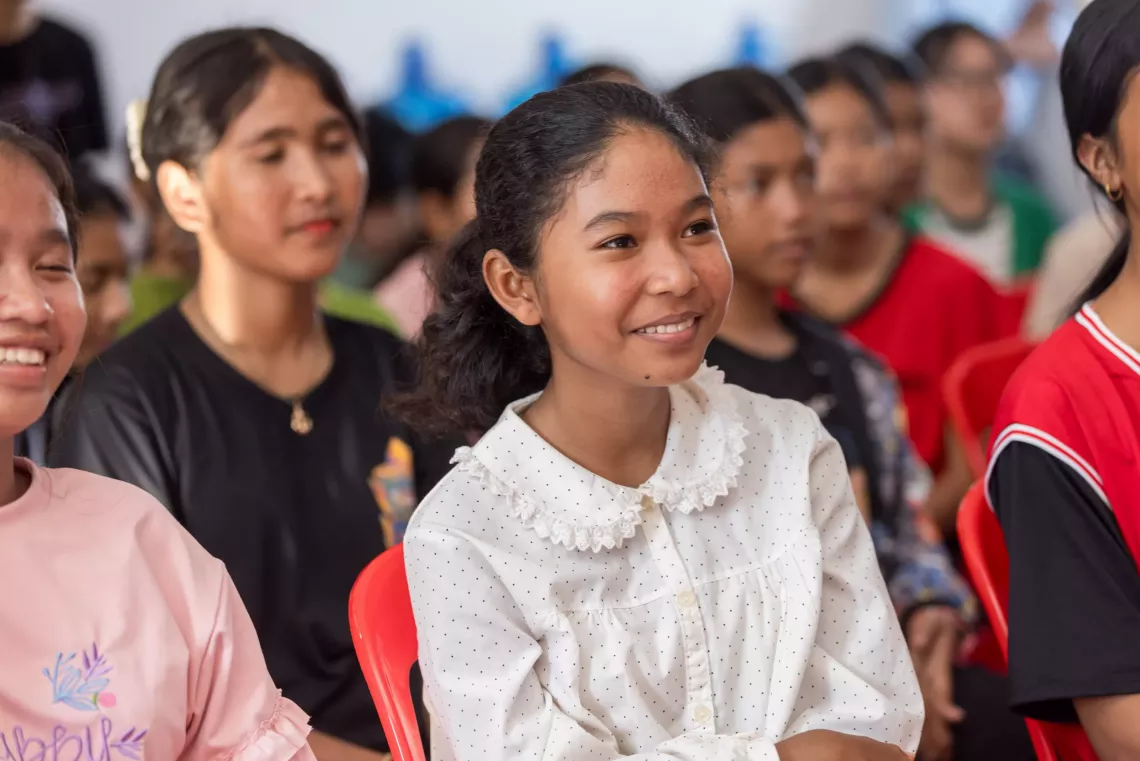
There was some resistance at first: from teachers who struggled to understand the concept of learning through play; from parents who thought girls should be homemakers not students; and from girls themselves, who believed STEM subjects were for boys. But Seng says those stereotypes are crumbling as the programme expands and the benefits become clear.
Key to GCC’s success is the role of older female students who are ambassadors for the initiative and mentors to the girls.
Sereny Mechpring, an undergraduate in food technology and engineering at Royal University in the capital Phnom Phen has been a mentor since December 2023, guiding adolescent girls as they learn the basics of coding and game development in workshops and game jams.
“The ‘A’ [for arts] in STEAM completely transforms how young people view STEM,” says Mechpring of the GCC curriculum. “Many students think of STEM as something mechanical or intimidating – lots of technical terms, machines and formulas – but when creativity is included, it becomes more human, more expressive.”
“It’s not just about technology anymore, it’s about problem-solving, storytelling, design, and imagination. That’s what makes STEM truly exciting and welcoming, especially for girls. It helps them see that they belong here too,” she says.

Inspiring the next generation
Besides being a student, Mechping is also founder of a food business and co-founder of a startup offering introductory courses in subjects such as AI and robotics as well as STEM-related careers advice. She hopes to inspire as well as mentor.
“I want the next generation to see in me someone who has expertise in engineering, I want them to look up to me as a role model, a woman who has made her own business, because they may have their own dreams but haven’t started to do it yet.”
Challenges remain, such as continuing to break down stereotypes about what girls can do and achieve, and traditional ideas about how teaching should be done, as well as building the infrastructure necessary to bring electricity, internet connectivity and computers to remote underserved communities.
But Seng says GCC is now a core part of Cambodia’s ambitions to prepare a generation of girls for the future.
“The teacher’s role is not to teach everything themselves, but to allow students and learners to create their knowledge themselves, through curiosity and problem-based learning,” says Seng. “This will equip our students with the skills for the 21st century world of work.”


