

Sanitation Programme Facility
A revolution in sustainable financing for affordable household sanitation in sub-Saharan Africa.
The Sanitation Programme Facility (SPF) is a UNICEF-brokered innovative financing solution designed to accelerate access to improved sanitation in poorer households across sub-Saharan Africa. By leveraging donor guarantees and technical assistance, the SPF bridges the gap in commercial financing, enabling sustainable access to sanitation for tens of millions of people.
The challenge
High upfront costs and unaffordable loans with steep interest rates and collateral requirements make it difficult for low-income households to build toilets, limiting both demand and investment in safe sanitation.
In sub-Saharan Africa:
- 762 million people lack access to basic sanitation
- 193 million people have no toilet at all and need to resort to open defecation.
But there’s an innovative solution to catalyze the financing and building of toilets on a massive sale.
Unlocking investment for sanitation through blended finance
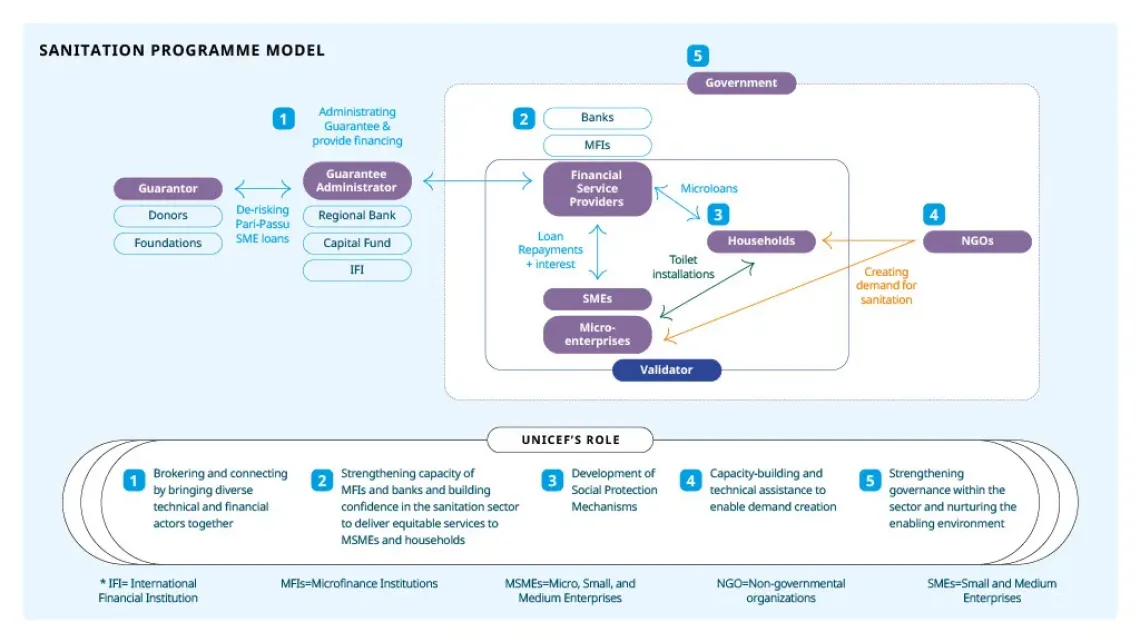
Blended finance – a strategic combination of public and private funding – offers untapped potential in the Water, Sanitation and Hygiene (WASH) sector. The SPF approach secures donor-backed guarantees and/or reduced-interest capital to unlock significant commercial financial investment. This creates affordable credit options for households and micro-, small- and medium-sized enterprises (MSMEs) to invest in sanitation infrastructure.
The concept involves UNICEF working with Development Financial Institutions (DFIs) or independent fund managers to establish and administer SPF models, tailored to the unique contexts of each country. This approach could scale up financing, enabling tens of millions of people to access safe sanitation and improve children’s health, nutrition, safety and ability to go to school.
Proven success
Pilot projects in Ghana, Nigeria, and Togo demonstrate the SPF's potential. These initiatives enabled US$1.6 million in sanitation financing, and strengthened micro, small, and medium-sized enterprises (MSMEs). High repayment rates (e.g., rising to 97 per cent in Ghana) and significant benefits for low-income households, including 80 per cent of loans going to the poorest households in Togo.
“When it rained, we used to see human waste in the house, transported by the rushing water, with unbearable smells. But now, thank God, [access to credit] has enabled us to have our own toilet, and what we faced in the past, no longer exists. Even illnesses and outbreaks are less frequent.”
Nabara, 76, Togo
These successful pilots provide valuable evidence for regional scale-up. UNICEF is supporting the launch of SPFs in several sub-Saharan African countries and exploring the opportunity to establish a multi-million dollar guarantee for microfinance institutions (MFIs). This will enable the development of a sub-Saharan Africa-wide SPF mechanism. This initiative could unlock billions of dollars in financing over the coming years, delivering basic sanitation to millions of children and families by 2026.
Creating a conducive environment for innovative finance
Government support is critical to ensure the success of SPF. National governments can foster an enabling environment by:
- Establishing regulatory frameworks: Protect investors and ensure transparency.
- Building sectoral capacity: Train institutions to manage and oversee blended finance projects.
- Developing local markets: Support demand creation and establish sanitation market frameworks.
- Strategic planning: Integrate blended finance into national development plans for safe sanitation and water access.
- Promoting partnerships: Define roles and responsibilities across stakeholders to streamline collaboration.
UNICEF plays a pivotal role in brokering these partnerships, leveraging its WASH expertise and knowledge of local contexts to bring together guarantors, financial experts, and other stakeholders. Once the SPF is established, UNICEF will offer training and practical help to all the people and organizations involved, and work to increase demand for sanitation services, to create the right conditions for blended finance.
Learn more
About the UNICEF Sustainable WASH Innovation Hub
The UNICEF Sustainable WASH Innovation Hub is a global home for accelerating the scaling of transformative and climate resilient water, sanitation and hygiene solutions for children and their families.