VivaMama began with our founder’s own postpartum weeks – a doctor with years of public-health experience, sitting with a new baby and the same questions every other mother has, and no easy way to ask them. If a mother with a medical degree can feel alone, the problem is not the mother’s knowledge, it is that nobody is there to ask.
With VivaMama, a mother can ask a question out loud, in Hindi, in the words she would use with a friend, and get an answer back in plain rather than clinical language. But the design decision we are most careful about is the opposite one: VivaMama is built to know where its knowledge ends. It handles everyday reassurance and education, and the moment a question needs a trained human being, it hands over to one.
Underneath the conversation, it also keeps track. A clinically validated postnatal recovery index looks across five areas of a mother’s recovery – her physical healing, emotional wellbeing, lactation and nutrition, reproductive health and basic vital signs – so the picture builds up over weeks instead of resetting with every conversation.
And it does not try to stand in for anyone. VivaMama rides on top of the system that already exists, supporting community health workers and the home-visit routines that already reach mothers. It is built to respect India’s data-protection rules, so a mother’s information stays hers.
Building with open source
We are open sourcing the heart of this because postpartum care is too important to lock inside one company. When the building blocks are open, other organisations, governments and developers can adapt them for their own communities and languages far faster and more cheaply than starting from nothing.
Openness also keeps us honest. Anyone can look at how the tool works and see for themselves where it defers to a human. For a technology that talks to mothers about their own health, that is not a nice-to-have; it is how trust gets earned.
We joined UNICEF Femtech Ventures early on, with a clear idea and the beginnings of a product. In the months since, VivaMama has become something real.
We have built the product and earned our first revenue, with mothers coming directly to us for support. We have begun on-the-ground testing with frontline health workers at a public health facility, watching real mothers use VivaMama and folding what they tell us back into it.
And we have built the kind of institutional relationships that give a young company credibility: a clinical validation partnership with a renowned medical college; participation in an open digital health network; and funding under the Government of India’s Startup India programme through Indian Institute of Technology (IIT Indore).
UNICEF mentorship has kept user-centred design at the heart of what we build, pushed us to build privacy and data protection in from the very start rather than bolt them on later, and helped us shape a business model that keeps VivaMama viable while we open-source the solution for wider impact.
Testing, learning, iterating
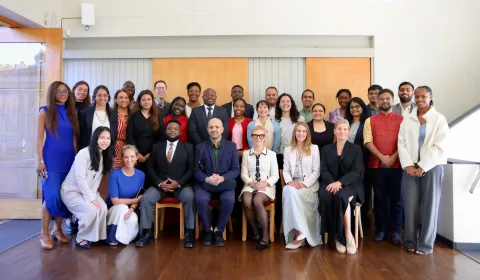
At the in-person workshop in Pretoria we met the UNICEF Venture Fund team, got direct feedback on our solution, and swapped ideas and hard-won lessons with fellow grantees. It also connected us to the wider ecosystem – UNICEF country offices, philanthropies and partners such as theGovernment of Sweden– while sessions on technology, open sourcing, fundraising and roadmap-building helped us look at the business through the lens of scale.
Through these early months our discipline has stayed simple: build the product with our users close, test continuously with a small group, and learn and iterate. The introductions to organisations like UNICEF's country office in India and the India Health Fund helped us put VivaMama in front of the right people and open conversations about pilots have been just as valuable. For a company still early in its journey, that steady feedback from experienced professionals at every step has been immensely useful.
For the rest of the programme our hope is simple. Get VivaMama into the hands of more mothers and more health workers, open source the first version of the chatbot, and gather the early evidence that tells us honestly whether it is making a difference to how mothers recover. We would like to leave this cohort not only with a product, but with something we can point to.