The Humanitarian Cash Operations and Programme Ecosystem
Humanitarian cash transfers offer an opportunity to support families to meet their needs in a dignified, effective, and efficient manner. UNICEF continues expanding the use of humanitarian cash transfers, reaching more than 2.9 million families in 48 coun

Introduction
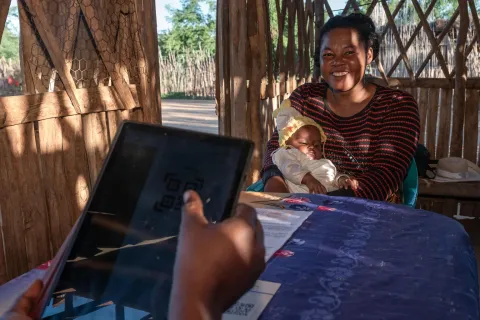
Humanitarian cash transfers offer an opportunity to support families to meet their needs in a dignified, effective, and efficient manner. UNICEF continues expanding the use of humanitarian cash transfers, reaching more than 2.9 million families in 48 countries with $ 520 million in 2023. The scaled use of cash transfers is supported by UNICEF’s corporate digital solution, Humanitarian cash Operation and Programme Ecosystem (HOPE). This system safely processes the personal data of families receiving UNICEF’s cash assistance, in line with quality standards, while ensuring a risk informed implementation of cash programs. The HOPE platform initially deployed in 2021, is currently supporting approximately a quarter of the HCT volume disbursed by UNICEF with $ 130 million delivered to 2.7 million people (approx. 500,000 families) in 2023.
Delivering in fragile contexts
The HOPE system was used to support the delivery of cash assistance in Gaza, illustrating the flexibility of digital solutions to access crisis affected families in conflict settings with limited access. This cash program has supported over half a million crisis-affected families, and HOPE was used to safely register and manage the personal data of families, resulting in providing cash payments to every fourth person receiving cash assistance in the Strip. Preparedness activities, such as having the system already deployed and training key country staff, were critical to successfully use HOPE in the Gaza Strip. Once payments were disbursed, post distribution monitoring reports were conducted digitally using UNICEF’s RapidPro digital solution, using the families registered in the HOPE system, to facilitate this task.
UNICEF has been implementing a cash transfer program in Sudan to support pregnant and lactating women through the nation-wide Mother and Child Cash Transfer (MCCT+) program. In 2023, this program supported 52,000 mothers and their children for the first 1000 days of life with cash assistance to access health and nutrition services. To support the effectiveness of this program, and given the flexibility of HOPE, the digital solution was used to deliver incentive payments to front line workers (FLWs) providing health and nutrition services in the MCCT+ program.
Enhancing the platform
To achieve these results, key elements of the HOPE system were strengthened in 2023 to ensure the digital personal data management solution remains as flexible as possible to support families in addressing their needs across various humanitarian contexts. To date, the HOPE system counts on the learnings and experiences of twenty countries where it is currently deployed to inform these enhancements. 2023 saw the creation of the HOPE Payment Module. This module takes information registered in the system for the user to seamlessly create tailored payment lists for meeting program objectives. The module includes a function to automatically calculate the benefit amount per family, ensuring that all required approval processes are met, and valid for audit purposes. Another achievement was the release of the HOPE software into open-source digital libraries, placing HOPE towards becoming a Digital Public Good for the benefit of the humanitarian community, globally. An Accountability to Affected Populations (AAP) Module was also newly developed in 2023. This module is connected to UNICEF’s digital solutions RapidPro, to facilitate a two-way communication channel with families receiving cash assistance. The module was piloted in the Gaza Strip to allow families to safely reach cash out points amid the volatile security situation. A dashboard was created for the existing Grievance Module to strengthen the overall processing of grievances in real-time. The dashboard includes key prioritization filters to provide more visibility to urgent grievances, and operators from the call center use the dashboard to seamlessly assign grievances according to the established standard operating procedures. A HOPE User Steering Committee was created in early 2023 to regularly inform a practitioner driven strategic vision of the system, and for country-level learnings to effectively improve the platform.
Outlook and Future Prospects
UNICEF remains steadfast in its commitment to excellence, innovation, and integrity. Moving forward UNICEF will continue to ensure HOPE is fit for purpose, and that necessary updates are done in a timely manner. As the system continues to grow, UNICEF will enforce key protective measures, such as targeted restrictions, to protect access to sensitive data. The visualization of custom reports will be strengthened with the creation of a dedicated digital workspace, and the use of biometrics for the deduplication and authentication functions of the system will be integrated. UNICEF will also further develop the use of HOPE for the payment of front-line workers at scale, in risk informed manner.