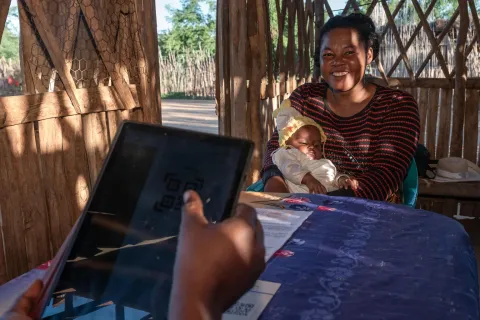
HOPE: Humanitarian Cash Transfer system launched in CAR
In response to the crisis in Central African Republic, UNICEF launched a number of Humanitarian Cash Transfer interventions.

In response to the crisis in Central African Republic, UNICEF launched a number of Humanitarian Cash Transfer interventions. In Bambari, a Cash + Education project allows many parents to get their out-of-school children back into the classroom. The project specifically targets children with disabilities (CWD) and out-of-school girls, providing their parents with monthly cash grants, while also working on improving the accessibility of schools, the integration of CWD in schools and the appropriate mobility assistance.
HOPE – Humanitarian cash Operations and Programme Ecosystem
During the project design phase, Amandine Frisetti, who leads the Humanitarian Cash Transfer (HCT) team in Bangui, identified a lack of beneficiary data management tools as a potential risk preventing proper programme implementation and quality.
With the support of the HQ HCT team in EMOPS, the Cash + Education project in Bambari was chosen to be the first UNICEF project to use the Humanitarian cash Operations and Programme Ecosystem (HOPE). HOPE is UNICEF’s Humanitarian Cash Transfer Management Information System. It offers a digital solution for each step of a humanitarian programme delivering cash assistance: beneficiary registration, targeting, payment list approval, authorization, reconciliation, and verification as well as grievances and feedback management. This digital solution is aimed at (i) enhancing the Humanitarian Cash Transfers programme quality, (ii) ensuring highest standards of data protection and information security and (iii) mitigating the fiduciary risks across the programme cycle.
Between 20 – 23 April 2021, colleagues in UNICEF CAR office and the staff from three implementing partners (Jesuit Refugees Services, Lutheran World Federation and the Norwegian Refugee Council) were trained in the use of HOPE. Colleagues have shared the required data management responsibilities and assigned roles to each other. The allocation of roles had a dual purpose: to distribute tasks between UNICEF and the partners and to mitigate the risk of errors and fraud through the segregation of duties.
Victor Setibo, JRS, team leader in Bambari was thrilled about the opportunity to use HOPE.
“It is stressful to keep track of personal data of beneficiaries without a structured tool that helps you in keeping data secured,” he said.
“HOPE allows me and my team to detect potential duplicates beneficiaries and manage in a traceable manner all the work required to solve grievances coming from beneficiaries.”
Charlotte Toumba from LWF also emphasized the advantages of HOPE for programme quality and accountability. “With HOPE we can trace the reason why a beneficiary is receiving assistance and we can better explain it to the communities we serve while also taking their feedback into account,” she said.
UNICEF country staff also found it helpful to access a platform that would ensure proper checks and balances are in place for the implementation of cash programmes. “HOPE finally allows UNICEF to have sound segregation of duties in the approval and authorization process of beneficiaries list,” said Hermann Yves Zon, UNICEF Finance Specialist in Bangui. “Beneficiaries data are now stored in a secure environment accessed only on a need to know basis. I feel more at ease now to support in the implementation of HCT from an operational perspective since every action is logged in the system and we can claim full transparency when an auditor inquires into these aspects.”
Cleophas Muhindo Mbonzo, a Humanitarian Cash Transfer specialist in Bangui explained it through an effective metaphor: “UNICEF programme and operations colleagues as well as implementing partners and Financial Service Providers are all part of the same football team. HOPE clarified our roles and responsibilities so that each of us can play our role towards a common goal - to deliver cash assistance in an efficient, transparent and accountable manner.”
Beneficiaries
After two years of investment EMOPS HCT Data team is excited to witness HOPE’s proven ability to manage personal data to deliver humanitarian cash assistance. What is most encouraging is hearing the voices of beneficiaries whose data are now processed in a safe data management platform.
“Before, it was difficult to buy supplies for my children,” said Thérèse, a mother of four children, two of whom are already in school. “My husband is dead, and I am visually impaired, so I don't work.”
With the money she received from the Jesuit Refugee Service (JRS), UNICEF's partner in this project, she will be able to pay for school fees, clothes, and food for her children.
“With the money we received, my mother will be able to buy me notebooks, pens and a bag to go to school” says 15-year-old Divine with great enthusiasm, under her mother’s gaze.
Divine, who is particularly fond of French, is happy to be back in her primary school where she attends third grade class.
UNICEF is rapidly scaling up the use of Humanitarian Cash Transfers, globally. The number of countries implementing this aid modality more than doubled in three years from 13 in 2017 to 31 in 2019. Last year the number of UNICEF country offices supporting the use of some form of HCT skyrocketed to 71.
HOPE is a seamless experience that allows more children like Divine and Therese to access the financial assistance they need to overcome barriers to basic services in humanitarian contexts. To learn more about HOPE you can watch this recent demo delivered at HQ or reach out to the HCT data team through the HCT one-stop-shop to request support or advice on HOPE.