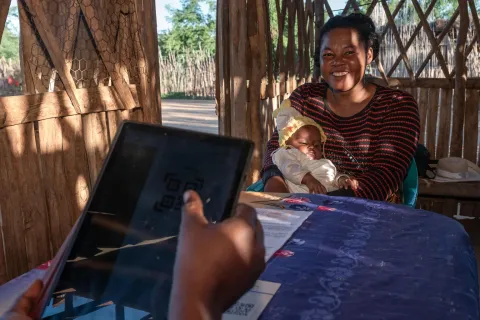
Bringing HOPE to teachers in South Sudan
HOPE – the Humanitarian cash Operations and Programme Ecosystem – has gone live in its fourth country: South Sudan!

HOPE – the Humanitarian cash Operations and Programme Ecosystem – has gone live in its fourth country: South Sudan!
In early 2021, UNICEF was approached by the EU and the Ministry of General Education and instruction (MoGEI) of South Sudan to conduct a payment under a programme known as OUTREACH to approximately 36,000 teachers across the country in order to incentivize teacher attendance and reopening of schools after a year-long closure due to COVID-19.
Recognizing the tremendous challenges inherent in registering and paying so many teachers – such as identifying duplicate teachers, securely preparing payment instructions lists, and reconciling reported payments from the financial service provider – the South Sudan Country Office (SSCO) engaged with the Cash Transfer team at HQ-level to deploy the HOPE system to handle the end-to-end payment process.
The use of HOPE for OUTREACH highlights the usefulness of the system beyond delivery of humanitarian cash transfers to end beneficiaries. Under OUTREACH, the system has proven its usefulness in paying UNICEF programme intermediaries (in this case, teachers), showing that it is a powerful tool which could be applied for similar projects elsewhere involving payments to other intermediaries such as vaccinators, community health workers or other extension workers.
What is HOPE?
HOPE is UNICEF’s Humanitarian Cash Transfer Management Information System. It offers a digital solution for each step of a humanitarian programme delivering cash assistance: beneficiary registration, targeting, payment list approval, authorization, reconciliation, and verification as well as grievances and feedback management.
This digital solution is aimed at (i) enhancing the Humanitarian Cash Transfers programme quality, (ii) ensuring highest standards of data protection and information security and (iii) mitigating the fiduciary risks across the programme cycle.
The system has already been deployed and is in use in three countries – the Central African Republic, Antigua & Barbuda and Afghanistan. Now, with South Sudan, HOPE is being used for its first large-scale programme and is showing how it can be a powerful tool for delivering UNICEF’s projects at scale.
Using HOPE to Pay Teachers Across South Sudan
From August 9th- 12th, 2021, UNICEF staff and implementing partners from Christian Mission for Development (CMD) and the Community Empowerment Network (CEN) were trained in the use of HOPE. Since HOPE allows for strong segregation of responsibilities, training up both UNICEF and implementing partner staff allowed the SSCO education team to mitigate the risk of errors and fraud across the payment lifecycle.
UNICEF colleagues reflected on this and the other useful features of HOPE which made it a powerful tool in addressing the challenges presented by the daunting ask of paying thousands of teachers across every state of South Sudan in a short timeframe.
Among many features, John Tileyi Yuggu, an Education Specialist based in SSCO in Juba highlighted the system’s usefulness in identifying duplicate teachers as part of the preparation of payment lists: “As the project launched, we were pondering how to make payment of incentives to over 36,000 individual teachers. HOPE came to the rescue, especially in flagging errors in teacher registration lists and potential duplicates in such a huge caseload. In the context of South Sudan, where similarity of names is a common phenomenon, the system identified many records that required correction and adjudication to resolve the duplicates. This opened the gateway that enabled us to process the payments with confidence. We look forward to using the system for other future projects in SSCO.”
Cecillia Chawatama, Programme Specialist in Cash Transfers agreed, commenting that, “Managing a huge case load without any established management Information system can be really challenging and stressful. HOPE was indeed a life saver as it came at a time we were confronted with a huge scale project without any MIS in place for data management. The system gave us confidence about the credibility of our beneficiary payment list.”
Other features of the system are also particularly helpful, Cecillia noted, ”UNICEF has a commitment to be accountable to affected populations; it is exciting to see how HOPE’s Grievance and Feedback module has been built into the system, thus making it easier to track beneficiary feedback and complaints.”
Operations staff also reflected on the value of the system. Asina Binnia, finance of for SSCO says, “Hope gives us the opportunity to have data that we can refer to for future use; we can extend this facility to other community mobilizers such as EPI/C4D. While it is easy to trace budget information in VISION, it is often very difficult to get individual-level information on recipients that we have supported. HOPE makes this easy. HOPE equals available beneficiary data.”
HOPE and UNICEF’s Effort to Scale up Humanitarian Cash Transfers
UNICEF is rapidly scaling up the use of Humanitarian Cash Transfers, globally. The number of countries implementing this aid modality more than doubled in three years from 13 in 2017 to 31 in 2019. Last year the number of UNICEF country offices supporting the use of some form of HCT skyrocketed to 71.
The use of HOPE is a seamless experience that allows more UNICEF beneficiaries to securely receive the financial assistance they need to overcome the barriers that prevent them from meeting their basic needs in humanitarian contexts.