Justice Has a New Champion
Suriname Launches Child Ombuds Institute

In a landmark achievement for children’s rights, the Government of Suriname has officially launched the National Child Ombuds Institute — the country’s first-ever independent body dedicated exclusively to promoting and protecting the rights of children.
This milestone marks the culmination of years of unwavering advocacy and strategic partnership, led by UNICEF Suriname, which has championed the vision, legislative groundwork, and institutional development of this transformative initiative.
The journey began in 2020, when UNICEF Suriname initiated a dialogue with the President, advocating for an independent mechanism aligned with the principles of the UN Convention on the Rights of the Child (CRC). Through expert guidance, legislative reviews, knowledge exchanges, and cross-sector convenings, UNICEF played a pivotal role in shaping this national commitment into reality, where a few years after the Presidential Commission to oversee the establishment of the ombuds institute was installed.

The decisive breakthrough came in November 2024, when the National Assembly passed the Child Ombuds Institute Act, securing 22 votes in favour. It was a moment that reflected not only political will but a shared vision for justice, equity, and inclusion for every child in Suriname.
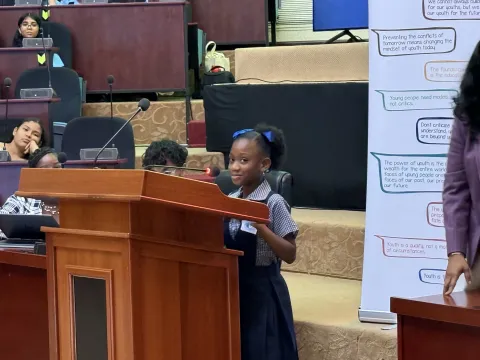
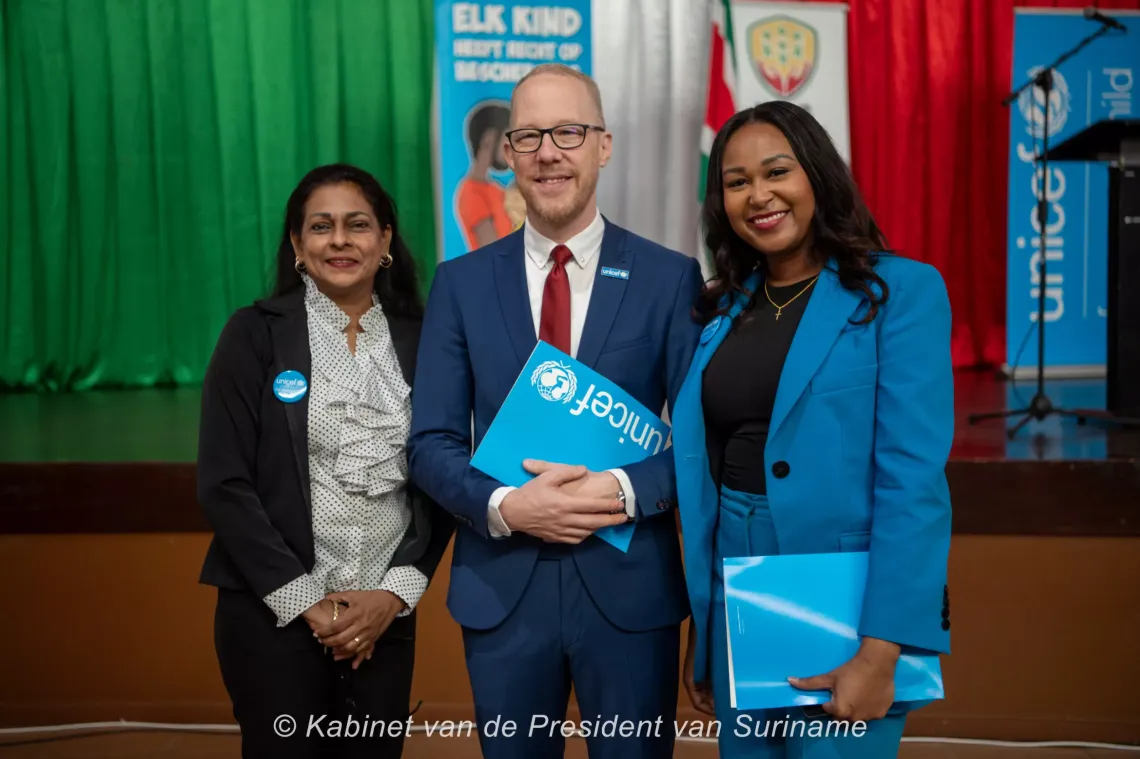
The celebratory launch on April 22, brought together the voices of children and the country’s highest officials. H.E. President Chandrikapersad Santokhi, joined by ministers, civil society leaders, youth advocates, development partners and children unveiled the Institute’s nameplate in a ceremony symbolizing progress for child rights.
“With this Institute, we reaffirm our commitment to justice for every child,” said President Santokhi. “We are building a society where the rights of children are not only protected but actively upheld.”
The Child Ombuds Institute will serve as an independent watchdog — receiving and investigating complaints of children’s rights violations, advising on policy and practice, and holding systems accountable. Critically, it also places children’s voices at the heart of decision-making, institutionalizing their right to participate in matters that affect their lives.

During his remarks at the launch, UNICEF Representative a.i. Gabriel Vockel commended this achievement: “The opening of the Institute sends a powerful message: that Suriname is committed to upholding the rights of every child. This is a milestone in democratic governance and an investment in the wellbeing and future of the nation’s children.”
Suriname now joins a select group of countries in Latin America and the Caribbean that have established independent child rights institutions, reinforcing a global movement to ensure justice systems truly serve children and young people.
UNICEF remains steadfast in its support, working alongside the Institute to strengthen operational capacity, raise public awareness, and ensure that the office is inclusive, child-friendly, and accessible to all, especially the most vulnerable.
As Suriname turns the page to a new era of child rights protection, the launch of the Child Ombuds Institute stands as a powerful legacy of what enduring partnerships can achieve.
Justice now has a new champion — for every child.