"Girls Can't": The Generation That Refuses to Accept It
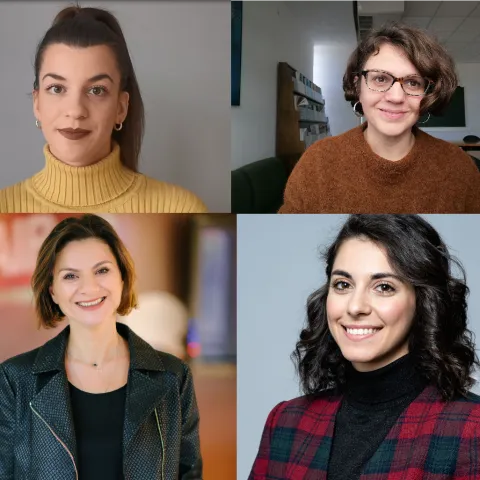
On the occasion of International Women's Day, three girls, members of UNICEF Greece's Children and Youth Advisory Board, share their thoughts and experiences on gender equality in Greece.

- Ελληνικά
- English
"Go back to your kitchen," "Don't speak, you're a girl," "Girls aren't that good at chess" "Don't become an engineer, you won't progress"—these are the phrases 16-year-old Katerina from Corfu hears in her daily life. Words that sound like they belong to another era are still heard in schools, on the streets, and at family gatherings. Words that continue to hurt, limiting girls' right to dream freely, to grow, and to become whatever they desire. On the occasion of International Women's Day, three 16-year-old girls, members of UNICEF Greece's Children and Youth Advisory Board, share their thoughts and experiences on gender equality in Greece today. Katerina, Cecilia, and Emmy have different backgrounds and interests, but they are united by the desire for a world where women have equal opportunities and are treated with respect.

Katerina: Chess Champion and Human Rights Advocate
16-year-old Katerina from Corfu, a Greek chess champion and human rights activist, has experienced gender inequality in various aspects of her life. "Even today, in the 21st century, you can feel that many people still consider women inferior," she says. "Even at school, you hear all sorts of sexist comments from boys."
In chess, a sport dominated by men, Katerina has often faced discrimination despite her achievements. "There is this idea that girls aren’t as good, that they’re worse," she explains. "And people say it as if it’s a fact, not an opinion."
"Many people think girls are weaker (at chess), that they get scared more easily. But that’s not true. If you look at top female chess players, you’ll see that they play beautifully and aggressively. So, these are just stereotypes."

Cecilia: Fighting for Equal Access and Safety
16-year-old Cecilia from Athens, who is passionate about equal access to education, highlights how "women's daily experiences are deeply affected by issues of safety." She believes that society does not teach men to respect women but instead teaches women to be afraid.
She believes that girls often feel the need to be extra cautious when walking alone, especially at night, and they experience interactions differently than boys—whether it's receiving unwanted comments in the street or worrying about harassment. Society frequently forces girls to adopt self-protective behaviors, such as dressing "appropriately" or avoiding certain places alone.
"But the problem is not what we wear or where we go. The problem is that we live in a society that holds us responsible for our own safety instead of educating others to respect us."

Emmy: A Champion for Equality in Action
16-year-old Emmy from Komotini, passionate about arts and volunteering, believes that "people should be chosen for jobs based on their personality, determination, and abilities—not their gender."
From an early age, girls like Emmy experience discrimination, from small things to major decisions. She recalls a school parade where only boys were initially selected as flag bearers, but after her intervention, girls were included as well.
"The fact that some of us were born male and some female was not a choice. But we all have a responsibility to defend women's rights. Women are our fellow human beings, our sisters, our mothers, our grandmothers—and we exist thanks to them."
Common Challenges, Different Experiences
All three girls recognize that gender inequality remains a problem in Greece today. Katerina highlights the pressure women face from the multiple roles they are expected to fulfill, while Cecilia sees domestic and gender-based violence as the most serious issue facing women today. Emmy points out the challenges women encounter in the job market and the need to overcome stereotypes.
Dreams and Hopes for the Future
Katerina dreams of seeing more women in leadership positions. Cecilia hopes for a society where children are taught about equality from an early age. And Emmy finds inspiration in her mother—a woman who does it all.
"My mom does everything. She’s not just a mother. She’s so much more. She’s a hairdresser, a psychologist, a mathematician, a friend. She does everything she can to be all of that for me."
Messages of Strength and Change
"Believe in yourself and don't let anyone undermine you," advises Katerina. "You are strong, capable, and deserve to claim the respect, opportunities, and freedom that belong to you," emphasizes Cecilia. "We all have a duty to stand up for women's rights," says Emmy.
The voices of Katerina, Cecilia, and Emmy serve as an inspiration for all of us. They remind us that the fight for gender equality continues—but also that the new generation is ready to take it on.