Ghana Floods: Two Girls' Journey of Resilience
Elorm and Clementina, two students, share their experiences and renewed hope after the Akosombo floods

For fifteen-year-old Elorm Adjedakor and fourteen-year-old Clementina Atigle, both Junior High School (JHS) 3 students in Mepe, October 13, 2023, began like any other school day. They attended their classes as usual, unaware of the life-altering event unfolding. This was the day the Akosombo Dam, Ghana’s hydroelectric dam on the Volta River, spilled its waters, causing widespread flooding that displaced thousands in various towns, including Mepe in the Volta Region.
The dam, a vital source of electricity for Ghana and neighbouring West African countries like Burkina Faso, Togo, and Benin, had unleashed an unforeseen disaster.

When Elorm returned home from school, she was met with a scene of frantic urgency. Her parents were hastily packing belongings, their faces etched with alarm. "I asked what was happening, and they explained that the water was flooding the house," Elorm recounted. Her immediate concern wasn't for toys or clothes, but for her books. "One of my first concerns was my schoolbooks, which were essential for my studies both at home and school. I managed to gather all my books, which made me very relieved.”

For Clementina, the fifth of eleven children, the floods began around 8 PM on October 15. "We were all worried and did our best to pack as much as possible before floodwaters submerged our house," she recalled. Unfortunately, her efforts were not enough. They lost a lot, including her learning materials. Her textbooks and school uniforms were washed away. With their home submerged, Clementina and her family sought refuge at Mepe RC Primary School, where they stayed for a month and a half. Since her school was now being used as a temporary shelter, classes were also halted for that period, which made her even sadder.

With their home submerged, Elorm, the eldest of six children, quickly grasped the gravity of their situation.
"I then asked my father what our plans were now that we no longer had a home. I suggested that I go and stay with my aunt in the Eastern region until we resolve our issues at home. They agreed, and I left to join my aunt,”
Both girls faced significant challenges upon their return to school.
"Sometimes, it is hard for me to follow what the teacher is saying. Since I lost my textbooks, I have had to rely on my classmates to share with me,"
Elorm observed a similar struggle among her peers: "Seeing my friends in such a predicament made me sad and upset.”
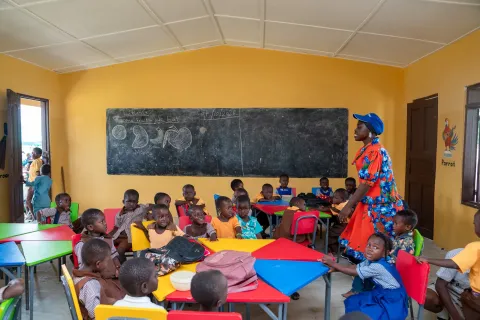
In January 2024, The United States Government, through the United States Agency for International Development (USAID), partnered with UNICEF to provide essential school supplies to children in communities affected by the Akosombo Dam spillage floods. Through the Akosombo Safe Activity, USAID and UNICEF distributed tents, books, and "school-in-a-box" kits containing stationery for teaching and learning.
"The education supplies provided through USAID and UNICEF support arrived at a crucial time, benefiting over 30,000 learners, including Elorm, Clementina, and many others across seven districts. Education cannot wait—even in times of emergency,”
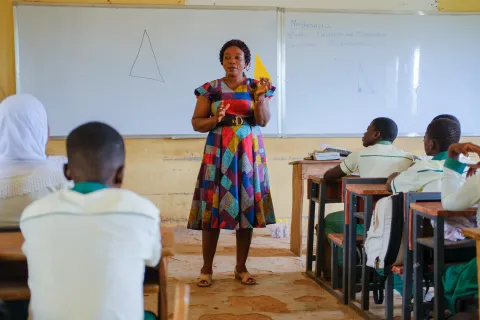
The impact has been profound for both girls. "The standout subject this year is Mathematics. We now have math sets provided for each of us, especially for lessons related to construction. It has become an enjoyable class where everyone can follow along easily. As a result, we are all performing much better in Mathematics,” said Elorm.
Clementina, who previously struggled with the subject, now finds joy in it. She explained that each student now has a mathematical set, aiding their understanding and teachers are equipped with materials for practical examples.

Thanks to USAID's generous support, many children affected by the devastating floods have successfully returned to school and resumed their education.
This initiative has provided essential learning materials and offered emotional support, fostering resilience and hope for their future.