UNICEF unites Georgia’s universities to advocate for child rights amidst growing challenges
With the newly established Child Rights Academic Network, Child Rights Centers across universities have revitalized their collaboration

- English
- ქართული
Over decades UNICEF Georgia has actively engaged universities in promoting child rights. The academic community has continuously evolved, becoming a vital force in advocating for child rights and playing a critical role within Georgia’s civic space. With the newly established Child Rights Academic Network, Child Rights Centers across universities have revitalized their collaboration - strengthening connections between academia, local authorities, and communities to safeguard children's rights.
Natia Jokhadze, UNICEF’s Education Specialist, recalls the establishment of the first Child Rights Centre at Akaki Tsereteli State University in Kutaisi in 2020, which was soon followed by the creation of Centers at seven state and three private universities across Georgia. “This marked the beginning of a significant new phase in integrating child rights into various university curricula,” she explains. “It also reflected a strong commitment to promoting child rights through awareness-raising, capacity building, and child participation, all facilitated by the newly established Child Rights Centers.
We believed it was essential for all professionals to become advocates for child rights and to embed these principles into the core of university education and academic work. Moreover, the Code on the Rights of the Child adopted in 2019 underscored the importance of specialized trainings for professionals working with children”.
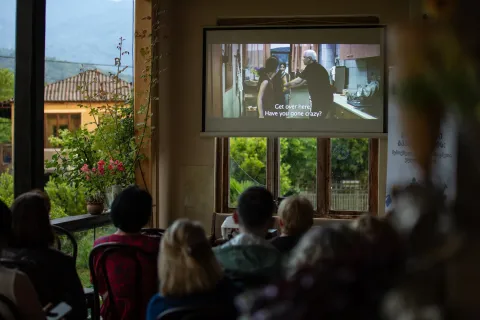
Over the years, the Child Rights Centers have served as resource hubs, creating and spreading knowledge about child rights among professionals, educators, academia, parents, and children as well as generating evidence on child rights issues. The Centres organized training sessions, open lectures, and discussions, and developed specific educational materials on child rights.
Over time, it also became clear that academia could play an even more significant role in advancing child rights advocacy by directly contributing to evidence building—particularly through research initiatives that actively engage students.
There have already been several examples demonstrating how the research capacity of universities can be enhanced through the platform of the Child Rights Centers. The Centers contributed to evidence generation on youth mental health, helping inform child-sensitive decisions by the Government and the Parliament. In 2024, the Centers actively contributed to a study aimed at mapping the skills and key competencies essential for youth development in Georgia.
UNICEF’s partnership with academia has attracted international interest, with Kutaisi, Batumi and Samtskhe-Javakheti State Universities hosting international conferences on the incorporation of child rights into university education curricula. These conferences laid a foundation for the thematic international forums dedicated to various aspects of child rights.
To benefit from international experience and best practices, the Child Rights Centres have established partnerships with European universities like University Paris Nanterre and Leiden University as part of the development of the first ever Master programme on Child Rights in Georgia. In April 2024, Kutaisi State University signed a Memorandum of Understanding (MoU) with the University of Patras in Greece to collaborate on child rights advocacy and share best practices in the field.

To benefit from international experience and best practices, the Child Rights Centres have established partnerships with European universities like University Paris Nanterre and Leiden University as part of the development of the first ever Master programme on Child Rights in Georgia. In April 2024, Kutaisi State University signed a Memorandum of Understanding (MoU) with the University of Patras in Greece to collaborate on child rights advocacy and share best practices in the field.
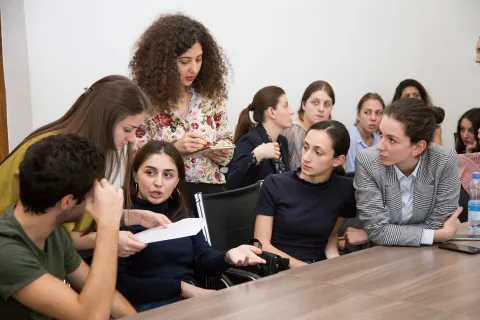
Today, the Centers have established dedicated academic spaces for child rights, developed comprehensive syllabi and courses, and enhanced training programmes for both pre-school and schoolteachers,” says Natia Jokhadze. “At the Child Rights Center at Tbilisi State University established in 2024, academic staff from diverse fields - including education, social sciences, law, medicine, and psychology - collaborate to design interdisciplinary programmes. We have also supported university faculty in building professional networks, both nationally and with peers from European universities, fostering mutual learning and the exchange of best international practices. These achievements over the past five years have been truly significant. With our continued support, universities are fulfilling their mission to serve the public with a strengthened child rights-based approach”.
In 2024, the Child Rights Academic Network of Georgia, an open platform for universities focused on education and research on child rights, was established. The network plans to conduct a study among preschool and school educators on child rights.
Batumi Shota Rustaveli State University (BSU) is the first Georgian university to become a member of CREAN, the leading Child Rights European Academic Network. CREAN brings together more than 30 leading universities in Europe, collaborating on teaching and research on children's rights.
“The partnership with UNICEF has enabled the Child Rights Center at Batumi Shota Rustaveli State University to deepen its focus on child rights and inclusive education, strengthen collaboration with regional educational institutions, and emerge as an international platform for academic dialogue on child rights and early childhood education,” says Professor Lela Turmanidze, Dean of the Faculty of Exact Sciences and Education.
“Membership in CREAN brings new responsibilities—actively participating in the network, sharing experiences, conducting high-quality research, and contributing to the generation of new knowledge in the field of child rights.”
UNICEF’s partnership with the Centres has paved the way for the development of Georgia’s first multidisciplinary MA programme in child rights. This programme is being created by three state universities with Child Rights Centres: Tbilisi State University, Batumi State University, and Telavi State University, with support from UNICEF and the Government of France. The programme aims to further enhance academic work on child rights and equip future professionals with the knowledge, skills and values necessary to work with and for children and advocate for their rights.
“The MA programme on child rights represents a significant milestone and serves as a key instrument for fulfilling the Code’s requirement to prepare child rights specialists,” says Natia. “We will continue to support universities in embracing this new master programme on child rights including the opportunity to continue strengthening their research capacities. Discussions are already underway to develop tailored child rights courses for a range of professional fields. Through this collaboration, we are empowering universities to build their advocacy skills and become strong champions for child rights.”
One of the professors from the partner universities was requested by the regional municipality to advise on specific child rights issues. This shows how universities are collaborating with policymakers to influence local child rights agendas.
UNICEF Georgia’s upcoming five-year programme of cooperation will prioritize a robust research agenda for child rights, focusing on generating evidence to inform child-sensitive policies and practices. The Child Rights Centers across universities will play a central role by facilitating research and supporting national studies. This agenda aligns with the broader goal of embedding child rights into academic work and professional training, ensuring that future policies are grounded in solid, locally generated evidence.
As one university professor shared with Natia, “UNICEF brought us together to collaborate on educational programmes for future teachers and united us around the shared mission of child rights advocacy”.