UNICEF welcomes the recognition of the progress achieved in ending childhood lead poisoning in Georgia at the World Economic Forum
- English
- ქართული
TBILISI, Georgia, 19 January 2024. UNICEF appreciates the recognition of the joint efforts undertaken by the Government of Georgia and UNICEF to end childhood lead poisoning in Georgia at the high-level discussion “Towards a Lead-Free Future” organized at the World Economic Forum in Davos. Highlighting the role of UNICEF by Prime Minister Irakli Garibashvili in addressing the issue of childhood lead poisoning in Georgia is highly appreciated.
The Government of Georgia, with the UNICEF supported Multiple Indicator Cluster Survey (MICS) discovered in 2018 that 41 per cent of children in Georgia had elevated blood lead levels. The Government responded decisively by taking immediate actions to address the problem and is following through by implementing a sustainable long-term strategy and a national response plan to eliminate lead exposure. Over the last five years, with UNICEF support Georgia has significantly upgraded its institutional capabilities, laboratory and surveillance capacity, front line services, regulatory action, enforcement and accountability mechanisms to end childhood lead poisoning.
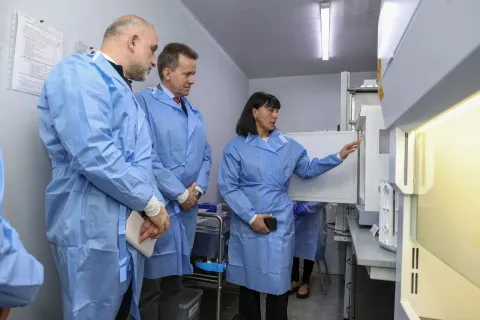
UNICEF has been a leading partner of the Government of Georgia among UN agencies in Georgia to address childhood lead poisoning. UNICEF advocacy, technical assistance and partnerships have enabled Georgia to be better equipped in addressing the problem. The recently launched Environmental Health (Lead) Surveillance System will ensure routine tracking of blood lead levels in children. The Chemical Risk-Factor Research Laboratory established at the National Centre for Disease Control and Public Health is central for the implementation of the Lead Surveillance System to detect lead in children’s blood and to identify the sources of exposure. UNICEF supported in equipping the Laboratory with specialized equipment and technical trainings for the laboratory staff. The data and evidence obtained through the Environmental Health (Lead) Surveillance System will inform future policy directions and interventions aimed at the elimination of lead poisoning.
UNICEF expresses its gratitude to the tremendous support of our donors who helped us throughout the process, in particular, USAID, Clarios Foundation and the Government of Estonia.
UNICEF reaffirms our commitment to the Government of Georgia in pursuing a lasting solution to this challenge and ensuring that every child in Georgia has the right to a clean, healthy and sustainable environment.
Media contacts
About UNICEF
UNICEF promotes the rights and wellbeing of every child, in everything we do. Together with our partners, we work in 190 countries and territories to translate that commitment into practical action, focusing special effort on reaching the most vulnerable and excluded children, to the benefit of all children, everywhere.
For more information about UNICEF and its work for children, visit www.unicef.org/georgia/