Restoring health and dignity in a remote health facility in The Gambia
New and upgraded water, sanitation and hygiene and immunization services are helping bring quality health services closer to communites.

In Karanta, a small village in the Sami district of the Central River Region, The Gambia, is a community united in gratitude for a highly transformed health facility supported by UNICEF, the Government of Japan and USAID. It is situated on the north bank of the River Gambia and hosts a health center serving communities stretching several miles. The facility is located in one of the most deprived regions in The Gambia, where most indicators for children and women’s health and wellbeing are lower than in all other regions, per the Multiple Indicator Cluster Survey (MICS 2018).
A few years ago, the health facility was grappling with water shortage and poor sanitation facilities. The only available water system was an old borehole that was barely functional, could hardly serve the entire facility. Poor toilets also posed a big challenge for visitors and staff.
In 2022, with funding from the Government of Japan and USAID, UNICEF worked with the Ministry of Health and the Department of Water Resources to support health facilities across the country to boost access to water, sanitation and hygiene facilities, strengthen capacity of health workers, modernize the country’s vaccine cold chain system with the procurement of modern cold chain facilities, including freezers for 47 health facilities, and boost mobility of health workers with 17 vehicles and 50 motorbikes.

“Two or three years back, water was a problem in Karantaba Health Center,” said Lamin S Jammeh, Officer in Charge of the health center. “We were just managing from our local borehole which was also dysfunctional because we were forcing ourselves so that we can have water. But with the support of UNICEF, now we have a borehole that supplies us 24 hours and water is no longer a problem.”
In 25 health facilities and 25 schools, UNICEF worked with the Department of Water Resources and the Ministry of Health to construct handwashing stations and a new solar-powered water supply system in 10 schools. The handwashing stations are constructed at the entrance of the premises where all visitors are required to wash their hands before entering.
“During the COVID-19 pandemic, there was a lot of transmission of the virus from one person to another but with this handwashing station, it minimized [disease transmission], because now everyone entering the facility will have to wash their hands properly,” Mr Jammeh said.

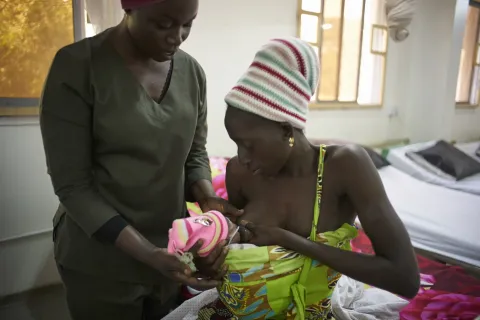
Mariama lives in a small village near Karantaba. She regularly visits the health facility for postnatal care for her son who was also delivered there. For her, the handwashing stations and new toilets at the maternity ward represent important progress for the facility.
“The toilets at the labour ward have great importance,” she said. “When women deliver, they use it to bathe, wash their clothes and do whatever they want. The toilets are very helpful.”
Kunja Sinyan, too, regularly visits the health facility for routine checks and immunization. For her, the handwashing stations are an important addition to the health facility.
“The reason we wash our hands is to stay healthy”, Kunja said as she rinsed her hands after washing them using one of the taps in the health facility. “When we visit the health facility, we first wash our hands properly before entering and when leaving too.”
A new cold chain system, procured and installed in the health facility with funding from the Government of Japan, is helping to ensure a steady supply, safe storage and management of vaccines so that every child can be vaccinated against vaccine-preventable diseases.
“As we all know, immunization is one of the key disease prevention methods”, said Mr Jammeh. “The cold chain installed here is standard and operating 24 hours. These are the interventions we want in the health sector.”
In addition to the 47 health facilities that received new cold chain facilities, one walk-in cold room was also procured to increase the storage capacity for the national vaccine storage. To enhance health outreach services, especially for remote and hard-to-reach communities, 17 vehicles and 50 motorbikes were procured from the Government of Japan grant and handed over to the Ministry of Health.