Small Packet - Big Change
With support from the Government and people of Japan, a health worker's visit and a packet of therapeutic food gave Ebrima a second chance at childhood.

In Cha Kunda in the Central River Region, Jonfolo Manneh watched her son Ebrima fade. What had begun as a loss of appetite became something far more alarming. A small body growing weaker by the day, too tired to eat, too fragile to play. Like many mothers in communities where the signs of severe acute malnutrition can creep in gradually and without warning, Jonfolo did not immediately have a name for what was happening to her child. She only knew that the boy who had once filled their home with laughter was disappearing before her eyes.
Then, a community health worker came to their door.
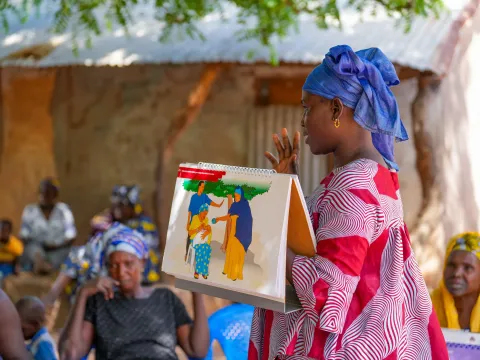
As part of a nationwide effort to strengthen nutrition services for children under five, community health workers trained in early detection visited households in KwonkoBa, identifying children at risk and connecting families to treatment before conditions became life-threatening. It was during one of these visits that Ebrima's condition was first properly recognised, not by a doctor in a distant hospital, but by a trained health worker who knew the community, knew the signs and knew what to do next. For Jonfolo, that knock on the door marked the moment everything began to change.
"I had been watching him get weaker and I did not know where to turn. When the health worker came and explained what was happening to my son, I felt both fear and relief at the same time fear because I finally understood how serious it was, and relief because someone was there to help us."
Ebrima was enrolled in a treatment programme that included the provision of Ready-to-Use Therapeutic Food, a specially formulated, nutrient-dense paste provided by the UNICEF with support from the Government and people of Japan and designed to reverse the devastating effects of severe acute malnutrition and restore a child's strength from within. Week by week, the change that Jonfolo had feared might never come began to reveal itself in Ebrima's appetite, in his energy, in the light returning to his eyes.
"My son was so weak he could not eat. When the health worker came and gave us the therapeutic food, I saw him change week by week. Today he runs and plays like any other child. I did not think that was possible," she said.

Today, Ebrima is a different child. He runs through the compound, chases friends and eats with an appetite that once seemed unimaginable. In 2025, 3,584 children received treatment for severe acute malnutrition, achieving an 81.4 percent cure rate that exceeds international standards. Behind every percentage point is a childlike Ebrima and a mother like Jonfolo, a family given back what malnutrition had threatened to take away.
In Cha Kunda, the health worker still visits. The community still screens. And Ebrima still runs.
* Development Coordination Officer, Programme Communications and Advocacy, Office of the United Nations Resident Coordinator, The Gambia.
** Communication Officer, UNICEF Gambia