
Children and Young People at the Heart of EU Actions
Guidance for EU decision-makers 2024-2029

Introduction
The upcoming EU political cycle (2024-2029), following the European Parliament Elections in June 2024, presents a crucial opportunity to place the youngest generations at the heart of the European project, which is essential for their future and the future of Europe.
This pivotal moment offers a chance to drive meaningful change and ensure that the needs and rights of children are central to EU policies and actions.
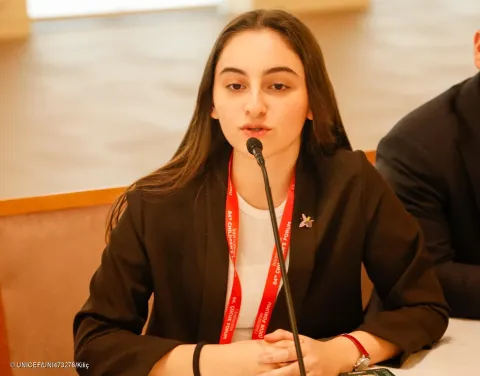
"If you are politically engaged, you can impact the present and the future."
Pavlina, 17, from Greece
The challenges facing the new European Union leadership
The current ‘polycrisis’ – multiple, simultaneous crises that are strongly interdependent – will continue to exert a harsh toll on children and adolescents. The recovery from the COVID-19 pandemic, heightened conflict, a cost-of- living crisis, discrimination, gender inequality, migration and displacement, and pushback against the climate agenda all wear heavily on children’s physical and psychological well-being.

In the longer-term, various trends pose risks for children: Weak global economic growth may result in the shrinking of investments for children and young people, while leading to an increase in child poverty and social exclusion. Geopolitical strains, ongoing conflicts, climate change and humanitarian crises will gravely threaten the lives and well-being of millions of children.
The decisions of the EU – its legislation, policy, practices and funding – have an enormous impact on children’s lives inside and outside the EU. Advances for children made by the EU, have helped promote new standards for children globally.
"We need young people to share their voices and share their opinions. Only then can we hope to bring about change."
ALEKSEJ, 18, from Croatia
UNICEF's key asks for EU leadership
Taking into account the situation of children in Europe and the rest of the world and the EU’s ambition to fight poverty, reduce inequalities, adapt to climate change, and uphold human rights, UNICEF calls on EU decision-makers to promote children's rights along three main courses of action in the new political cycle:
The EU must continue to champion and set high standards for children’s rights in its internal and external action to fight child poverty and ensure social protection; address the learning crisis and transform education; ensure children are healthy and well nourished; and protect children from all online and offline abuse and from the impact of the climate crisis.
Key asks:
- The EU must put child rights at the heart of its sustainable development agenda and the acceleration of actions towards the SDGs. Priority must be given to reaching the most vulnerable and disadvantaged children – children living in poverty, children affected by conflict and the climate crisis, children with disabilities, children on the move – and, in all these areas, maintain a sharp focus on girls.
- Child-sensitive national social protection is key to protecting children from multiple deprivations, including through the financially resourced European-wide expansion of the European Child Guarantee. Fighting inter- generational poverty starts with children.
- In the EU’s internal and external action, children’s health – including immunization – and nutrition should remain a priority. The EU should more boldly promote the mental health of children and adolescents and prioritize its financing. This is essential to their learning, leading healthy lives and transitioning from childhood to adulthood.
- As children are spending more time online than ever before, all EU legislation and policies relating to online use (including those on Artificial Intelligence) must be designed with the rights of children and young people in mind. This includes ambitious legislation on the protection of children against all forms of abuse, violence, exploitation, hate speech and cyberbullying, and programmes that empower children online, including media literacy.
- In its migration and asylum policies and legislation, the EU must uphold the “best interests of the child” principle in line with the UN Convention Relating to the Status of Refugees and the Convention on the Rights of the Child.
- The EU should continue to enlist the support of businesses in upholding children’s rights within the EU, and the external actions of businesses headquartered in the EU, through ambitious child-sensitive legislation on Corporate Sustainable Due Diligence.
- Child rights should continue to be central to negotiation and pre-accession assistance to EU candidate countries and potential candidates in transforming their societies, policies and legal systems. The EU should also expand its human rights dialogues with non-EU countries and ensure child rights remain at their core.
- The EU has already made substantial progress on environmental policies through the European Green Deal. This progress must be safeguarded and its implementation must ensure that it fully recognizes the specific vulnerabilities of children to climate change, their agency in climate adaptation and mitigation, and a just and fair transition for everyone.
The current level of investment in Europe’s internal and external action will not be sufficient to respond to challenges and provide children in the EU and globally with the opportunities to live in the world they want. European money must work for children.
Key asks:
- The MFF must fully support measures to accelerate the reduction of child poverty and skilling of children and young people in the EU.
- The current global needs have long outpaced the available and foreseen EU Multiannual Financial Framework (MFF) for the Neighbourhood and the World (Heading 6). This budget must contribute to accelerating the realization of children’s rights under the SDGs. While we acknowledge the EU’s competing priorities, children and child rights must be prioritized and mainstreamed in future budgetary considerations concerning the current and future MFF.
- The EU Strategy on the Rights of the Child has the potential to be a game changer for children globally. Monitoring its impact is essential, otherwise it risks being neither ambitious for, nor accountable to, children. A Child Monitoring Framework would allow the EU to monitor its external financing across its international financial instruments supported by a child-marker in the MFF.
- The European Commission, as a leader in implementing the Grand Bargain Commitments, should focus on expanding multi- year, flexible and predictable humanitarian funding. This will enhance overall efficiency and effectiveness in humanitarian response, helping to ensure increased impact for the most vulnerable children and the realization of their rights. With multi-year funding humanitarian programmes can plan and operate with greater certainty. Flexible funding ensures that humanitarian responses remain relevant and timely, addressing emergent crises without delay and strengthening the capacity of local responders.
- The EU must expand its utilization of innovative financing instruments that work for children, without compromising on aid principles, building on promising initiatives such as blended financing, outcome-based financing, debt restructure, social impact bonds and risk financing (both risk-transfer and risk-sharing) solutions.
The rolling out of the EU Strategy on the Rights of the Child calls for stronger governance across EU institutions – especially the Commission and the Parliament – in support of the rights of children, including their participation.
Key asks:
- The European Parliament should ensure that the impact on children's rights is a key consideration in all matters that affect them and is discussed at the Parliament.
- Child rights need to be more systematically streamlined across various priorities and actions by the European Commission.
- The EU should establish a European Authority for Children with appropriate resources, to ensure that progress on child rights is monitored and encouraged across sectors. Such a body would also ensure that the participation of children, including the most vulnerable and excluded, would be embedded in all planning stages of EU policy-making.
- EU decision-makers must listen to the voices of children and young people, as well as those who care about children, in global, European, regional, and national policy dialogues, take their views into account in decision-making processes, and empower them to become forceful drivers of change.
Children are at the heart of a sustainable and prosperous future for Europe and beyond. As the new EU leadership takes shape, it is crucial that their decisions reflect the rights and needs of the youngest generations. UNICEF calls on European leaders to ensure that children’s rights remain a priority across all policies and actions, from fighting poverty to addressing the climate crisis. Together, we can build a future where every child has the opportunity to thrive.