Small steps, stronger futures
Therapy support helping children with Down syndrome in Addis Ababa

Every week, mothers arrive at the Dibora Foundation therapy center in Addis Ababa carrying their children in their arms. Many travel long distances, hoping to give their children a better chance to grow, learn, and thrive.
In Addis Ababa, Dibora Foundation provides comprehensive physiotherapy and behavioral therapy services for children with Down syndrome. In partnership with UNICEF, the foundation is strengthening these services and expanding access to early intervention, helping children develop essential physical, communication and social skills while also supporting parents and caregivers.
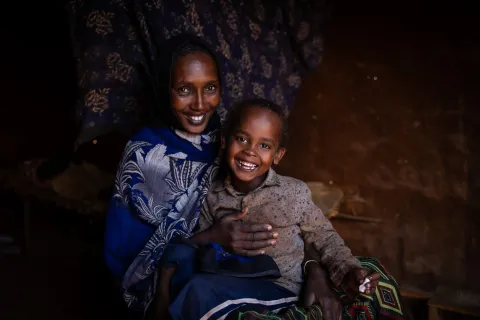
Among them is Hana Gizaw, who brings her two-year-old daughter Shalom for physiotherapy sessions.
When Shalom was born, doctors quickly identified that she had Down syndrome and advised the family to begin early follow-up.

“At first, she was unable to sit, balance, or move her body,” Hana remembers. “I was very worried about how she would grow and develop.”
When Shalom was 11 months old, her father heard about the therapy services offered at the Dibora Foundation and connected his family with the center. Since then, Shalom has been attending physiotherapy sessions regularly.
“At the beginning, she had individual therapy three times a week,” Hana says. “Later, it became twice a week, and now she attends group therapy once a week.”
The changes have been encouraging.
“She can now sit and crawl by herself, and she is becoming stronger,” Hana says with relief. “She has made a lot of improvement. We are happy here.”
For Hana, the support has been essential not only for Shalom’s development but also for helping her learn how to care for her daughter.
“They train us how to do physiotherapy for our children at home,” she explains. “We follow weekly therapy plans with our children at the center and at home.”
However, parenting children with Down syndrome often comes with additional responsibilities, especially for mothers.
“I used to work before,” Hana says. “But now I stay with my child full time. I cannot leave her somewhere and go to work.”
Across the therapy center, mothers share similar experiences.

Alem Sitotaw brings her two-year-old daughter Melona for therapy every week. Melona was diagnosed with Down syndrome shortly after birth at Yekatit 12 Hospital, where doctors referred the family to the center.
“God bless the doctor who told me about this place,” Alem says.
Melona started therapy when she was only six months old.
“When we first came, she could not do many things,” Alem explains. “Now she can sit, and she is trying to walk.”
Like many mothers, Alem has had to pause her work to focus on caregiving.
“It is always hard for mothers,” she says quietly. “I cannot leave her alone or with someone else.”

For older children, therapy can also help address behavioral and communication challenges.
Tenagne Getaneh’s daughter Bemnet, who is seven years old, began behavioral therapy after struggling with harmful behaviors.
“Before therapy, she used to hit herself, pull her hair, and hurt herself,” Tenagne recalls. “She would also bang against the wall.”
After four months of behavioral therapy sessions, Bemnet’s behavior improved significantly.
“She progressively stopped doing those things,” Tenagne says.
Tenagne works at the center as a cleaner, which allows her to care for her daughter while earning an income.
“I hope this service continues and does not stop,” she says. “There are many other children who need the same support.”
At the center, therapists work closely with families to support children’s development through individualized care.


Physiotherapist Amanda explains that each child’s journey begins with an assessment.
“First, we communicate with parents and screen the children at the center,” she says. “Then we identify their needs and design therapy plans.”
Children may receive individual or group physiotherapy sessions, with the frequency varying depending on their developmental needs.
But therapy does not stop when families leave the center.
“We train parents on how to continue the exercises at home,” Amanda explains. “Because children come here once or twice a week, parents play a crucial role in maintaining the progress.”


Behavioral therapists also support children who face emotional or behavioral challenges such as aggression, anxiety, or difficulty concentrating.
Behavioral therapist Abiy says, “The statistics show that one in three children with Down syndrome need behavioral therapy.”
“Some children struggle to communicate their needs or manage their emotions,” he explains.
Through structured sessions, therapists help children improve communication, attention, and emotional regulation.
“Our therapy rooms have different zones,” the therapist says. “One focuses on communication, another helps children calm their emotions, and another helps with motor coordination and focus.”
Many children show significant improvement after just a few months of therapy, particularly when support begins early.
Yet the demand for services remains high.
“The waiting list is very large,” Amanda says. “There are many families who need support, but we cannot reach everyone yet.”
For mothers like Hana, Alem, and Tenagne, the therapy center represents more than just a place for treatment; it is a place of hope.
“I am happy to have this opportunity for my child,” Hana says. “There are many children who stay hidden at home because their families cannot access services.”
As their children take small but meaningful steps forward, these mothers continue to hope for a future where more families can access the care and support they need.
Down syndrome is a genetic condition that occurs when a person is born with an extra copy of chromosome 21. It can affect a child’s physical growth, learning, and development. With early intervention, therapy, and inclusive support, children with Down syndrome can build important skills and reach their full potential.