Amidst climate crisis, education restores a girl’s hope in Ethiopia
UNICEF-supported alternative learning platforms help children catch up on missed learning opportunities

Climate change has a wide-ranging impact on Education. In the Southern Ethiopia region, frequent droughts followed by seasonal floods are disrupting the lives and livelihoods of the communities. Children have been displaced from their homes, and schools are often swamped with floodwaters leaving students without a place to learn. Despite these challenges, education remains a powerful source of hope for children and their families. In the South Omo zone, UNICEF, and its partner Imagine1day have set up alternative learning centres in Dasenech woreda (district), restoring hope for children like Nawi, a 10-year-old girl who has been displaced by the climate crisis.

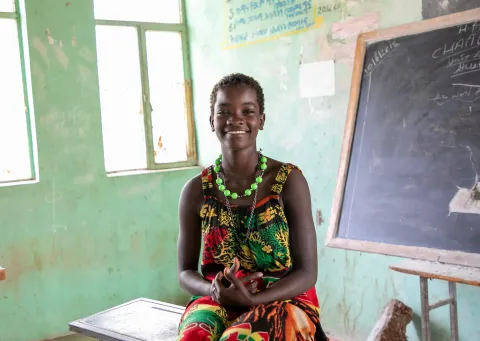
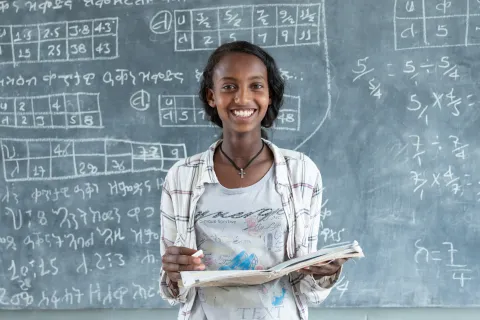
Nawi stands in front of her friends during environmental science class to explain what their teacher taught them about the five sense organs. Behind her, a sketch of the five sense organs is visible on the blackboard. Step by step, she explains the function of each organ to her classmates. “We use our eyes to see things, our ears to hear sound…”
"I don’t know much about climate change, but I understand its impact very well.”

Next was a maths class, and Nawi needed to concentrate on her learning. Despite being 10 years old, she is still at grade 2. For the past few years, drought followed by seasonal flooding has disrupted children's education in Dasenech woreda, where Nawi lives. As a result, she and thousands of other children have been displaced.
"I don’t know much about climate change, but I understand its impact very well,” she says. “We left everything behind and came here because of the flood.”
Nawi is now staying in a makeshift shelter in Kalem site for internally displaced people (IDP).
“Our school was flooded, so we came here and started learning again. Sometimes the weather here gets very hot, and that makes it hard to concentrate,” she says.

The alternative learning centre is part of the Accelerated Education Programme under UNICEF’s Bete (My Home) approach. It provides learning, protection, and life skill development opportunities for children affected by the climate crisis. In addition to providing a safe learning environment, the programme also incorporates psychosocial support to help children cope with trauma.
“This programme not only creates a safe learning space for children but also helps us to identify displaced children and reunite them with their families,” says Amanuel Kusheta, a programme manager from imagine1day. “Additionally, the programme is helping children like Nawi find joy in learning even if they stay in the IDP site.”
Nawi is a bright student. She performs well in class, and environmental science is her favourite subject. Every day, she loves to come to the learning centre with her best friend.
“We love learning here. If this [the learning centre] was not available, we would have dropped out of school.”

After finishing a half-day of classroom learning, Nawi heads to her tiny makeshift shelter, where she lives with her parents and younger siblings.

At home, she helps her mother with some chores. “Though she helps me at home, I want her to continue her education and achieve great things in the future,” says her mother.

Nawi hopes to continue her education. In the next academic year, she can join students in regular school as the accelerated education programme helps her catch up with missed classes.
“I love learning and want to continue until I graduate with a degree and become a teacher,” she says.
UNICEF, with the generous support of the UK Postcode Education Trust, supported climate-affected out-of-school children with education, protection, and life skills services. So far in the South Omo zone, the Accelerated Education Programme (AEP) supported close to 4,300 children. AEP is an alternative education approach that aims to address the educational needs of out-of-school children (ages 9-14). It has flexible learning time and a condensed curriculum and helps children to be integrated into the formal school.